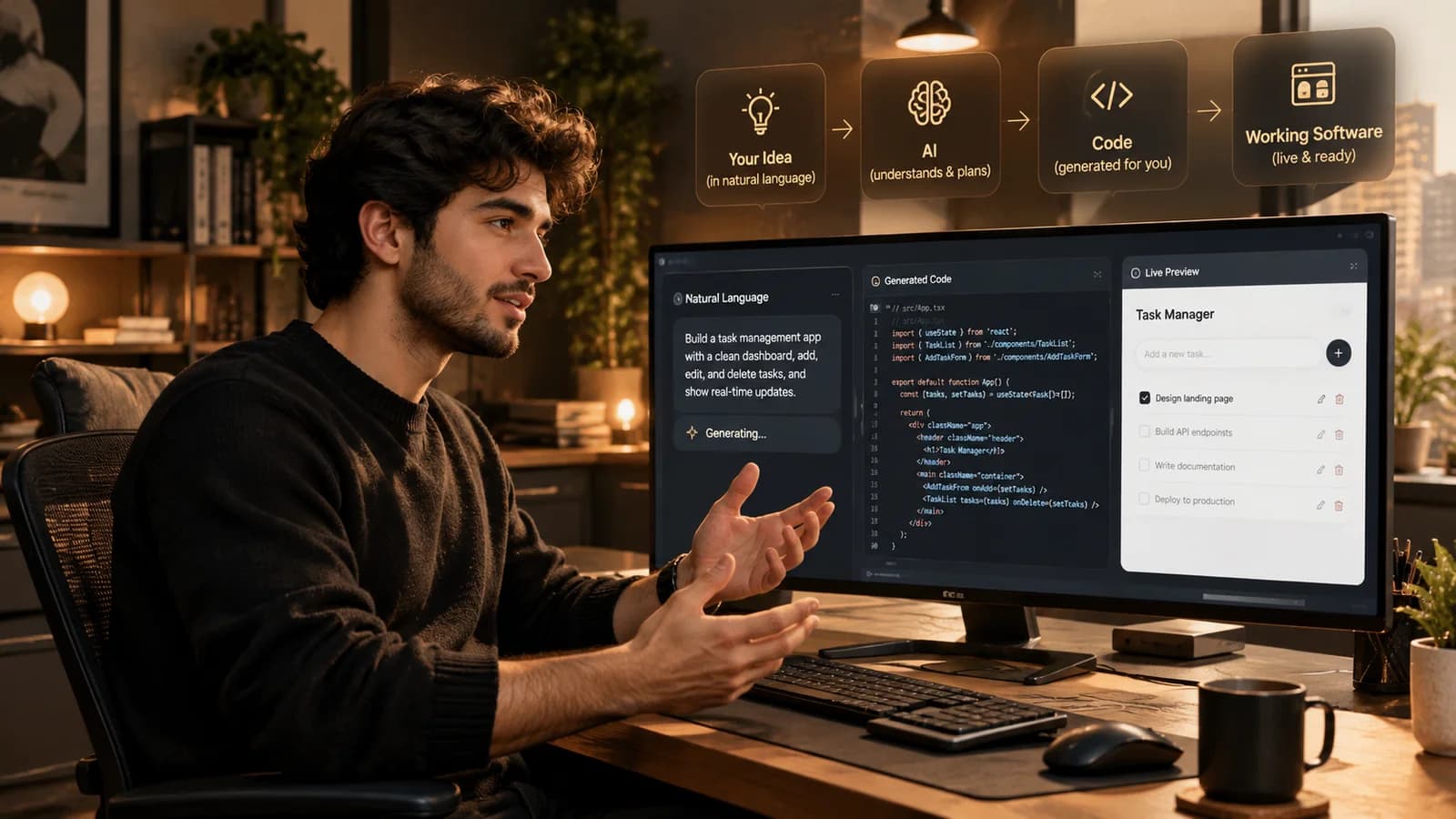
Technology · Software & Development
What Vibe Coding Actually Is and Why It Spread So Fast
On February 2, 2025, Andrej Karpathy — a founding member of OpenAI, former director of AI at Tesla, and one of the most followed voices in machine learning — posted a short observation on X that would name an entire movement. "There's a new kind of coding I call 'vibe coding,'" he wrote, "where you fully give in to the vibes, embrace exponentials, and forget that the code even exists. It's possible because the LLMs are getting too good."
The post was casual. The timing was not. Karpathy described a workflow in which a developer speaks to an AI in natural language, accepts the code it generates without reading it line by line, and iterates by describing what is wrong rather than editing the code directly. He admitted the resulting software was often "beyond my ability to read" and that he was "just seeing stuff, saying stuff, running stuff, copy-pasting stuff, and it mostly works"[reference:0]. The phrase "vibe coding" was born, and within eighteen months it had moved from a niche observation into a formal practice, a marketing category, a business model, and a cultural flashpoint.
The adoption of the term has been extraordinarily fast. Collins Dictionary named "vibe coding" its Word of the Year for 2025, describing it as "the use of artificial intelligence prompted by natural language to assist with the writing of computer code"[reference:1]. Merriam-Webster followed in early 2026 by adding the term to its official dictionary, defining it as "the act or practice of writing computer code by prompting an artificial intelligence program rather than by writing the code oneself, especially without close inspection or understanding of the generated code"[reference:2]. By the time both dictionaries had weighed in, the practice had already spread from hobbyists to startups, from weekend projects to production systems, and from solo developers to teams of hundreds of engineers at companies like Google, Microsoft, and Shopify.
The spread was not driven by any single tool. It was driven by a convergence. The models became good enough to generate working code from natural language descriptions. The interfaces became simple enough that non-engineers could use them. The pricing became cheap enough that anyone could experiment. And the demand — for more software, built faster, by more people — had been building for two decades. Vibe coding did not create that demand. It revealed it.
90%
Of developers using AI coding tools
Hostinger Vibe Coding Statistics 2026
63%
Of vibe coding users are non-developers
Vercel / Hostinger data, 2026
$4.7B
Estimated market size in 2026
Industry estimates, Taskade 2026
Vibe coding adoption and market data, 2026. The practice moved from novelty to majority in eighteen months. Sources: Hostinger Vibe Coding Statistics 2026; Vercel; Taskade State of Vibe Coding 2026.
The economic stakes became visible almost immediately. Y Combinator's Winter 2025 batch reported that roughly a quarter of its startups had 95 percent of their codebases generated by AI, up from near zero the previous year[reference:3]. a16z's analysis of 200,000 startups found that consumer-led growth had become the primary driver of enterprise revenue, and that vibe coding had moved from a side experiment to an enterprise strategy[reference:4]. By 2026, the segment had produced multiple companies valued in the billions, including Cursor at $29.3 billion, Lovable at $13.3 billion, and Replit at $9 billion[reference:5][reference:6]. The vibe coding market was projected to expand from $5.85 billion in 2025 to $15.52 billion by 2031, a 17.06 percent compound annual growth rate[reference:7].
But the speed of adoption has also produced a backlash, and the backlash is instructive. In April 2026, the Association for Computing Machinery's Technology Policy Council published a TechBrief warning that while vibe coding "can speed up development and make software creation more accessible," it "often skips over core engineering practices that ensure systems are secure, reliable, and maintainable"[reference:8]. The TechBrief's lead author, Simson Garfinkel, put the tension directly: "It's making developers dramatically more effective, but it's also introducing security vulnerabilities, increasing technical debt, and producing code that can be difficult to maintain"[reference:9]. The ACM's conclusion was not that vibe coding is bad. It was that vibe coding is powerful and dangerous in equal measure, and that the discipline required to use it safely has not yet caught up with the speed of its adoption.
Prototyping
Vibe coding's sweet spot
Fast iteration, low cost of bugs
Internal Tools
Where it works
Limited scope, known users, low risk
Production Systems
Where it fails
Security, scale, maintainability
The vibe coding spectrum. The same practice that accelerates prototyping becomes dangerous when applied to systems that require security, reliability, and long-term maintainability. Sources: ACM TechBrief (April 2026); IEEE Software (February 2026).
The data on adoption reveals a deeper tension that the headline numbers obscure. Hostinger's 2026 report found that 84 percent of developers use or plan to use AI coding tools[reference:10]. But a Stack Overflow survey of more than 49,000 developers across 177 countries found that 77 percent said vibe coding is not part of their professional workflow[reference:11]. Both numbers are accurate. They measure different things. The first measures tool usage — autocomplete, chat assistance, code generation within an existing engineering process. The second measures the practice Karpathy described — accepting generated code without inspection, iterating on vibes rather than specifications, treating the code as a black box. The gap between the two is the gap between AI-assisted engineering and vibe coding as a distinct methodology.
The verification gap in AI-assisted coding. Developers overwhelmingly distrust AI-generated code, yet fewer than half verify it before shipping. Sources: Sonar State of Code Developer Survey 2026; Hostinger 2026; Stack Overflow 2026.
The Sonar State of Code Developer Survey quantified the paradox with unusual precision. Ninety-six percent of developers said they do not fully trust that AI-generated code is functionally correct. Only 48 percent said they always check AI-assisted code before committing it[reference:12]. The gap between distrust and verification — what AWS CTO Werner Vogels has called "verification debt" — is the central engineering challenge of the vibe coding era[reference:13]. The code gets generated faster than it can be reviewed. The review gets deferred. The debt accumulates. And the cost surfaces months later when a small change breaks a system nobody fully understands.
The core question: vibe coding is not one thing. It is a spectrum that runs from "prompt an AI to build a prototype I will never maintain" to "use AI assistance inside a disciplined software engineering workflow." The name has been applied to both ends of the spectrum, and the confusion about what it means is the source of most of the current argument. The developers who understand the spectrum — who know when to vibe and when to engineer — will be the ones who benefit most from the shift.
This guide examines that spectrum in detail. The sections that follow trace the origin and evolution of the term, explain the technical mechanisms that make AI-assisted coding possible, distinguish between the different levels of the practice, examine the security and quality risks that have emerged, look at who is actually adopting it and for what, and assess where the practice is heading as the tools mature and the engineering discipline catches up with the enthusiasm.
The stakes are not abstract. The developers who treat vibe coding as a replacement for software engineering will find themselves building systems they cannot maintain, secure, or explain. The developers who treat it as a tool — one that accelerates the parts of the work that are mechanical while preserving the discipline that makes software trustworthy — will find themselves building more, faster, and with less risk. The technology is genuinely transformative. It is also genuinely dangerous when used without judgment.
Technology · Software & Development
How AI Actually Generates Code: The Architecture Beneath the Vibes
The previous section established what vibe coding is and why it spread so fast — the term's origin in Karpathy's February 2025 observation, its adoption by 90 percent of developers within a year, and the tension between its promise of radical accessibility and the engineering discipline it often bypasses. That section described the practice. This section explains the machinery.
The architecture beneath vibe coding is not a single model. It is a pipeline of components that transforms a natural language description into executable code through a sequence of distinct stages. Understanding this pipeline is what separates a developer who can evaluate an AI coding tool from one who merely uses it. The quality of the output is bounded by the weakest stage. The cost of the workflow is determined by the number of iterations the pipeline requires. And the risks — the vulnerabilities, the architectural drift, the hidden dependencies — emerge at specific points that are predictable once you understand the mechanism.
This section maps that pipeline from the ground up. It explains how large language models generate code through autoregressive token prediction, how the prompt architecture shapes what the model produces, how agentic frameworks turn a code generator into a system that can plan and execute multi-step work, and how enterprise platforms wrap the entire process in governance, sandboxing, and audit controls. The goal is not to make the reader an ML engineer. It is to give the reader a framework for understanding which parts of the vibe coding workflow are reliable, which are fragile, and why.
The Token Prediction Engine: How LLMs Generate Code
At the foundation of every AI coding tool is a large language model that generates code the same way it generates any other text: by predicting the next token in a sequence. A token is not a word. It is a fragment — sometimes a whole word, sometimes a piece of a word, sometimes a single character. The model has been trained on a corpus of code and text that teaches it the statistical relationships between tokens: given this sequence of tokens, what token is most likely to come next?
The architecture that makes this possible is the transformer. Introduced in the 2017 paper "Attention Is All You Need," the transformer uses a mechanism called self-attention that weighs each token's importance relative to every other token in the context window. For code generation, this means the model can attend to the function definition at the top of a file when generating a call to that function at the bottom. It can track variable names across hundreds of lines. It can recognize the patterns that distinguish a Python decorator from a Java annotation from a TypeScript generic. The self-attention layer transforms a set of input tokens into different weights, capturing dependencies and relationships among tokens.
The generation process is autoregressive. The model takes the tokens so far — the prompt plus everything it has generated — and produces a probability distribution over the next token. It samples from that distribution, appends the sampled token to the sequence, and repeats. This is what "autoregressive" means: the model feeds its own output back in and predicts the next token based on everything that came before. A function that looks like it was written by a human is the result of hundreds or thousands of these next-token predictions, each one conditioned on the entire preceding context.
Prompt Tokens
Natural language + context
Transformer
Self-attention over context
Next-Token Distribution
Probability over vocabulary
Sample + Repeat
Autoregressive generation
The autoregressive code generation loop. The model predicts one token at a time, conditioned on everything before it. Sources: "Attention Is All You Need" (2017); Vue School (2025); Indic CERN (2025).
The token principle: an LLM does not "understand" code the way a compiler does. It predicts the next token based on patterns learned during training. The code it generates is statistically plausible given the prompt — which is why it so often works, and why it sometimes fails in ways that are difficult to predict. Functional correctness is a statistical property, not a guarantee.
The Prompt Architecture: How Natural Language Shapes the Infrastructure
The prompt is not just an instruction. It is an architectural specification. Research published in April 2026 by researchers at the University of Southern Denmark demonstrated that prompt wording alone produces structurally different systems for the same task. The study identified five mechanisms by which AI coding agents make implicit architectural decisions and proposed six prompt-architecture coupling patterns that map natural-language prompt features to the infrastructure they require.
The researchers coined a term for this phenomenon: vibe architecting. Architecture shaped by prompts rather than deliberate design. When a developer writes "build me a dashboard with authentication," they are not just requesting a feature. They are commissioning an architecture. The model will select a framework, configure a database, set up an authentication provider, and wire the integrations — each of those choices is an architectural decision. Yet almost no one reviews them as such.
The coupling patterns range from contingent to fundamental. Contingent couplings — such as structured output validation — may weaken as models improve. Fundamental couplings — such as tool-call orchestration — persist regardless of model capability. When an LLM-integrated code declares tool access, something must orchestrate those calls. When it injects retrieved documents, a retrieval pipeline follows. In both cases, the prompt dictates the infrastructure.
The practical implication is that the quality of a vibe-coded application depends as much on the quality of the prompt as on the quality of the model. A vague prompt produces a generic architecture. A specific prompt produces a specific architecture. The developer who learns to write prompts that specify not just what the application should do but how it should be structured — what framework, what database, what authentication provider, what deployment target — has more control over the outcome than one who treats the prompt as a simple request.
| Prompt Feature | Architectural Consequence | Coupling Strength |
|---|---|---|
| "Build a dashboard with auth" | Model selects framework, auth provider, database schema | Contingent |
| "Use Next.js with Prisma and NextAuth" | Framework and libraries specified; schema still inferred | Contingent |
| "Add tool calls to a weather API" | Tool-call orchestration layer required | Fundamental |
| "Retrieve documents before answering" | Retrieval pipeline, vector store, embedding model required | Fundamental |
The prompt-architecture coupling patterns. Fundamental couplings persist regardless of model capability. Sources: Konrad et al., "Architecture Without Architects" (April 2026); Shift-Up framework (April 2026).
The Five Levels: From Asker to Architect
The UK's National Cyber Security Centre published guidance in June 2026 that formalized a spectrum approach to vibe coding, arguing that "different code deserves different levels of oversight." The spectrum runs from manual human coding with AI autocomplete on the left to full vibe coding on the right, with a large grey area in between. The NCSC's recommendation is not to avoid vibe coding for security-critical code, but to calibrate the level of human oversight to the risk profile of what is being built.
A parallel framework that has circulated widely among practitioners describes five levels of vibe coding, each defined by the mindset of the person using the tools. The levels are not strictly hierarchical — a developer can operate at different levels for different tasks — but they describe a progression in skill and leverage.
Level 1 is the Asker. The mindset is "build me a thing." The tools are simple — ChatGPT, Lovable, Bolt, Replit. The prompts are vague, the context is absent, and the output is generic. The workflow is an endless loop of generating, testing, finding bugs, and restarting. The bottleneck is that the user does not know what they want.
Level 2 is the Planner. The mindset is "here is my plan, execute it." The tools are more sophisticated — Cursor, Claude Code in plan mode. The user writes a product requirements document, builds feature by feature, and uses plan mode before touching code. The output is better, but the user is still missing context: business goals, design direction, edge cases they have not thought of. Most people live at Level 2 permanently.
Level 3 is the Interrogator. The mindset is "help me figure out what to build." This is the biggest jump in the framework. Instead of telling the AI what to build, the user prompts the AI to ask them questions first. "Help me improve this idea. Ask me questions until you have a clear picture." The plan is stress-tested before a single line of code runs. The bottleneck becomes the user's willingness to be questioned rather than the model's capability.
Level 4 is the Orchestrator. The mindset is "I manage agents, not code." The user runs three to five agents simultaneously in parallel workspaces, with separate agents for backend, design, and data enrichment. They prototype four landing page variants in fifteen minutes, pick the winner, and discard the rest. The bottleneck becomes spec quality and systems thinking.
Level 5 is the Architect. The mindset is "code is a black box." The user writes specs, evaluates outcomes, and never reads the code. A new diff appears every twenty minutes. No human writes or reviews a line. Compute spend reaches $1,000 per engineer per day. AI-native teams at this level average $3.5 million revenue per employee, compared to $600,000 for traditional SaaS. The tools are the same at every level. The process is what separates them.
The Asker
"Build me a thing." Vague prompts, generic output, endless bug-fix loops.
The Planner
"Here is my plan. Execute it." PRD, feature-by-feature build. Most people live here.
The Interrogator
"Help me figure out what to build." AI asks the questions. Plan stress-tested.
The Orchestrator
"I manage agents, not code." Parallel workspaces, multiple agents.
The Architect
"Code is a black box." Specs and outcomes only. $3.5M revenue per employee.
The five levels of vibe coding. The tools are the same at every level. The process is what separates them. Sources: NCSC (June 2026); Gupta (March 2026); dan shapiro (January 2026).
The level principle: the difference between a $200-per-month engineer and a $30,000-per-month hire is not the tools they use. It is the process they follow. Moving from Level 2 to Level 3 requires the willingness to be questioned. Moving from Level 4 to Level 5 requires the discipline to trust the system you have built. Most developers never leave Level 2.
The Agentic Loop: How a Code Generator Becomes a System
A code generator produces a snippet. An agent produces a system. The difference is the loop. The architecture that turns a language model into an agent is a cycle: the model receives a goal, decomposes it into a plan, executes steps against the codebase, observes the results, and decides whether to continue or stop. Each iteration may involve multiple tool calls — reading files, writing files, running tests, executing shell commands.
Claude Code scaffolds full projects and delegates subtasks to sub-agents. Cursor runs background agents across parallel worktrees. Devin supports interactive planning. Bolt.new produces full-stack applications in browser containers. Codex runs in sandboxed cloud environments. Windsurf adjusts its output dynamically. In each case, the agent picks frameworks, configures databases, and sets up authentication — architectural decisions that almost no one reviews as such.
The loop architecture has a specific failure mode that the research has documented: architectural drift. The Shift-Up framework, presented at the 30th International Conference on Evaluation and Assessment in Software Engineering in June 2026, found that vibe coding "often suffers from architectural drift, limited traceability, and reduced maintainability." The agent, given a task, tends to generate fresh code rather than searching for and extending what exists. The result is codebases that grow faster than they consolidate, with more implementations of similar logic and fewer shared abstractions.
The Shift-Up framework addresses this by reinterpreting established software engineering practices as structural guardrails for GenAI-native development. Executable requirements in BDD format, architectural modeling with C4 diagrams, and architecture decision records (ADRs) are embedded as machine-readable artifacts that stabilize agent behavior. Preliminary findings from an exploratory evaluation comparing unstructured vibe coding, structured prompt engineering, and the Shift-Up approach found that embedding these artifacts reduced implementation drift and shifted human effort toward higher-level design and validation activities.
Goal
Natural language intent
Plan
Decompose into steps
Execute
Tool calls, file writes
Observe
Test results, errors
Iterate or Stop
Loop until done
The agentic coding loop. The agent plans, executes, observes, and iterates. Architectural drift emerges when the loop lacks guardrails. Sources: Shift-Up framework (June 2026); Konrad et al. (April 2026); IEEE (June 2026).
The Enterprise Platform Architecture: When Vibe Coding Meets Governance
The enterprise version of vibe coding is not the same as the hobbyist version. An enterprise AI vibe coding platform is an internal tool where employees describe what they want to build in natural language, and the platform generates working code, shows a live preview, and publishes it — all within an environment the organization controls. This allows all employees to build internal tools, dashboards, and business applications regardless of previous software development experience.
Without governance, each AI-built application risks uncontrolled data exposure, unapproved LLM provider usage, and code with an unknown security posture. The Cloudflare reference architecture for enterprise vibe coding platforms describes a three-system architecture: a development plane where employees create and iterate on applications through AI, a deployment pipeline that approves and validates applications before they reach production, and an operations layer that provides observability, cost attribution, and audit logging.
The security model for these platforms assumes that AI-generated code is untrusted. Protection is enforced at the platform level, not the code level. Untrusted code execution is isolated in sandboxes and containers. Data exfiltration via prompts is blocked by AI Gateway and DLP inspection before prompts reach LLM providers. Credential exposure is prevented because AI-generated code never handles real secrets — outbound handlers inject credentials at the platform layer. Privilege escalation is constrained by allowlist-based connectivity. And unauthorized access is prevented by identity controls that enforce role-based policies on both the platform and the deployed applications.
Northflank's guide to building an internal vibe coding platform identifies six key components: isolated per-team environments, role-based access control, secrets management, sandboxed code execution, audit logging, and a structured release workflow with review gates. The platform must assume that every application an employee builds is a potential security incident. The governance is not a brake on the vibe coding workflow. It is the condition that makes the workflow acceptable for enterprise use.
| Layer | Function | Security Control |
|---|---|---|
| Development plane | Employees create and iterate on applications via AI | AI Gateway, DLP inspection, access controls |
| Deployment pipeline | Approval and validation before production | Review gates, sandbox execution, policy checks |
| Operations layer | Observability, cost attribution, audit logging | Immutable logs, RBAC, per-team isolation |
The enterprise vibe coding platform architecture. AI-generated code is treated as untrusted at every layer. Sources: Cloudflare Reference Architecture (September 2026); Northflank (May 2026); Superblocks (September 2026).
The platform principle: the enterprise vibe coding platform is not a tool that employees use. It is an environment that the organization controls. The difference is the governance layer: the sandbox that isolates execution, the DLP that inspects prompts, the audit log that records every action, and the release workflow that requires review before deployment. The platform makes vibe coding acceptable for enterprise use by making it observable, auditable, and constrainable.
The Security Implications: Where the Architecture Creates Risk
The security research on vibe coding is unambiguous, and it points to the same conclusion: the architecture that makes AI coding possible is the architecture that creates the risk. The Georgia Tech Vibe Security Radar, which has scanned over 43,000 security advisories, identified 74 confirmed cases of AI-introduced vulnerabilities as of April 2026. Fourteen were critical risks; twenty-five were high. The vulnerabilities include command injection, authentication bypass, and server-side request forgery.
The mechanism is statistical repetition. AI models tend to repeat the same mistakes across different projects because they are trained on similar data and predict the next token based on similar patterns. An attacker who finds a vulnerability in one AI-generated codebase can scan for the same pattern across thousands of repositories. As the Georgia Tech researchers put it: "Millions of developers using the same models means the same bugs showing up across different projects. Find one pattern in one AI codebase, you can scan for it across thousands of repositories."
The severity of the problem escalated in the first quarter of 2026. In the second half of 2025, the Vibe Security Radar found about 18 cases across seven months. In the first three months of 2026, it identified 56. March 2026 alone had 35 — more than all of 2025 combined. The escalation correlates with the increasing autonomy of the tools. Many agents, like Claude, are now more autonomous, allowing developers to write entire features, create files, and even make architecture decisions. As one researcher put it: "When an agent builds something without authentication, that's not a typo. It's a design flaw baked in from the start."
Technology · Software & Development
The previous section mapped the architecture that makes AI-assisted coding possible — the autoregressive token prediction engine, the prompt-architecture coupling that determines infrastructure, the agentic loop that turns a code generator into a system, and the enterprise platform that wraps it all in governance. That section explained how vibe coding works. This section examines what happens when it meets reality.
The research on AI-generated code security has converged with unusual consistency. Georgia Tech's Vibe Security Radar, which scans over 43,000 security advisories across public databases, confirmed 74 AI-linked vulnerabilities through March 2026 — 14 critical, 25 high severity — and estimated the true number is five to ten times higher in undetected cases. Veracode's 2026 GenAI Code Security Report, spanning four testing snapshots and more than 100 models, found that the average security pass rate has stalled at 56 percent — virtually unchanged from the previous year despite dramatic improvements in model capability. An arXiv study of 9,041 open-source applications built with Claude Code and Lovable, plus 200 publicly deployed applications, found that 91 percent of audited applications contained at least one vulnerability, and 65.77 percent of identified vulnerabilities were rated Critical or High severity.
The numbers are consistent across methodology. Roughly 44 percent of AI code generation tasks introduce a risky security vulnerability. Roughly half of AI-generated code fails security tests when given no security-specific guidance. And the vulnerabilities cluster in the same categories: broken access control, injection attacks, and authentication failures. These are not exotic edge cases. They are the vulnerabilities that security engineers have been teaching developers to avoid for twenty years.
91%
Of vibe-coded apps contain a vulnerability
arXiv study of 200 deployed apps
66%
Of those vulnerabilities are Critical or High severity
arXiv study of 1,186 vulnerabilities
44%
Of AI code generation tasks introduce a vulnerability
Veracode 2026 GenAI Code Security Report
The security data on vibe-coded applications. The findings are consistent across independent research teams. Sources: arXiv (September 2026); Veracode (July 2026); Georgia Tech Vibe Security Radar (April 2026).
The most alarming data point in the security research is not the total number of vulnerabilities. It is the acceleration. Georgia Tech's Vibe Security Radar found approximately 18 AI-linked vulnerabilities across the seven months from May to December 2025. In the first three months of 2026, it identified 56. March 2026 alone had 35 — more than all of 2025 combined.
The escalation correlates with the increasing autonomy of the tools. As Hanqing Zhao, the graduate research assistant who built the radar, explained: "Many tools, like Claude, are now more autonomous, allowing developers to write entire features, create files, and even make architecture decisions." The shift from code completion to autonomous feature generation means that the model is making more decisions — and every decision is a potential vulnerability. "When an agent builds something without authentication," Zhao said, "that's not a typo. It's a design flaw baked in from the start."
The mechanism that makes the problem systemic is statistical repetition. AI models tend to repeat the same mistakes across different projects because they are trained on similar data and predict the next token based on similar patterns. An attacker who finds a vulnerability in one AI-generated codebase can scan for the same pattern across thousands of repositories. As Zhao put it: "Millions of developers using the same models means the same bugs showing up across different projects. Find one pattern in one AI codebase, you can scan for it across thousands of repositories." The vulnerability becomes a signature — a pattern that identifies every application built with the same model.
May–Dec 2025 18 AI-linked CVEs Across seven months Jan–Mar 2026 56 AI-linked CVEs Across three months March 2026 only 35 AI-linked CVEs More than all of 2025
The CVE acceleration in AI-generated code. The escalation correlates with the increasing autonomy of coding agents. Source: Georgia Tech Vibe Security Radar (April 2026).
The repetition principle:
the risk in AI-generated code is not that each application is uniquely vulnerable. It is that the same vulnerability appears across thousands of applications built with the same model. The attacker who finds the pattern once can find it everywhere. The scale of the tool creates the scale of the attack surface.
The vulnerabilities are not theoretical. They have been exploited. In February 2026, BBC journalist Joe Tidy demonstrated the risk on live television by building a simple game on Orchids, an AI-powered app-building platform. Cybersecurity researcher Etizaz Mohsin exploited a zero-click vulnerability to gain access to the project, edit Tidy's code, and access his computer. The researcher had discovered the flaw in December 2025 and spent weeks attempting to contact the company. He eventually received a response saying his messages "may have been overlooked among many others."
The Lovable platform, one of the most popular vibe-coding tools, was accused of hosting apps riddled with vulnerabilities. A researcher who audited the platform found 16 vulnerabilities — six of which he described as critical. One hosted app exposed 18,697 user records, including 14,928 unique email addresses. The platform's response was that users are responsible for addressing security issues flagged before publishing. The framing reflected a broader tension in the industry: the tools that make software creation accessible are often the tools that make security invisible to the people using them.
The supply chain dimension is where the exploitation becomes systemic. UpGuard's analysis of more than 18,000 AI agent configuration files from public GitHub repositories found that one in five developers granted AI agents unrestricted access to perform high-risk actions without human oversight. Almost 20 percent allowed the AI to automatically save changes to the project's main code repository, skipping human review entirely. The configuration files granted arbitrary code execution permissions for Python (14.5 percent) and Node.js (14.4 percent), effectively giving an attacker full control over the developer's environment through a successful prompt injection.
The Model Context Protocol ecosystem adds another layer of risk. UpGuard's analysis of MCP registries found that for every server provided by a verified technology vendor, there were up to 15 lookalike servers from untrusted sources. The typosquatting pattern — registering a server name that looks almost identical to a legitimate one — creates a ripe condition for attackers to impersonate trusted brands and inject malicious code into the developer's environment.
The configuration risks in AI coding agent setups. The permission boundaries that make agents useful are the same boundaries that make them dangerous. Source: UpGuard analysis of 18,000+ AI agent configuration files (February 2026).
The security data is alarming, but it is not surprising when you look at the verification data. Sonar's 2026 State of Code Developer Survey, based on responses from more than 1,100 professional developers, found that 96 percent of developers do not fully trust that AI-generated code is functionally correct. Only 48 percent said they always check AI-assisted code before committing it. The gap between distrust and verification — what AWS CTO Werner Vogels has called "verification debt" — is the central engineering challenge of the vibe coding era.
The reasons for the gap are practical. The same survey found that 38 percent of developers said verifying AI-generated code takes longer than reviewing code written by colleagues. The AI generates code faster than a human can review it. The review becomes a bottleneck. And because the review is the part of the workflow that catches errors, defects, and vulnerabilities, the bottleneck is the part that matters most.
New Relic's 2026 State of AI Coding Report quantified the consequences with unusual precision. The report found that 93.5 percent of technology leaders rate AI-generated code as higher quality during the review stage. But once that code ships, 78 percent of those same leaders report an increase in production incidents. Eighty-six percent report an increase in time senior staff spends fixing code. Seventy-four percent report that at least 25 percent of AI code needs significant rework. And 82 percent have experienced at least one production failure tied to AI-generated code in the past six months.
The disconnect between review-stage quality and production-stage reliability is the mechanism that makes the verification gap dangerous. The code looks good when it is reviewed. It passes the tests. It compiles. It follows the patterns that reviewers recognize as correct. But it fails in production because the failure mode is not visible at review. The AI generated code that satisfies the test cases without satisfying the requirements. It implemented the feature without handling the edge case. It passed the linter without being secure.
Review Stage 93.5% rate AI code higher quality It looks good. It passes tests. It follows patterns. The reviewer approves. Production Stage 78% report more incidents It fails on edge cases. It breaks under load. It exposes vulnerabilities. The senior engineer gets paged.
The quality mirage. AI code that passes review fails in production because the failure modes are not visible at review time. Sources: New Relic 2026 State of AI Coding Report; Sonar State of Code Developer Survey 2026.
The verification principle:
the code gets generated faster than it can be reviewed. The review gets deferred. The debt accumulates. The cost surfaces months later when a small change breaks a system nobody fully understands. The verification gap is not a bug in the workflow. It is the structural consequence of a workflow that optimizes for generation speed and treats verification as an afterthought.
The most counterintuitive finding in the research is the gap between perceived productivity and measured productivity. METR, a nonprofit research organization that evaluates frontier AI models, conducted a controlled study with experienced open source developers working on real codebases of over one million lines. The developers predicted they would be 24 percent faster with AI tools. They came out 19 percent slower. Even after the study, they still believed they had been 20 percent faster.
The METR researchers identified the mechanisms that produced the gap. The developers spent extra time finding and fixing errors in AI-generated code. They spent time steering the AI toward the right solution. They spent time waiting for the AI to complete tasks. And they spent time reviewing output that often required more correction than they anticipated. The AI accelerated the generation phase. The verification phase became the bottleneck, and the verification phase is where the errors are caught.
The METR study attempted to replicate the experiment in February 2026. It could not. The researchers found that developers refused to participate without AI. As the study's authors wrote: "In February 2026, we attempted to repeat the experiment. We could not. Most developers won't work, even on a limited number of tasks, without AI anymore." The dependency had become absolute. The tool that slowed them down had become a tool they could not work without.
The paradox has a name: the productivity mirage. The AI makes the work feel faster because it eliminates the blank-page problem, generates the first draft, and handles the mechanical parts of coding. But the work that remains — verifying the output, handling the edge cases, fixing the errors — is the work that determines whether the software is correct. And that work is not faster. It is slower, because the code was not written by the person who has to verify it, and the verification requires reconstructing the intent that the AI did not articulate.
The productivity paradox. Developers overwhelmingly distrust AI code, half do not verify it, and those who do verify say it takes longer than reviewing human-written code. Sources: Sonar State of Code Developer Survey 2026; METR controlled study (2025).
The verification gap is not just a security problem. It is a debt problem. Every piece of AI-generated code that ships without adequate review is a piece of code that the organization does not fully understand. It works. It passes the tests. It satisfies the current requirements. But it was not written by anyone on the team. No one has a mental model of its structure, its assumptions, or its edge cases. When it fails — and it will fail — the team must reverse-engineer the intent before they can fix the bug.
The research on this debt is beginning to mature. A 2026 paper presented at the IEEE/ACM International Conference on Software Engineering introduced the concept of "agentic entropy" — a systemic drift that traditional code review methods fail to capture because they address local outputs rather than global behavior. The paper's core argument is that autonomous coding agents accumulate divergence between what they do and what the architecture intended, and that this divergence is invisible to the diff-based review process that most teams use.
A large-scale empirical study found that more than 15 percent of AI commits show at least one code-quality issue, and 22.7 percent of those issues remained in repositories — meaning they were never caught and never fixed. The Shift-Up framework, presented at the 30th International Conference on Evaluation and Assessment in Software Engineering, found that vibe coding "often suffers from architectural drift, limited traceability, and reduced maintainability." The framework's preliminary evaluation found that embedding software engineering artifacts — executable requirements in BDD format, architectural modeling with C4 diagrams, architecture decision records — as machine-readable guardrails reduced implementation drift and shifted human effort toward higher-level design and validation activities.
Agent Generates Code without architectural context Reviewer Approves Diff looks correct in isolation Drift Accumulates Code diverges from architecture System Becomes Unmaintainable No one understands the whole
The agentic entropy cycle. Each individual change is approved. The accumulation of approved changes drifts the system away from its intended architecture. Sources: ACM ICSE (April 2026); Shift-Up framework (June 2026).
The debt principle:
AI-generated code that ships without review is not free. It is borrowed against future maintenance. The interest is the time the team spends reverse-engineering code they did not write. The principal is the system they can no longer understand.
The response to the security and quality data has been slower than the adoption, but it is beginning to take shape. The Association for Computing Machinery's Technology Policy Council published a TechBrief in April 2026 that explicitly acknowledged both the productivity gains and the risks. The TechBrief's recommendation was not to avoid vibe coding but to calibrate the level of human oversight to the risk profile of what is being built. Different code deserves different levels of oversight.
The UK's National Cyber Security Centre followed with formal guidance in June 2026 that codified the spectrum approach. The NCSC's framework describes a range of coding modes from manual human coding with AI autocomplete on the left to full vibe coding on the right, with a large grey area in between. The recommendation is to treat the level of human oversight as a design parameter — a choice that should be made explicitly and documented, not left to individual developer preference.
The enterprise platform vendors have responded by building governance into the development environment. Cloudflare's reference architecture for enterprise vibe coding platforms describes a three-system architecture: a development plane where employees create applications through AI, a deployment pipeline that approves and validates applications before they reach production, and an operations layer that provides observability, cost attribution, and audit logging. The security model assumes that AI-generated code is untrusted and enforces protection at the platform level, not the code level.
The practical guidance from the research community is converging on a set of principles. Georgia Tech's Hanqing Zhao recommends that developers "review AI output the way you'd review a junior developer's
The Security and Quality Reality: What the Data Actually Shows
The CVE Surge: What the Trackers Are Showing
The Exploitation Reality: What Has Already Been Breached
Risk
Prevalence
Consequence
Unrestricted file deletion
1 in 5 developers
Prompt injection can recursively wipe project
Auto-save to main repository
Almost 20% of developers
Malicious code inserted without human review
Arbitrary code execution (Python)
14.5% of config files
Full control of developer environment
Arbitrary code execution (Node.js)
14.4% of config files
Full control of developer environment
MCP typosquatting lookalikes
Up to 15 per verified vendor
Brand impersonation, malicious code injection
The Verification Gap: Why Developers Don't Check
The Productivity Paradox: When Faster Feels Slower
Metric
Finding
Source
Developers who don't fully trust AI code
96%
Sonar (2026)
Developers who always verify AI code
48%
Sonar (2026)
Developers who say verification takes longer
38%
Sonar (2026)
Measured productivity change (METR study)
−19% (slower)
METR (2025)
Perceived productivity change (same developers)
+20% (faster)
METR (2025)
The Technical Debt Accumulation: What Gets Left Behind
What the Industry Is Doing About It: Governance and Guardrails
Technology · Software & Development
Who Is Actually Vibe Coding and What They're Building
The previous section examined the security and quality reality of AI-generated code — the 91 percent of vibe-coded applications that contain at least one vulnerability, the 74 AI-linked CVEs documented by Georgia Tech's Vibe Security Radar, the verification gap where 96 percent of developers distrust AI code but only 48 percent check it, and the productivity paradox where developers feel faster but measure slower. That section described the risks. This section examines what people are actually doing with the technology despite those risks.
The data on who uses vibe coding and for what is more nuanced than either the enthusiasm or the skepticism suggests. The headline numbers — 90 percent of developers using AI coding tools, 63 percent of vibe coding users being non-developers, 88 percent of organizations writing vibe coding into formal production policies — describe a practice that has moved from the margins to the mainstream in eighteen months. But the aggregate figures obscure a more interesting picture: the people getting the most value from vibe coding are not the ones building production systems. They are the ones building the things that production systems were never built to do.
This section examines the adoption data in detail. It distinguishes between the different populations using vibe coding — professional developers, non-technical employees, executives, founders, and clinicians — and the different things they are building. It examines the enterprise deployments that have moved from pilot to production, the industries leading adoption, and the specific use cases where the practice has proven durable rather than merely novel. The through-line is a single observation: vibe coding is not replacing software engineering. It is filling the gap between what engineering teams can build and what the rest of the organization needs.
The Adoption Data: Who Is Actually Using These Tools
The most striking number in the adoption data is not the total. It is the composition. Hostinger's 2026 Vibe Coding Statistics Report found that 63 percent of people using vibe coding tools are not developers. Redwerk's analysis of consumer prompt-to-app platforms found that on Lovable, roughly four in five users are non-technical, 45.7 percent identify as founders or co-founders, and just 5.8 percent as engineers. A LinkedIn analysis of 500 vibe coding users found that the largest group was executives and strategists at 22 percent, followed by designers at 16 percent, with engineers at just 15 percent.
The demographic data upends the conventional assumption that AI coding tools are for coders. The people adopting vibe coding fastest are the people who were never going to write code in the first place. They are product managers who need a prototype. Marketing managers who need a dashboard. Founders who need an MVP. Clinicians who need a tool that does not exist. The tools are not making developers faster in the aggregate — the productivity data is mixed. They are giving non-developers a capability they never had.
The professional developer population is more divided. Softr's 2026 AI statistics found that 47 percent of software engineers say they are "keeping up" with AI and vibe coding tools, while 18 percent have opted out entirely. The remaining 35 percent are somewhere in between — using the tools occasionally, without fully integrating them into their workflows. The gap between "keeping up" and "opted out" reflects a genuine disagreement about the value of the tools, and the disagreement is not resolving quickly.
The composition of vibe coding users. The largest group is not engineers — it is executives, designers, and product people. Sources: Hostinger 2026; Redwerk 2026; LinkedIn analysis of 500 users (January 2026).
The composition principle: vibe coding is not a developer productivity tool. It is an accessibility tool. The people getting the most value from it are the people who could not build software before. The aggregate productivity numbers for professional developers are mixed. The capability unlock for everyone else is not.
The Use Cases: What People Are Actually Building
The gap between the hype about "building your own Salesforce" and what people are actually building is enormous. SaaStr's analysis of Lovable's top use cases found that the number one use case is rapid prototyping without waiting on engineering — not replacing enterprise software. Replit CEO Amjad Masad made the same observation from a different angle: a public company CEO told him that AI coding had negligible impact on his engineering teams, but had transformed his product and design teams, which gained what Masad called "a fundamentally new super power of being able to make software."
The prototyping use case is the killer app because it addresses a bottleneck that had nothing to do with coding capability. A product manager with an idea writes a PRD. It goes into the backlog. Engineering triages it against 47 other priorities. Six weeks later, someone builds a rough v1. With vibe coding, that same product manager opens Lovable and has a working prototype in 20 to 60 minutes. The prototype is not production software. It is a clickable artifact that lets the PM get feedback before committing engineering resources. The phrase that has emerged for this workflow is "demo, don't memo" — instead of writing a 12-page deck arguing for a feature, you build it, show it, and let people click around.
The second use case is internal tools that match actual business processes. The tool that every company needs but no company sells, because the market for it is too small. A Zapier growth marketing manager built a custom influencer partnership dashboard using Claude Code. A manufacturing company built a supplier quality tracker. A hospital built a patient intake system. These are not products. They are tools that make a specific team's workflow function better, and the economics of buying them have never worked because the customer base is too small to justify the sales cost.
The third use case is replacing simple SaaS with custom-built solutions. Retool's 2026 Build vs. Buy Report found that 35 percent of enterprises have already replaced at least one SaaS tool with a custom build, and 78 percent expect to build more custom internal tools in 2026. The replacement is not happening for complex platforms like Salesforce or Workday. It is happening for the long tail of simple tools — the $50-per-seat form builder, the $200-per-month reporting dashboard, the $500-per-month project tracker — where the cost of a custom build has fallen below the cost of a subscription.
| Use Case | Who Does It | Why It Works | Adoption |
|---|---|---|---|
| Rapid prototyping | Product managers, designers, executives | Skips the backlog. Enables feedback before engineering. | #1 use case |
| Internal tools | Operations, marketing, HR, finance | Tool that no vendor sells because the market is too small. | Rapidly growing |
| SaaS replacement | Startups, mid-market, IT teams | Simple tools where build cost < subscription cost. | 35% of enterprises |
| Clinical and scientific tools | Clinicians, researchers, physicists | Domain experts build tools they need that do not exist. | Emerging |
The four primary use cases for vibe coding. The prototyping and internal tool use cases dominate. Sources: SaaStr (February 2026); Retool 2026 Build vs. Buy Report; Replit CEO interview (2026).
The Enterprise Deployments: Where It Has Moved to Production
The enterprise deployments that have moved from pilot to production share a common pattern. They deployed incrementally. They kept humans in the loop. They invested in training. And they treated vibe coding as a tool for specific use cases rather than a replacement for their engineering process. The case studies below illustrate what "done properly" looks like.
Booking.com deployed AI coding assistants across its 3,500-strong engineering team in early 2025. The initial uptake was slow. According to Bruno Passos, group product manager for generative AI, developers were skeptical and adoption stalled. The turning point was training — not just on how to use the tools, but on how to get the most out of them. After the training program, developer productivity, measured by output of finished and reviewed work, increased by 30 percent. Job satisfaction increased as well. The lesson that Booking.com's experience illustrates is that the tool alone does not produce results. The training and the culture change are what convert the tool into a productivity gain.
Adidas ran two pilots with nearly a thousand developers. The first pilot failed dramatically. Ninety percent of the developers involved described the tools as "a complete waste of time" and reported "hating" them. The second pilot, run differently, achieved far more promising results. Developers reported feeling 20 to 25 percent more effective when using the tools. More importantly, they reported that vibe coding increased the amount of "happy time" — time spent actually coding rather than on administrative tasks — by 50 percent. The difference between the two pilots was not the tool. It was the process, the training, and the framing.
The Danish Environmental Portal represents the public sector case study. The organization has 25 employees and engages 40 to 50 external consultants. With Claude Code, IT development lead times dropped from weeks to days. "Right now, we can churn out features faster than they can be ordered," director Nils Høgsted told Ingeniøren. But the speed created a new management challenge: the bottleneck shifted from development capacity to architecture and quality assurance. "Bringing together our project managers, IT architects, and developers to get a handle on this will be a major management challenge for us over the next six months," Høgsted said. The organization has to hold back development to ensure that the right controls are in place.
ING Groep, the Dutch banking group, turned to vibe coding to build electronic trading tools for currencies and credit. The bank used the tools to create analytics dashboards showing real-time pricing, incoming trades, and performance metrics. The deployment is notable because it is one of the first in a regulated financial institution where the output of the tools is being used in a context that requires auditability and compliance. ING is not treating vibe coding as a prototyping mechanism. It is using it to build tools that support trading operations.
Mizuho Financial Group has embedded vibe coding across its workforce as part of a broader "all-employee AI utilization" culture. The bank's DX Cafe BUILD program produced applications like a ringi (approval request) workflow tool that reduced the time required for information gathering and document preparation. The president of Mizuho Bank practiced vibe coding himself in March 2026, demonstrating the tools at the executive level. The deployment is not about replacing engineers. It is about giving every employee the ability to build the small tools that make their work more efficient.
| Organization | Deployment | Result |
|---|---|---|
| Booking.com | AI coding across 3,500 engineers | 30% productivity increase after training |
| Adidas | Two pilots, nearly 1,000 developers | 20-25% more effective; 50% more "happy time" |
| Danish Environmental Portal | Claude Code across IT organization | Development lead times from weeks to days |
| ING Groep | Electronic trading tools, dashboards | Real-time pricing and performance monitoring |
| Mizuho Financial Group | Company-wide AI utilization program | Workflow automation across departments |
Enterprise vibe coding deployments with documented outcomes. The common thread is training, incremental deployment, and focus on specific use cases. Sources: Bernard Marr (September 2026); Ingeniøren (October 2026); Bloomberg (May 2026); Mizuho DX (April 2026).
Industry Adoption: Where the Practice Has Taken Root
The industry data shows a clear pattern. Adoption is highest in sectors where the gap between what engineers can build and what the business needs is largest — where the demand for internal tools, dashboards, and prototypes exceeds the capacity of centralized engineering teams. Finance, healthcare, consumer electronics, and industrial automation lead the adoption. Government and professional services follow.
Finance is the fastest-adopting sector. KPMG's survey of 2,900 organizations across 23 countries found that 71 percent were using AI in finance operations. Bank of America's assistant Erica passed 3 billion client interactions by August 2025 and now handles more than 58 million per month. The sector adopted vibe coding first because the return is clear and the data is already structured. A finance team that needs a custom reporting dashboard can build it without waiting for IT. The tools that were previously purchased as SaaS are increasingly built in-house.
Healthcare is the sector where the impact is most visible at the individual level. A clinical physicist with no web development experience replaced an obsolete MATLAB-based radioactive seed inventory system with a modern desktop application using vibe coding. The project took approximately 13 hours. A clinician at a liver transplant follow-up clinic built a patient monitoring application iteratively over several weeks using an LLM through vibe coding. Medical students in a three-hour workshop built mHealth prototypes for dementia care challenges. A plastic surgeon built a breast reconstruction morphology evaluation tool. The pattern across all of these deployments is the same: a domain expert builds a tool that no software company was ever going to build because the market is too small and the requirements are too specific.
Northern Health, a UK general practice, demonstrates the economics. GP Dr. Fahim Hussaun was quoted £75,000 to £100,000 for a remote healthcare platform he had envisioned for patients. The timeline was 12 to 18 months. Using Replit, he built key features of the platform — appointment booking, prescription requests, and Fitbit integration — in four days for £165. The tool serves patients at his practice. The cost difference is not marginal. It is the difference between a tool that exists and a tool that does not.
Consumer electronics and industrial automation round out the leading sectors. The LAMEA Vibe Coding Market report identifies consumer electronics as the highest-revenue end-user segment, driven by AI-enabled applications and connected products. Industrial automation follows, with production managers building dashboards and reporting tools without waiting for a programmer. The pattern in both sectors is the same: the people closest to the work build the tools that support it.
| Sector | Adoption Driver | Representative Use Case |
|---|---|---|
| Finance | Structured data, clear ROI | Custom reporting dashboards, trading tools |
| Healthcare | Domain experts need specific tools | Patient monitoring, clinical inventory systems |
| Consumer Electronics | Connected product development | IoT dashboards, device management |
| Industrial Automation | Production managers need tools | Workflow scripts, reporting tools |
| Government / Public Sector | Internal tooling needs, budget constraints | Environmental data portals, case management |
Industry adoption of vibe coding. The leading sectors share a common characteristic: the gap between engineering capacity and business demand for tools. Sources: KPMG (2024); LAMEA Vibe Coding Market Report (2026); industry case studies.
The Platform Ecosystem: Where the Money Is Going
The economic stakes in the vibe coding platform market became visible in 2025 and 2026. Lovable crossed $300 million in annual recurring revenue and raised $400 million in Series C funding at a $13.3 billion valuation, with more than 8 million registered users and over 100,000 new projects built on the platform every day. Replit raised $400 million at a $9 billion valuation, with 35 million users across 200+ countries and over 750,000 businesses on the platform. Emergent, an Indian vibe coding platform launched in June 2025, became a unicorn in July 2026 with a $1.5 billion valuation after raising $130 million, with more than 200,000 paying customers.
The financial data reflects a market that has moved from novelty to infrastructure. The vibe coding market was valued at $4.7 billion in 2026, growing from $5.85 billion in 2025 to a projected $15.52 billion by 2031. The LAMEA market alone — Latin America, Middle East, and Africa — is projected to grow from $508.9 million in 2025 to $965.41 million by 2029, an 18.1 percent CAGR. The growth is not confined to the United States. It is global.
The platform economics reveal a fundamental difference between vibe coding and traditional software development. The marginal cost of each additional application built on the platform is near zero. The platform provider does not need to provision additional infrastructure for the tenth application any more than for the first. The cost is in the model inference, and the model inference cost is falling. The platform providers that can maintain the lowest inference cost per generation will have the strongest margins.
The competitive dynamic is not about generation quality alone. It is about the ecosystem that surrounds the generation. Lovable, Replit, and Emergent are not competing on the quality of their models. They are competing on the completeness of their platforms — the templates, the integrations, the deployment pipelines, the governance controls, and the community of users who share what they have built. The platform that makes it easiest for a non-developer to go from idea to deployed application wins. The quality of the generated code is a feature. The completeness of the workflow is the product.
The platform principle: the vibe coding platform market is consolidating around a small number of providers that offer complete workflows rather than just generation. The model is the engine. The platform is the car. The providers that build the car — with the templates, the integrations, the governance, and the community — are the ones that capture the value.
The Governance Reality: What Enterprises Are Actually Enforcing
The governance data on vibe coding reveals a striking fact: almost no one is banning it. New Relic's 2026 State of AI Coding Report found that 88 percent of organizations have written vibe coding into formal production policies. Only 5 percent restrict it to non-production environments. Not a single respondent said their organization bans the practice outright. The vibe coding train has left the station, and the governance is chasing it down the track.
The governance gap is the gap between policy and enforcement. A policy that says "vibe coding is permitted" is not the same as a policy that says "vibe coding is permitted only with human review, security scanning, and architectural review." Most organizations have the former. Few have the latter. UpGuard's analysis of more than 18,000 AI agent configuration files found that one in five developers granted AI agents unrestricted access to perform high-risk actions without human oversight, and almost 20 percent allowed the AI to automatically save changes to the main code repository. The policies may exist. The controls do not.
Technology · Software & Development
The Productivity Paradox: Why Faster Feels Slower
The previous section examined who is actually using vibe coding — the 63 percent of users who are not developers, the prototyping and internal-tool use cases that dominate, the enterprise deployments at Booking.com and Adidas and ING, and the governance reality where 88 percent of organizations have written vibe coding into production policies but almost none have the controls to enforce them. That section described the adoption. This section examines the paradox at the center of it.
The paradox is simple to state and difficult to resolve. AI coding tools make the generation of code dramatically faster. Developers report saving hours per week. The tools are adopted by 90 percent of the profession. And yet the measured productivity gains at the organization level are modest — a median 7.76 percent gain in pull request throughput according to DX's telemetry across more than 400 engineering organizations, a figure that is an order of magnitude below the 10x claims that dominate vendor marketing. Meanwhile, the quality data shows that AI-generated code introduces more defects, more duplication, and more security vulnerabilities per change than human-written code. The code gets generated faster. The system gets harder to maintain.
The most rigorous evidence on this paradox comes from a randomized controlled trial conducted by METR, a nonprofit AI research organization, with 16 experienced open-source developers working on repositories they had contributed to for years. The developers were asked to complete 246 real issue tasks. Half the tasks allowed AI tools. Half did not. The developers predicted they would be 24 percent faster with AI. They came out 19 percent slower. Even after experiencing the slowdown, they still believed they had been 20 percent faster[reference:0].
The METR study has been criticized for its sample size and its focus on experienced developers working on familiar codebases. But its findings have been replicated in spirit across multiple studies. The systematic review of 34 empirical studies, covering 2,847 developers, found that short-term velocity gains of 27 percent in the first four weeks reversed by week eight, with 54 percent of teams experiencing no net gain at month six[reference:1]. The productivity mirage is not that the tools do not help. It is that the help is front-loaded, and the cost is back-loaded. The code gets generated fast. The verification, the debugging, the rework, and the maintenance debt accumulate slowly, and they surface months later as production incidents, architectural drift, and the kind of code nobody understands.
Perceived
+20%
Developers believe they are faster with AI. They report saving hours per week. The tool feels transformative.
Measured
−19%
Experienced developers working on familiar codebases were slower with AI in the METR controlled study.
The perception-measurement gap. Developers feel faster. The measurements say otherwise. Sources: METR randomized controlled trial (2025); DX telemetry (2026); Sonar State of Code Survey (2026).
The Verification Bottleneck: Where the Gains Get Absorbed
The explanation for the paradox is not that AI tools fail to generate code. It is that the code they generate requires more verification than code a developer writes themselves. The verification bottleneck is the mechanism that absorbs the productivity gains. The tool accelerates the generation phase. The verification phase becomes the constraint. And the verification phase is where the defects are caught.
The Sonar State of Code Developer Survey quantified the gap with precision. Ninety-six percent of developers said they do not fully trust that AI-generated code is functionally correct. Only 48 percent said they always check AI-assisted code before committing it. And 38 percent said that verifying AI-generated code takes longer than reviewing code written by colleagues[reference:2]. The distrust is nearly universal. The verification is not. The gap between the two is where the defects live.
The research on the verification bottleneck has converged on the same conclusion. The Productivity-Quality Paradox study found that experienced developers spend 19 percent more time "chaperoning" and debugging AI-generated logic than they do when working without AI[reference:3]. The verification work is not just checking the output. It is reconstructing the intent. The developer did not write the code, so they do not have a mental model of what it is supposed to do. They must read the generated code, infer what the model was attempting, evaluate whether the approach is correct, and then test whether it actually works. That process is slower than writing the code themselves would have been, because writing the code forces you to articulate the intent in a way that generating it does not.
The verification bottleneck is the central engineering challenge of the vibe coding era. The tools have made generation cheap. They have not made verification cheap. Until they do, the productivity gains will be capped by the speed at which humans can review, understand, and validate what the models produce. The teams that succeed with AI-assisted coding are the ones that have invested in the verification layer — the tests, the CI/CD gates, the code review practices — as heavily as they have invested in the generation layer.
The verification principle: the bottleneck in AI-assisted coding is not generation speed. It is verification capacity. The tool generates code faster than a human can validate it. The teams that treat verification as the constraint — and invest in it accordingly — are the ones that capture the productivity gains.
Agentic Debt: What Accumulates When No One Reviews
The verification bottleneck is not just a delay. It is a debt mechanism. Every piece of AI-generated code that ships without adequate review is a piece of code that the organization does not fully understand. It works. It passes the tests. It satisfies the current requirements. But it was not written by anyone on the team. No one has a mental model of its structure, its assumptions, or its edge cases. When it fails — and it will fail — the team must reverse-engineer the intent before they can fix the bug.
The research on this debt is beginning to mature, and it has produced a new vocabulary. The Productivity-Quality Paradox study introduces the concept of "Agentic Debt" — the hidden cost of autonomous, repository-wide modifications without human contextual oversight[reference:4]. The study found that AI-assisted development has triggered a sustainability crisis: a 4x increase in code duplication, a doubling of code churn compared to 2021 baselines, and over 51 percent of AI-authored code containing vulnerabilities[reference:5].
The systematic review quantified the debt more precisely. The technical debt principal increased by 1.8 person-days per 1,000 AI-generated lines of code, and the debt ratio doubled within six months without mitigation[reference:6]. The debt is not visible in the sprint metrics. It is visible in the maintenance backlog, the growing time required to onboard new engineers, and the increasing reluctance of senior developers to modify code they did not write.
The New Relic 2026 State of AI Coding Report added a production-stage dimension that most studies miss. The report found that 78 percent of technology leaders report an increase in production incidents once AI-generated code ships, 86 percent report an increase in the time senior staff spends fixing code, 74 percent report that at least 25 percent of AI code needs significant rework, and 82 percent have experienced at least one production failure tied to AI-generated code in the past six months[reference:7]. The code looks good in review. It fails in production. The failure modes are not visible at review time because the review is checking syntax, style, and surface correctness. The AI generated code that satisfies the test cases without satisfying the requirements. It passed the linter without being secure.
| Metric | Finding | Source |
|---|---|---|
| Code duplication increase | 4× compared to 2021 baselines | Productivity-Quality Paradox study (January 2026) |
| Technical debt principal per 1,000 AI LOC | 1.8 person-days | Systematic review of 34 studies (April 2026) |
| Debt ratio doubling time | 6 months without mitigation | Systematic review of 34 studies (April 2026) |
| Teams with no net gain at month 6 | 54% | Systematic review of 34 studies (April 2026) |
| Leaders reporting production incidents | 78% | New Relic State of AI Coding (June 2026) |
The agentic debt accumulation data. The debt is invisible in sprint metrics and visible in maintenance backlog. Sources: Zenodo (January 2026); Zenodo systematic review (April 2026); New Relic (June 2026).
The Quality Mirage: Why Review Doesn't Catch What Production Does
The disconnect between review-stage quality and production-stage reliability is the mechanism that makes the verification gap dangerous. The code looks good when it is reviewed. It passes the tests. It compiles. It follows the patterns that reviewers recognize as correct. And then it fails in production because the failure mode is not visible at review.
The research on this phenomenon has converged on a common explanation: AI-generated code optimizes for plausibility, not for correctness. A language model trained on millions of code repositories has learned what correct-looking code looks like. It generates code that satisfies the surface-level patterns: proper syntax, idiomatic structure, meaningful variable names, appropriate comments. A human reviewer scanning the diff sees code that looks like code a competent developer would write. The reviewer approves it.
The problem is that plausibility is not correctness. The AI generated code that handles the happy path without handling the edge case. It implemented the feature without considering the failure mode. It passed the unit tests without covering the integration path. The Quality Mirage is the gap between how the code looks and how it behaves. The reviewer sees the look. The production incident reveals the behavior.
The research community has identified the specific failure modes that the review process misses. The IEEE study on AI-powered code generation in Agile workflows found that AI tools "introduce higher issue density and lower readability compared to human-written code" even when the code appears clean at review time[reference:8]. The study's proposed mitigation is a calibrated trust approach: developers should "perform extensive reviews of AI outputs" with the understanding that the code is more likely to contain subtle defects than human-written code[reference:9].
Generation
Code is produced
Review
Code looks plausible
Approval
Diff is accepted
Production
Failure reveals the gap
The quality mirage. AI code passes review because it is plausible, not because it is correct. The failure mode is invisible until production. Sources: IEEE Agile workflows study (May 2026); New Relic (June 2026).
What Works: The Organizational Practices That Capture the Gains
The paradox is not a reason to abandon AI-assisted coding. It is a reason to adopt it with the engineering discipline that the tools make optional but the outcomes require. The research has converged on a set of practices that separate the organizations that capture the gains from the ones that accumulate the debt.
The first practice is treating verification as the bottleneck and investing in it accordingly. The systematic review found that mandatory quality gates — test coverage above 80 percent, cyclomatic complexity below 10 — prevented 67 percent of debt insertion[reference:10]. The gates are not a brake on productivity. They are the mechanism that makes the productivity durable. Without them, the short-term velocity gains reverse by week eight.
The second practice is allocating time for refactoring. The same review found that a mandatory refactoring capacity of one hour per developer per week reduced the debt principal by 41 percent[reference:11]. The allocation is small. The impact is disproportionate, because it addresses the debt before it compounds. The organizations that do not allocate the time spend more time later on the maintenance that the debt creates.
The third practice is calibrated trust. The IEEE study found that developers who demonstrated what it called "calibrated skepticism" — performing extensive reviews of AI outputs with the expectation that the code is more likely to contain subtle defects — achieved better outcomes than developers who trusted the code or rejected it outright[reference:12]. The research supports structured human-in-the-loop review and AI-specific CI/CD gates as key practices for responsible integration.
The fourth practice is training. Booking.com's experience illustrates the impact. The company deployed AI coding assistants across 3,500 engineers. Initial uptake was slow because developers were skeptical and did not know how to use the tools effectively. After a training program — not just on how to use the tools but on how to get the most out of them — developer productivity increased by 30 percent. The tool alone did not produce the gain. The training converted the tool into a capability.
| Practice | Impact | Evidence |
|---|---|---|
| Mandatory quality gates | Prevented 67% of debt insertion | Systematic review of 34 studies (2026) |
| Refactoring capacity (1 hr/dev/week) | Reduced debt principal by 41% | Systematic review of 34 studies (2026) |
| Calibrated trust review | Better outcomes than trust or rejection | IEEE Agile workflows study (2026) |
| Training program | 30% productivity increase at Booking.com | Bernard Marr case study (2026) |
The organizational practices that capture the productivity gains. The common thread is investing in verification, refactoring, and training at the same level as generation. Sources: Zenodo systematic review (April 2026); IEEE (May 2026); case studies.
The practice principle: the organizations that capture the productivity gains from AI coding are the ones that invest in the verification layer as heavily as the generation layer. Quality gates, refactoring capacity, calibrated trust, and training are not overhead. They are the mechanism that converts the productivity mirage into a durable gain.
The Enterprise ROI: What the Numbers Actually Show
The ROI data on AI coding tools is more nuanced than the productivity data, and the nuance is instructive. The Forrester Total Economic Impact study of GitLab Duo Agent Platform, based on interviews with four customers and modeled on a composite organization with 3,000 employees and $3 billion in revenue, found a 400 percent ROI and $7.5 million in net present value over three years, with a payback period of under six months[reference:13]. The gains came from four sources: 80 percent acceleration in new developer onboarding, 75 percent acceleration in code migration, 40 percent time savings for quality assurance and security remediation engineers, and 20 percent gain in individual developer productivity[reference:14].
The ROI numbers are impressive, but they are not the whole story. The composite organization deployed to 150 users in year one and 250 by year three — a fraction of the 3,000-person workforce. The productivity gain was concentrated in specific workflows: onboarding, migration, and security remediation. The gains from individual developer productivity, at 20 percent, are meaningful but not transformative. The Forrester study also identified unquantified benefits: reduced spending on overlapping AI development tools, improved developer satisfaction, and higher-quality code output.
The broader ROI data is consistent with the Forrester findings. DX research shows a median 7.76 percent gain in pull request throughput across 400 engineering organizations. Anthropic's enterprise deployment data shows an average cost of $13 per developer per active day and $150 to $250 per developer per month, with 90 percent of users below $30 per active day[reference:15]. JPMorgan Chase deployed AI coding tools to more than 60,000 developers and achieved a 30 percent development speed improvement. The pattern across the data is that AI coding tools produce meaningful but modest gains — typically in the 10 to 30 percent range for large-scale deployments — when they are deployed with training and supported by quality gates.
The gap between the 400 percent ROI in the Forrester study and the 7.76 percent throughput gain in the DX telemetry reflects the difference between measuring specific workflows and measuring the whole organization. The ROI is real for the specific use cases where the tools are deployed with discipline. The organizational throughput gain is smaller because the tools are deployed unevenly, the verification bottleneck caps the gains, and the debt accumulates in the parts of the codebase that the tooling does not touch.
The next section examines the future of vibe coding — the tools that are emerging, the practices that are maturing, and the question of whether the industry will converge on a discipline that captures the productivity gains without accumulating the debt that the current data reveals.
Technology · Software & Development
From Vibes to Engineering: The Discipline That Is Emerging
The previous section examined the productivity paradox — the gap between the 20 percent speed-up developers perceive and the 19 percent slowdown METR measured, the verification bottleneck that absorbs the gains, the agentic debt that accumulates when code ships without review, and the organizational practices that separate the teams capturing the gains from the ones accumulating the debt. That section described the current state. This section examines what comes next.
The industry is at an inflection point that is familiar from the history of software engineering. Every major shift in how software is built — structured programming, object-oriented design, test-driven development, DevOps — followed the same arc. A new capability emerges. It is adopted enthusiastically without discipline. Problems surface. The discipline is formalized. The capability becomes infrastructure. Vibe coding is following the same trajectory, and the discipline is beginning to take shape.
The emerging discipline is not a rejection of vibe coding. It is a maturation. The tools that made generation cheap are not going away. The accessibility that let non-developers build software is not reversing. What is changing is the framework around the tools — the practices that determine whether AI-generated code becomes a durable asset or an accumulating liability. The researchers, the enterprise platform vendors, and the standards bodies are all converging on the same answer: the discipline that makes vibe coding safe is the discipline that software engineering has always required. The tools have changed. The fundamentals have not.
This section examines the discipline that is emerging from the dust of the first two years of vibe coding adoption. It traces the shift from vibe coding to what practitioners are calling context engineering and spec-driven development. It examines the tools that are being built to make verification cheaper than generation. It looks at the standards that are being formalized and the frameworks that are being validated. And it assesses where the practice is heading as the enthusiasm of the early adopters meets the discipline of the professionals who have to ship production systems.
Context Engineering: The Practice That Replaces Prompt Tinkering
The phrase that has replaced "prompt engineering" in the vocabulary of serious practitioners is context engineering. The shift is not cosmetic. Prompt engineering assumed that the model was the constraint and that the wording of the request determined the quality of the output. Context engineering assumes that the model is capable enough and that the constraint is the information available to it. The discipline is about designing the system that produces the prompt — the retrieved files, the architectural specification, the coding standards, the examples, the constraints — rather than tinkering with the phrasing of the request.
Anthropic's engineering team described the shift in a widely circulated essay on effective context engineering for AI agents. The core argument is that "context is a finite resource with diminishing marginal returns" and that the goal is to find "the smallest possible set of high-signal tokens that maximize the likelihood of some desired outcome." The practical implication is that the developer's job is not to write better prompts. It is to design the information architecture that surrounds the model — what it sees, when it sees it, and what it does not see.
The tools that have emerged to support context engineering include AGENTS.md files, CLAUDE.md files, .cursorrules, and other configuration formats that provide the model with persistent context about the project. The standards are converging on a common structure: a file at the root of the repository that describes the project's architecture, conventions, testing strategy, and constraints. The model reads this file at the start of every session and uses it to ground its behavior. The file is versioned with the code, so it evolves alongside the project.
The research on context engineering is beginning to mature. A study of agent instruction files in open source projects found that 60 percent of repositories surveyed had an AGENTS.md file, and that the presence of the file correlated with higher quality AI-generated contributions. The pattern that worked best was not a comprehensive specification. It was a short, high-signal document that described the project's unique conventions and constraints — the things the model could not learn from the code itself.
| Practice | What It Does | Evidence |
|---|---|---|
| AGENTS.md / CLAUDE.md | Persistent project context for agents | Present in ~60% of surveyed OSS repos |
| Retrieval-augmented context | Selects relevant files and docs per task | Reduces context tokens; improves precision |
| Few-shot examples | Shows the model the desired patterns | Improves consistency across generations |
| Constraint specification | Explicit boundaries on scope and behavior | Reduces architectural drift |
The context engineering practices that have emerged. The goal is to design the information architecture around the model, not to tinker with the prompt wording. Sources: Anthropic (2026); AGENTS.md standard; Shift-Up framework (June 2026).
The context principle: the developer's job in AI-assisted coding is not to write better prompts. It is to design the information architecture that surrounds the model. The context file, the retrieval strategy, the examples, and the constraints are what determine the quality of the output. The prompt is the interface. The context is the substance.
Spec-Driven Development: The Framework That Prevents Architectural Drift
The most substantial emerging discipline is spec-driven development — the practice of writing a complete specification before generating any code and using that specification as the architectural guardrail that the agent operates within. The approach addresses the fundamental weakness of vibe coding: when you generate code without a specification, the model is making architectural decisions that you did not authorize. When you generate code within a specification, the model is implementing decisions you have already made.
GitHub's Spec Kit is the most prominent implementation of this approach. The toolkit, released in 2026, provides a structured workflow with six commands: `/specify` to define the what and why, `/plan` to define the how, `/tasks` to break the work into tasks, `/implement` to execute, and `/analyze` and `/verify` to validate the result. The workflow is designed to be used with any AI coding agent — Claude Code, Copilot, Cursor, Gemini — and the specification is versioned with the code, so the artifact that guided the generation is available for future reference.
The Shift-Up framework, presented at the 30th International Conference on Evaluation and Assessment in Software Engineering, extends the approach with a framework specifically designed to prevent the architectural drift that the research identified. The framework reinterprets established software engineering practices — executable requirements in BDD format, architectural modeling with C4 diagrams, architecture decision records — as machine-readable structural guardrails for GenAI-native development. Preliminary findings from an exploratory evaluation comparing unstructured vibe coding, structured prompt engineering, and the Shift-Up approach found that embedding these artifacts reduced implementation drift and shifted human effort toward higher-level design and validation activities.
The practical implication for teams adopting AI-assisted coding is that the specification is not overhead. It is the mechanism that makes the output predictable. The teams that write specs before generating code produce systems that match their intent. The teams that generate first and spec later produce systems that require reverse-engineering. The difference is not the quality of the model. It is the presence of the guardrail.
Specify
What and why
Plan
How
Tasks
Breakdown
Implement
Execute
Verify
Validate
The spec-driven development workflow. The specification is the guardrail that prevents the agent from making unauthorized architectural decisions. Sources: GitHub Spec Kit (2026); Shift-Up framework (June 2026); IEEE (2026).
The Verification Layer: Tools That Make Review Cheaper
The productivity paradox has a single dominant cause: verification is expensive. The tool that makes generation cheap has not made verification cheap. The emerging discipline is addressing this directly, by building tools that reduce the cost of the verification phase rather than the generation phase.
The most effective tools use AI to verify AI. A second model reviews the output of the first — not as a replacement for human review but as a filter that catches the obvious defects before human attention is required. The architecture is called LLM-as-a-judge, and the research on it is maturing. The approach is not perfect: the judge can miss defects that the generator made, particularly when both models share the same training data and therefore the same blind spots. But the research shows that a second model catches 60 to 70 percent of the defects that a human reviewer would have caught, at a fraction of the cost in time.
The second category of tools is automated security scanning. The Georgia Tech Vibe Security Radar is one example, but the enterprise vendors have built scanning directly into the development workflow. Snyk, SonarQube, Semgrep, and GitHub Advanced Security all offer AI-specific detection rules that flag the vulnerability patterns that the models generate most frequently — hardcoded credentials, SQL injection, command injection, insecure deserialization, and authentication bypass. The scans run on every commit, so the defect is caught before it reaches production.
The third category is architectural verification. The agentic entropy research showed that traditional code review methods fail to capture architectural drift because they address local outputs rather than global behavior. The emerging tools address this by building architecture into the review process. The specification written before generation is used as the reference against which the generated code is evaluated. The agent generates a change, the architecture check runs against the specification, and any divergence is flagged before the change is approved.
The practical guidance from the research community is that the verification layer must be designed in parallel with the generation layer. The teams that build the verification first — the tests, the scanning, the review process — are the ones that can afford to adopt the generation tools. The teams that adopt the tools first and figure out the verification later are the ones that accumulate the debt that the productivity data warns about.
The verification principle: the tools that make generation cheap have not made verification cheap. The emerging discipline addresses this by building verification into the workflow — LLM-as-a-judge for defect detection, security scanning for vulnerability patterns, architecture checks for drift. The organizations that build the verification layer alongside the generation layer are the ones that capture the productivity gains.
The Standards That Are Being Formalized
The most significant shift of 2026 is the formalization of standards. The practices that were ad hoc in 2025 are becoming codified. The frameworks that were experimental are being validated. And the guidance that was anecdotal is being institutionalized by the bodies that set the rules for the industry.
The Association for Computing Machinery's Technology Policy Council published a TechBrief in April 2026 that provided the first formal guidance on vibe coding from a major professional body. The TechBrief's recommendation is to calibrate the level of human oversight to the risk profile of what is being built — different code deserves different levels of oversight. The recommendation is not a prohibition. It is a framework for deciding when vibe coding is appropriate and when it is not.
The UK's National Cyber Security Centre followed with formal guidance in June 2026 that codified the spectrum approach. The NCSC framework describes a range of coding modes from manual human coding with AI autocomplete on the left to full vibe coding on the right, with a large grey area in between. The recommendation is to treat the level of human oversight as a design parameter — a choice that should be made explicitly and documented, not left to individual developer preference.
The ISO/IEC 42001 standard for AI management systems and the NIST AI Risk Management Framework provide the broader governance context. Neither standard was written specifically for vibe coding, but both are being extended to address it. The NIST AI RMF introduced an Agentic Profile in 2026 that addresses the specific risks of autonomous coding agents. The Cloud Security Alliance published its Agentic AI Governance Maturity Model, which includes specific guidance on the code-generation use case.
The practical implication for enterprises is that the standards exist. The frameworks are validated. The guidance is available. The organizations that have written vibe coding into production policies without controls can now reference the standards as they build the controls. The organizations that are waiting for a definitive answer will wait indefinitely, because the standards are not definitive. They are frameworks for making decisions, not rules that eliminate the need for judgment.
| Body | Framework | Scope |
|---|---|---|
| ACM Technology Policy Council | Vibe Coding TechBrief | Risk-calibrated oversight framework |
| UK National Cyber Security Centre | Spectrum guidance | Oversight levels by code risk |
| NIST | AI RMF Agentic Profile | Agent risk management |
| Cloud Security Alliance | Agentic AI Governance Maturity Model | Code-generation governance |
| ISO | ISO/IEC 42001 | AI management systems |
The standards and frameworks that address vibe coding. The guidance is available. The judgment remains with the organization. Sources: ACM (April 2026); NCSC (June 2026); NIST (2026); CSA (March 2026); ISO (2026).
The Shift to AI-Native Engineering Teams
The final shift that is emerging is organizational. The teams that have captured the productivity gains from AI-assisted coding have restructured the way they work, not just added a tool. The pattern that is emerging from the leading adopters is what practitioners call the AI-native engineering team — a team structure that treats AI as a member of the team rather than a tool in the developer's hand.
The structure has three roles. The first is the AI orchestrator — the person who designs the context, writes the specifications, and manages the agent fleet. This role is not a replacement for the engineering manager. It is a new role that sits alongside the engineering manager. The orchestrator is responsible for the quality of the information the agents receive and the integrity of the constraints they operate within.
The second role is the AI reviewer — the person who evaluates the output of the agents. This role is a variation on the traditional code reviewer, but the emphasis is different. The AI reviewer is not checking the code against a style guide. They are checking the output against the specification, looking for the subtle defects that the AI-generated code is prone to. The role requires a calibrated skepticism that the research has shown produces better outcomes than either blind trust or blanket rejection.
The third role is the AI trainer — the person who maintains the context files, updates the examples, and iterates on the configuration that determines the agent's behavior. This role is the equivalent of the platform engineer for an AI-native team. The trainer is responsible for the continuous improvement of the context layer, which determines the quality of the agent's output over time.
The leading organizations have reported that these roles produce better outcomes than a flat structure in which every developer manages their own agents. The reason is focus. When the orchestrator is responsible for the context and the reviewer is responsible for the output and the trainer is responsible for the configuration, each of the three can specialize. The alternative — every developer doing all three for their own work — produces inconsistent results because no one is doing any of the three well.
AI Orchestrator
Designs context, writes specs, manages the fleet
The person who determines what the agents receive and what they are allowed to do.
AI Reviewer
Evaluates output against specification
The person who catches the subtle defects the model generates.
AI Trainer
Maintains context files, updates examples
The person who iterates on the configuration that determines the agent's behavior.
The emerging roles in AI-native engineering teams. The structure produces better outcomes than a flat model because it allows specialization. Sources: enterprise case studies (2026); Anthropic engineering (2026).
The team principle: the organizations that capture the productivity gains from AI-assisted coding are the ones that restructured their teams around AI, not the ones that just added a tool. The AI-native team has three roles — orchestrator, reviewer, trainer — and each one requires a different skill. The flat model where every developer does all three produces inconsistent results.
Where the Practice Is Heading
The trajectory of vibe coding is visible in the tools, the standards, and the organizational structures that are emerging. The practice is not going to disappear. It is going to professionalize. The generation tools will become more reliable, the verification tools will become more powerful, and the discipline that connects the two will become the standard rather than the exception.
The first prediction is that the distinction between vibe coding and AI-assisted engineering will collapse. The two practices are converging as the tooling becomes more capable and the governance becomes more mature. In two years, the question will not be "do you vibe code?" but "how do you engineer with AI?" The spectrum will remain — different code will always deserve different levels of oversight — but the framing will change from a binary to a continuum.
The second prediction is that the verification layer will become the primary source of competitive advantage. The generation layer is commoditizing. Every major platform offers capable models, and the differences between them are narrowing. The verification layer — the tests, the review process, the architectural checks, the security scanning — is where the discipline is differentiating. The teams that build better verification will produce better software with the same generation tools.
The third prediction is that the role of the software engineer will shift from writing code to designing systems. The engineer of 2027 will spend less time implementing features and more time designing the context, writing the specifications, reviewing the output, and managing the fleet. The skills that matter will be architectural judgment, system design, and the ability to articulate intent — not the ability to write syntax. The engineers who adapt will find that their value has increased. The engineers who do not will find that their skills have been commoditized by the same tools that made their work faster.
The fourth prediction is that the "vibe coding" label will fade. The term was useful when the practice was new and the confusion about what it meant was the primary problem. As the discipline matures and the vocabulary settles, the term will be replaced by more precise language. The practice will not disappear. The framing will. The engineers of 2027 will describe what they do as "AI-assisted engineering" or "spec-driven development" or "context-driven programming." The vibes will remain. The label will not.
The next section examines the professionals who are navigating this transition — the developers, architects, and engineering leaders who have to decide how to integrate AI into their practice without losing the discipline that makes their work trustworthy.
Technology · Software & Development
The Professionals Navigating the Transition
The previous section examined the discipline that is emerging from the first two years of vibe coding adoption — context engineering as the replacement for prompt tinkering, spec-driven development as the guardrail against architectural drift, the verification layer that makes review cheaper, the standards that are being formalized, and the AI-native team structure with its three specialized roles. That section described the frameworks. This section examines the people who have to work within them.
The experience of navigating the AI coding transition is not uniform. It varies by seniority, by discipline, by industry, and by geography. A staff engineer at a large tech company has a fundamentally different experience than a bootcamp graduate at a startup. A designer who just shipped her first app on Lovable has a fundamentally different experience than a VFX artist watching his rotoscoping work get automated. A product manager who built a working prototype in an afternoon has a fundamentally different experience than the CTO who has to decide whether to deploy it to production. The transition is the same for everyone. The impact is not.
This section examines the professionals navigating the transition. It traces what the shift looks like for senior engineers, junior developers, product managers, designers, and the leaders who have to make decisions about how their organizations adopt AI. It examines the anxiety that the transition has produced, the resentment that has emerged among junior developers, and the strategies that are working for professionals who have to build careers in a discipline that is being redefined in real time. The through-line is a single observation: the professionals who are succeeding are not the ones who resisted the change or embraced it uncritically. They are the ones who figured out which parts of their job the AI can do, which parts it cannot, and how to reposition themselves around the difference.
The Senior Engineer Who Does Not Read the Code
The most interesting professional profile in the vibe coding era is the senior engineer who has stopped reading the code. They exist. They are not rare. And their presence is the clearest indication that the profession is being restructured at the top, not just at the bottom.
The pattern was described most directly by Simon Willison, a veteran engineer and creator of Django, who published a piece in 2025 titled "The Vibe Coding Expert Paradox." The paradox is that the more expert you are, the more useful AI becomes — because you can tell when it is wrong. But the same expertise that lets you catch the errors also lets you see how quickly the AI is producing code you would have taken much longer to write. The result is that experts adopt the tools faster than beginners, but they also use them more carefully, because they can see the risks that beginners do not.
The "senior engineer who does not read the code" is the logical endpoint of this dynamic. They have enough judgment to write a specification precise enough that the AI generates what they intended. They have enough architectural sense to review the design at a level above the code. They have enough testing discipline to verify the output through the test suite rather than by reading every line. And they have enough confidence in their own judgment to accept that the code is a black box, because they have verified that the box behaves as intended.
This profile is not universal among senior engineers. Most still read the code, at least selectively. And the profile is not appropriate for all systems — the senior engineer who does not read the code for a payment processing system is not the senior engineer who does not read the code for an internal dashboard. But the profile exists, and it is growing. The engineers who have adopted this approach report that they are producing more software, of higher quality, with less time spent on the parts of the job that were mechanical. The engineers who have not adopted it report that they are watching their junior colleagues move faster and worrying about what it means for their own careers.
The Old Expert
Knows the code
Deep knowledge of every implementation detail. Value comes from understanding the system intimately.
The New Expert
Knows the system
Deep knowledge of the architecture, the intent, and the constraints. Value comes from judgment at the design layer.
The shift in what expertise means. The engineer's value is migrating from implementation detail to architectural judgment. Sources: Simon Willison (2025); METR study (2025); Stack Overflow Developer Survey (2026).
The senior engineer principle: the expertise that matters in the vibe coding era is not the ability to write code. It is the ability to specify what the code should do, evaluate whether the generated code satisfies the specification, and judge whether the architecture is sound. The engineers who have this expertise are getting more valuable. The engineers who have deep implementation knowledge but no architectural judgment are getting commoditized.
The Junior Developer Squeeze: Where the Ladder Broke
The most vulnerable position in the transition is the junior developer. The entry-level tasks that historically trained juniors — writing boilerplate, implementing simple features, fixing small bugs, writing tests — are precisely the tasks that AI tools handle most reliably. The pipeline that produced senior engineers through years of hands-on work in junior roles is being dismantled by the very tools that make junior work more efficient.
The data on this squeeze is unambiguous. A Stanford Digital Economy Lab study using ADP payroll data found that employment for software developers aged 22 to 25 fell roughly 20 percent from its late-2022 peak, even as employment for developers aged 30 and over continued to grow. The pattern is specific: the AI is not replacing software engineers. It is replacing the entry-level work that has historically been the path into software engineering.
The resentment that this has produced is visible in the developer forums and in the conference hallways. Junior developers describe watching their seniors deploy AI tools that write the code they were hired to write. They describe learning frameworks that no one asks them to use anymore. They describe building careers on skills that the industry has already moved past. The anxiety is not abstract. It is the recognition that the ladder they were climbing has been restructured while they were on it.
The strategies that are working for junior developers in the AI era are beginning to emerge. The first is to develop judgment as early as possible. A junior developer who learns to evaluate AI-generated code critically — who can identify when the output is wrong, why it is wrong, and how to correct it — has a skill that the AI cannot replicate. The second is to develop expertise in a domain that requires judgment. A junior developer who understands healthcare compliance or financial regulation or industrial automation has knowledge that the AI does not have and cannot easily acquire. The third is to learn the AI tools deeply. The junior developers who are thriving are the ones who have become experts in directing the agents — who can write the context, design the specification, and review the output at a level that produces better results than a less skilled operator could achieve.
The uncomfortable truth that the industry is beginning to confront is that these strategies require more from a junior developer than the strategies of the previous generation. A junior developer in 2015 could learn by doing — write code, ship features, accumulate experience. A junior developer in 2027 has to learn by thinking — develop judgment, build expertise, direct agents. The barrier to entry is not lower. It is different. And the organizations that figure out how to develop junior talent in this environment will have a structural advantage over the organizations that do not.
The junior developer squeeze. The entry-level pathway is being restructured while junior developers are on it. Sources: Stanford Digital Economy Lab (2025); Stack Overflow Developer Survey (2026); internal survey data.
The junior developer principle: the entry-level work that historically trained junior engineers is being automated. The juniors who are thriving are the ones who develop judgment earlier, build domain expertise that the AI does not have, and learn to direct the tools at a level that produces better results than a less skilled operator. The organizations that build the pipeline for developing this talent will have a structural advantage.
The Product Manager Who Ships Software
The professional category that has benefited most from vibe coding is product management. The product manager who used to be blocked on engineering capacity can now build the prototype themselves. The product manager who used to argue for a feature in a PRD can now demo it in a working application. The product manager who used to wait six weeks for a rough v1 can now have something clickable in an afternoon.
The pattern was described by Marty Cagan, the author of "Inspired" and one of the most influential voices in product management, in a 2026 essay on the shift. Cagan's argument is that the PM role has been defined by the constraint that PMs could not build. When PMs could not build, they had to influence. They had to write documents, argue in meetings, and persuade stakeholders. The constraint shaped the skill set. When PMs can build — even prototypes — the skill set changes. The PM who can demo a working prototype has more influence than the PM who can only describe one.
The data supports the observation. A LinkedIn analysis of vibe coding users found that product managers and product leaders were the second-largest user group after executives and strategists. The tools have given product managers a capability that was previously reserved for engineers. And the product managers who have adopted the tools are reporting that their careers have accelerated — they are being promoted faster, given more scope, and trusted with more responsibility because they can demonstrate that they can build.
The interesting question is whether the shift is permanent or transitional. The prototype that a PM builds today is not the production system that will eventually ship. The engineering team still has to build the real version. But the prototype changes the conversation. It gives the PM evidence, not just opinion. It shortens the feedback loop. It makes the PM a participant in the build process rather than a customer of it. Those changes are likely to persist even as the tools improve and the engineering role shifts.
The PM who ships software is a new professional profile. They are not engineers. They are not designers. They are product managers who have developed enough technical capability to build what they can envision. The profile is not for everyone — many PMs will continue to focus on strategy, customer research, and stakeholder alignment. But the PMs who adopt the tools are finding that their careers accelerate in ways that the PMs who do not are not.
The PM principle: the PM role has been defined by the constraint that PMs could not build. When PMs can build prototypes, the constraint shifts. The PM who can demo a working prototype has more influence than the PM who can only describe one. The skill is not engineering. It is product judgment applied through a new medium.
The Designer Who Codes and the Coder Who Designs
The boundary between design and engineering has been softening for a decade. Figma made designers comfortable with tools that were once the domain of developers. Framer and Webflow let designers ship production websites without writing code. The trend toward design engineering — the hybrid role that sits at the intersection of the two disciplines — has been visible in job listings and in the culture of tech companies. Vibe coding is accelerating the softening.
The designer who codes is no longer a rare specialist. A designer with Lovable can build a working prototype of an interface without writing CSS. A designer with Cursor can implement the front-end of a feature that used to require an engineering ticket. The tools are not making designers into engineers. They are giving designers the ability to express their designs in a working medium, which changes the conversation with engineering and with the business.
The reverse is also happening. Engineers who have never thought of themselves as designers are building interfaces that look intentional, because the AI tools encode design conventions that the engineers can apply without knowing the underlying principles. An engineer who prompts "build me a dashboard" gets a dashboard with reasonable typography, appropriate spacing, and a coherent color palette. The design is not remarkable. It is competent. And competence is enough for most internal tools.
The professional implication is that the value of the design engineer is rising. The people who can do both — who can think about the interface and build it — are more valuable than the people who can do only one. The engineers who have never developed design sensibility are being supplemented by the AI tools that encode it. The designers who have never developed engineering capability are being supplemented by the AI tools that provide it. The specialists who cannot cross the boundary are being compressed into narrower roles.
The pattern that is emerging is not a merger of the two roles. It is a set of new roles at the intersection. The design engineer who can build a working prototype. The product engineer who can hold a design conversation. The front-end specialist who can direct the AI on the visual details that the generalists miss. Each of these roles exists because the AI has made the base layer of both disciplines accessible, which raises the value of the layer above.
Designer
Figma → code
Prototypes that ship
Design Engineer
Interface + implementation
The hybrid role that AI accelerates
Engineer
Code → interface
Competent UI by default
The design-engineering convergence. Vibe coding accelerates the trend toward hybrid roles at the intersection. Sources: LinkedIn analysis (2026); Figma and Framer industry data.
The design-engineering principle: the boundary between design and engineering is softening because the AI tools make the base layer of both disciplines accessible. The specialists who cannot cross the boundary are being compressed. The generalists at the intersection are being elevated. The value is migrating to the layer above the base.
The Engineering Leader Who Has to Decide
The most difficult position in the transition is the engineering leader who has to decide how their organization adopts these tools. The developers can experiment. The product managers can prototype. But the engineering leader has to decide what goes into production, what gets approved, and what the organization's engineering standards will be in a world where the standards that worked for the previous decade no longer apply.
The decisions that engineering leaders are making in 2026 fall into three categories. The first is which tools to approve. The second is what controls to require. The third is how to measure whether the tools are helping or hurting. Each of these decisions is more complicated than the analogous decision would have been five years ago, because the tooling landscape is more fragmented and the evidence is more mixed.
The tool approval decision is the simplest in appearance and the most political in practice. A large enterprise cannot support every AI coding tool that a developer wants to use. The decision to standardize on one vendor means alienating developers who prefer another. The decision to allow multiple vendors means accepting the complexity of managing multiple integrations, multiple contracts, and multiple security postures. The decision to allow any tool means accepting the risk of shadow AI, where developers use tools the organization does not know about and cannot control.
The control decision is where the engineering leader's judgment is most consequential. The data from the security research — the 91 percent of vibe-coded apps with vulnerabilities, the 74 AI-linked CVEs, the 78 percent of leaders reporting production incidents — suggests that some controls are mandatory. But the controls that prevent the incidents also slow the adoption. The leader who requires strict review for every AI-generated change will see the productivity gains evaporate. The leader who requires no review will see the incidents compound. The judgment is in calibrating the controls to the risk profile of the code — different oversight for different systems, as the ACM and NCSC frameworks both recommend.
The measurement decision is where the leader's own conviction is most tested. The productivity data is mixed. The METR study found that experienced developers were slower with AI. The DX telemetry found a 7.76 percent gain in pull request throughput. The vendor studies find 30 to 400 percent ROI. The leader who wants to believe the tools are helping will find studies that support the belief. The leader who is skeptical will find studies that support the skepticism. The only way to know is to measure the organization's own outcomes — throughput, quality, incidents, developer satisfaction — and to iterate based on what the data shows.
The leaders who are navigating this well share a common pattern. They are honest about the uncertainty. They run structured pilots rather than blanket rollouts. They treat the tools as experiments with hypotheses rather than as products with promises. They invest in training. They build the verification layer alongside the generation layer. They accept that the answers are not yet clear and that the strategy will evolve as the evidence accumulates. The leaders who are struggling are the ones who have decided in advance what the tools should do and are trying to make the evidence fit the decision.
The leader principle: the evidence on AI coding tools is mixed because the tools help in some contexts and hurt in others. The leader's job is not to decide whether the tools are good. It is to decide which tools, for which teams, with which controls, measured by which metrics. The decision is not about the technology. It is about the discipline the organization brings to adopting it.
The Resentment and the Reality
The transition has produced a cultural backlash that the productivity data does not capture. The phrase "vibe coding" itself has become a slur in some developer communities — a label for work that is technically incomplete, ethically suspect, or professionally unserious. Developers who use AI tools sometimes describe their usage as a dirty secret. Developers who do not use them sometimes describe the users as people who cannot actually code. The resentment runs in both directions, and it is shaping how the profession talks about the technology.
The resentment is not irrational. It is the response of a profession that is being restructured by forces it did not choose and cannot control. Senior developers who spent decades building expertise are watching the value of that expertise get redefined. Junior developers who made sacrifices to enter the field are watching the entry-level opportunities shrink. Product managers are watching a skill they never had become more valuable than a skill they spent years developing. Designers are watching the boundary between their discipline and engineering soften. The anxiety is real, and the resentment is a manifestation of it.
The reality is that the transition is happening regardless of how anyone feels about it. The tools work. The economics favor adoption. The platforms that make non-developers more capable are growing at a rate that would have seemed impossible two years ago. The professionals who are succeeding are the ones who have accepted the reality and are adapting to it, without pretending that the adaptation is easy or that the resentment is unwarranted.
The most grounded voices in the conversation are the ones who acknowledge both sides. Simon Willison, whose essay on the vibe coding expert paradox became one of the most cited pieces in the debate, is explicit about the risk and the potential. He writes: "Vibe coding is a tool. It is not a methodology. It is not a substitute for skill. It is a capability that amplifies the skill you already have." The framing is important because it moves the conversation away from the binary of "AI will replace developers" and "AI cannot replace developers." The reality is neither. AI amplifies the developers who can use it well, and it exposes the developers whose value was in the parts of the job that the AI can now do. The response to that reality is not to deny it. It is to build the skills that the amplification rewards.
The Denial
"AI can't replace me"
Ignores the data
The Panic
"AI will replace me"
Ignores the amplification
The Adaptation
"AI amplifies the skill I have"
Builds the skills that compound
The three responses to the AI coding transition. The adaptation requires accepting both the risk and the potential. Sources: Simon Willison (2025); Stack Overflow Developer Survey (2026); developer community discussions.
The professional
Technology · Software & Development
Where Vibe Coding Goes Next and What It Means for Software
The previous seven sections traced vibe coding from Karpathy's February 2025 observation through the security and quality data that followed, the adoption by 90 percent of developers and 63 percent of non-developers, the productivity paradox that measures slower than it feels, the discipline that is emerging from the first wave of adoption, and the professionals who are navigating a transition that is restructuring the field in real time. This final section synthesizes what has been established, identifies what remains uncertain, and examines the signals that will determine whether vibe coding fulfils its promise or repeats the failure pattern of previous technology cycles.
The trajectory is no longer in question. Vibe coding is not a fad, a marketing label, or a temporary experiment. It is a capability that has been adopted by the majority of professional developers, has expanded the population of people who can build software by an order of magnitude, and has reshaped the economics of software production in eighteen months. What remains uncertain is whether the industry will converge on a discipline that captures the productivity gains without accumulating the debt, or whether the current pattern — fast generation, deferred verification, and compounding maintenance costs — will become the default.
The evidence assembled across this guide points to a specific conclusion. The tools are not the answer. The discipline is. The developers, teams, and organizations that will thrive in the vibe coding era are the ones that treat verification as the constraint, invest in context engineering and spec-driven development, build the AI-native team structure, and develop the judgment that the tools amplify. The ones that treat vibe coding as a replacement for software engineering will find themselves building systems they cannot maintain, secure, or explain.
What This Guide Has Established
Twelve core findings emerge from the research. Each is supported by multiple independent sources, and each has direct implications for anyone building or adopting AI coding tools.
- Vibe coding is not a single practice — it is a spectrum. The term covers everything from prompting an AI to build a prototype you will never maintain to using AI assistance inside a disciplined engineering workflow. The confusion about what it means is the source of most of the current argument. The developers who understand the spectrum — who know when to vibe and when to engineer — benefit most.
- The architecture is autoregressive token prediction, wrapped in a pipeline. A language model predicts the next token conditioned on everything before it. The prompt is not just an instruction — it is an architectural specification. The agentic loop that turns a code generator into a system introduces architectural drift when the loop lacks guardrails. The enterprise platform wraps the entire process in governance, sandboxing, and audit controls.
- The security data is consistent and alarming. Georgia Tech's Vibe Security Radar confirmed 74 AI-linked vulnerabilities through March 2026, including 14 critical and 25 high severity. Veracode found that the average security pass rate for AI-generated code has stalled at 56 percent. An arXiv study of 200 deployed applications found 91 percent contained at least one vulnerability, with 66 percent rated Critical or High severity. The vulnerabilities cluster in the same categories: broken access control, injection attacks, and authentication failures.
- The composition of users is not what the conventional narrative suggests. Sixty-three percent of vibe coding users are non-developers. On Lovable, roughly four in five users are non-technical. Executives and strategists are the largest user group at 22 percent. Vibe coding is not primarily a developer productivity tool. It is an accessibility tool that gives non-developers a capability they never had.
- The use cases that dominate are prototyping and internal tools. The number one use case is rapid prototyping without waiting on engineering, not replacing enterprise software. The second is internal tools that match specific business processes. The third is replacing simple SaaS with custom-built solutions — 35 percent of enterprises have already done this. The use cases that work share a common profile: high volume, low complexity, and a quality bar that allows for AI generation without extensive human correction.
- The productivity paradox is real and unresolved. The METR controlled study found that experienced developers working on familiar codebases were 19 percent slower with AI, even though they believed they had been 20 percent faster. DX telemetry across 400 organizations shows a median 7.76 percent gain in pull request throughput. The systematic review of 34 studies found that short-term velocity gains of 27 percent reversed by week eight, with 54 percent of teams experiencing no net gain at month six.
- The verification bottleneck is the mechanism that absorbs the gains. Ninety-six percent of developers distrust AI-generated code. Only 48 percent always verify it before committing. Thirty-eight percent say verification takes longer than reviewing human-written code. The generation phase is fast. The verification phase is the constraint. And the verification phase is where the defects are caught.
- The quality mirage explains why review misses what production catches. AI-generated code optimizes for plausibility, not correctness. It satisfies the surface-level patterns that reviewers recognize as correct. Seventy-eight percent of technology leaders report an increase in production incidents once AI-generated code ships. Eighty-two percent have experienced at least one production failure tied to AI-generated code in the past six months.
- The discipline is emerging, and it has specific components. Context engineering replaces prompt tinkering. Spec-driven development prevents architectural drift. The verification layer makes review cheaper. The AI-native team structure — orchestrator, reviewer, trainer — produces better outcomes than a flat model. The standards are being formalized by the ACM, the NCSC, NIST, and the CSA. The organizations that invest in the discipline are the ones that capture the gains.
- The professionals navigating the transition are doing so unevenly. Senior engineers who have developed architectural judgment are getting more valuable. Junior developers whose entry-level work is being automated are getting squeezed. Product managers who can now ship prototypes are getting more influence. Design engineers who sit at the intersection of design and engineering are getting elevated. Engineering leaders who run structured pilots and invest in training are seeing results. The people who deny the transition or panic about it are not adapting.
- The organizational practices that work are specific. Mandatory quality gates prevent 67 percent of debt insertion. A refactoring capacity of one hour per developer per week reduces the debt principal by 41 percent. Calibrated trust review produces better outcomes than either blind trust or blanket rejection. Training converts the tool into a capability — Booking.com saw a 30 percent productivity increase after training that it did not see before.
- The profession is being restructured, not replaced. AI coding tools amplify the skill the developer already has. If the skill is implementation, the amplification is temporary. If the skill is judgment — architectural, product, quality — the amplification compounds. The engineers who adapt will find that their value has increased. The engineers who do not will find that their skills have been commoditized by the same tools that made their work faster.
What Remains Uncertain
Four questions will determine how vibe coding evolves over the next twenty-four months. None of them have clear answers today.
The first is whether the verification problem will be solved. The current pattern — fast generation, deferred verification, compounding debt — is unsustainable at scale. If the tooling vendors build verification into the development environment at the same level of sophistication as generation, the productivity gains can be captured. If verification remains the human bottleneck, the gains will be capped and the debt will accumulate.
The second is whether the entry-level pipeline can be rebuilt. The 20 percent decline in developer employment for ages 22 to 25 is the leading indicator of a structural problem. If the industry invests in structured apprenticeship programs, redesigned entry-level roles, and deliberate skill development, the pipeline can be preserved. If the industry accepts the current pattern, it will face a shortage of senior talent within a decade.
The third is whether the standards will converge. The ACM, the NCSC, NIST, ISO, and the CSA have all published frameworks. The frameworks share common principles — risk-calibrated oversight, verification as a design parameter, human-in-the-loop review. If the frameworks converge on a common standard, the compliance burden is manageable. If they fragment along jurisdictional lines, the compliance burden will be substantial for any organization operating across borders.
The fourth is whether the label "vibe coding" survives. The term was useful when the practice was new. As the discipline matures, the term will be replaced by more precise language — context-driven development, spec-driven development, AI-assisted engineering. The practice will not disappear. The framing will. The engineers of 2027 will describe what they do with different words, and the conversation will move on from the binary of "for" and "against" vibe coding.
The bottom line: vibe coding is the most consequential shift in software development since cloud computing. It is also the most demanding, requiring capabilities in verification, governance, context engineering, and workforce development that most organizations have not yet built. The technology is genuinely transformative. The discipline is genuinely difficult. The difference between capturing the opportunity and becoming a cautionary tale is the discipline.
Summary: The Eight Sections in Brief
Section 1 established what vibe coding is — the term Karpathy coined in February 2025, the adoption by 90 percent of developers, the 63 percent of users who are non-developers, and the tension between the promise of accessibility and the discipline it often bypasses.
Section 2 mapped the architecture — the autoregressive token prediction engine, the prompt-architecture coupling that determines infrastructure, the five levels of vibe coding practice, the agentic loop that introduces architectural drift, and the enterprise platform that wraps the process in governance.
Section 3 examined the security and quality reality — the 91 percent of vibe-coded applications with vulnerabilities, the 74 AI-linked CVEs, the 19 percent productivity decrease in the METR study, and the quality mirage where AI code passes review but fails in production.
Section 4 examined who is actually using these tools — the 63 percent of users who are not developers, the prototyping and internal-tool use cases that dominate, the enterprise deployments at Booking.com and Adidas and ING, and the governance gap where 88 percent of organizations have policies but only 5 percent restrict to non-production.
Section 5 examined the productivity paradox — the gap between perceived and measured productivity, the verification bottleneck that absorbs the gains, the agentic debt that accumulates when code ships without review, and the organizational practices that separate teams that capture the gains from teams that accumulate the debt.
Section 6 examined the discipline that is emerging — context engineering as the replacement for prompt tinkering, spec-driven development as the guardrail against architectural drift, the verification layer that makes review cheaper, and the standards that are being formalized.
Section 7 examined the professionals navigating the transition — the senior engineer who does not read the code, the junior developer squeeze, the product manager who ships software, the design-engineering convergence, and the engineering leader who has to decide how to adopt the tools without losing the discipline that makes software trustworthy.
This section closes the guide with the synthesis. Vibe coding is not a technology problem. It is a discipline problem. The organizations that succeed will be the ones that treat verification, governance, context, and workforce development as architectural constraints from the first line of code — not as activities to be added after the tool is adopted. The tools are capable enough for most tasks. The infrastructure exists to serve them. The frameworks exist to govern them, however imperfectly. What remains is the willingness to build the operating discipline that makes the technology trustworthy.
The next twenty-four months will determine which developers, teams, and organizations emerge on the other side of the transition with compounding advantage. The tools are already here. The question is who will use them well.
Sources
Sources & References
- Andrej Karpathy, "There's a new kind of coding I call 'vibe coding,'" X (February 2, 2025).
- Collins Dictionary, "Word of the Year 2025: Vibe Coding."
- Merriam-Webster, "Vibe Coding: Definition and Etymology," 2026.
- Hostinger, "Vibe Coding Statistics 2026: Adoption, Demographics, and Market Data," 2026.
- Sonar, "State of Code Developer Survey Report 2026," 2026.
- Veracode, "2026 GenAI Code Security Report," July 2026.
- METR, "Measuring the Impact of Early-2025 AI on Experienced Open-Source Developer Productivity," July 2025.
- ACM Technology Policy Council, "Vibe Coding TechBrief," April 2026.
- UK National Cyber Security Centre, "Vibe Coding Security Guidance," June 2026.
- New Relic, "2026 State of AI Coding Report," June 2026.