Technology · AI & Machine Learning
The Year AI Coding Agents Became Routine
Something shifted in the developer toolchain between January and July of 2026, and the JetBrains Developer Ecosystem Survey captured it with unusual clarity. When the firm asked more than 15,000 professional developers worldwide how often they used AI coding agents at work, ninety percent said at least once a week. Sixty-eight percent said every single day[reference:0]. These were not experimental side projects or weekend explorations. They were the primary workflow.
The tool rankings told an even sharper story. Claude Code, which held a workplace usage rate of just 3 percent in early 2025, reached 39 percent by mid-2026 — a roughly thirteen-fold increase in eighteen months. GitHub Copilot, the long-time default, sat at 21 percent, down from 29 percent a year earlier. OpenAI's Codex, a relative unknown at 27 percent awareness in January, climbed to 65 percent awareness and 16 percent workplace adoption by summer. Cursor, once the darling of the AI-IDE wave, saw usage slip from 18 percent to 12 percent as developers migrated toward terminal-native and cloud-hosted agents[reference:1].
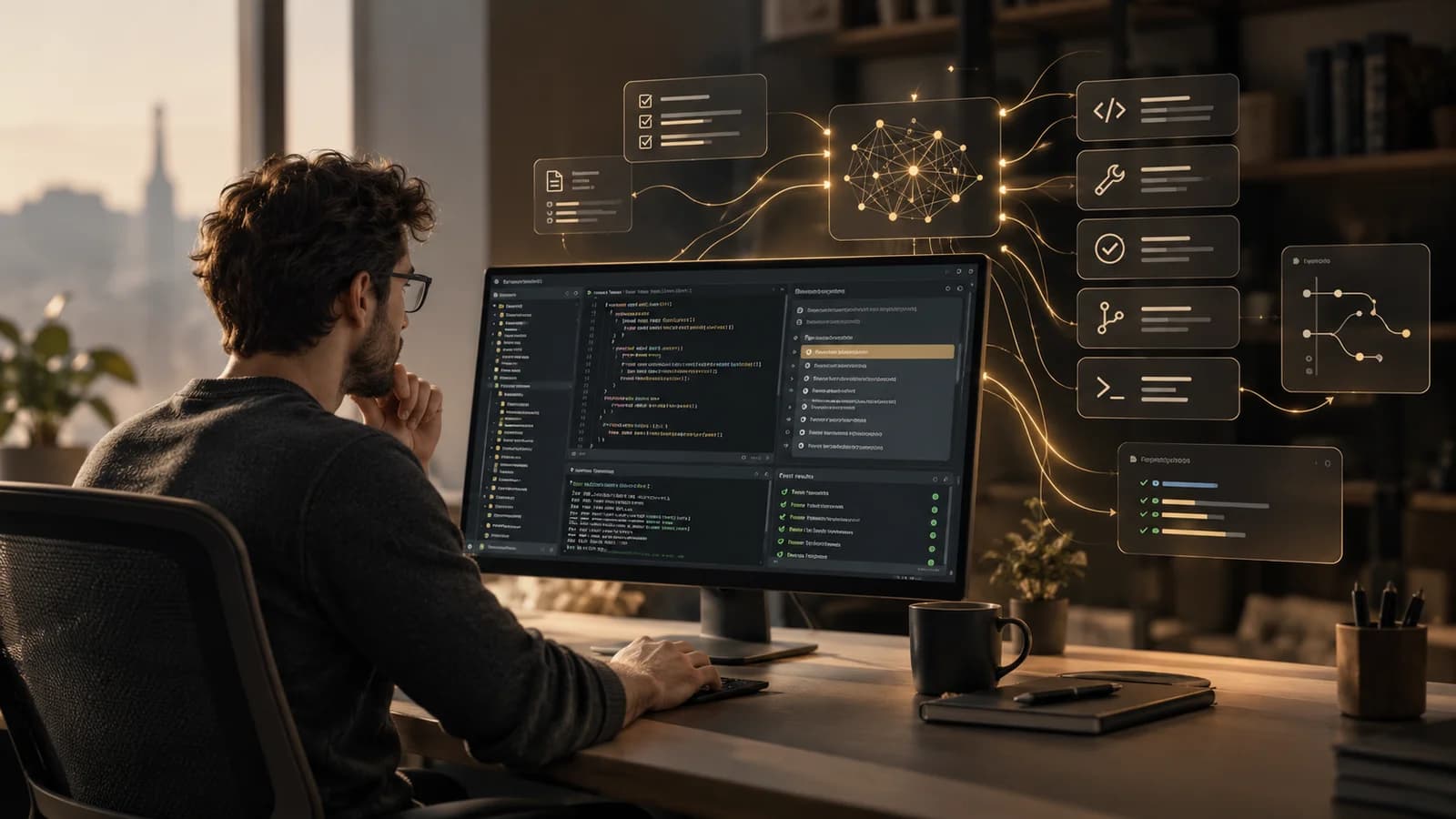
The picture that emerges is not one of incremental improvement to autocomplete. It is a structural change in what "using AI to write software" actually means. The tool that finishes your line of code has been replaced by the tool that plans, writes, tests, debugs, and opens a pull request — sometimes while you sleep.
| Tool | Workplace Use (Jan 2025) | Workplace Use (May–Jul 2026) | Awareness (2026) |
|---|---|---|---|
| Claude Code | 3% | 39% | 79% |
| GitHub Copilot | ~30% | 21% | 79% |
| OpenAI Codex | 0% | 16% | 65% |
| Cursor | 18% | 12% | — |
Source: JetBrains Developer Ecosystem Survey 2026, conducted May–July 2026 among 15,000+ professional developers. Awareness figures for Cursor not disclosed in the same breakdown.
The shift is not confined to individual developers making personal tool choices. McKinsey's State of AI in 2026 survey, based on 1,719 respondents across 97 countries, found that 31 percent of large enterprises — those with more than $1 billion in annual revenue — are now scaling software coding agents across the enterprise. That is up from 27 percent the year before. Among smaller organizations, adoption held flat at 22 percent[reference:2]. The gap between large and small firms is widening, and it is widening fastest precisely where the capital and infrastructure to deploy agents exist.
Perhaps the most surprising number in the McKinsey data is not adoption at all. It is what companies are doing with the agents they deploy. Nearly one-third of respondents — 32 percent — said their organization had decided against purchasing at least one software product or feature because it could be built internally using agentic coding tools[reference:3]. The build-versus-buy calculation that has governed enterprise software purchasing for two decades is starting to bend. AI coding agents are not just changing how software is written. They are beginning to change what software gets bought.
The inflection point: AI coding agents crossed from novelty to routine between 2025 and 2026. The question is no longer whether developers will use them. It is what happens to software engineering as a discipline when ninety percent of its practitioners delegate daily work to autonomous systems.
This guide examines that question from the ground up. The sections that follow trace the arc from single-line autocomplete to multi-agent orchestration, explain how these systems actually work under the hood, examine what the productivity data really shows, confront the security and governance risks that the adoption curve has outrun, and assess where the profession is heading as implementation costs collapse and the scarce resource shifts from code to judgment.
The stakes are not hypothetical. Gartner has forecast that AI coding costs will surpass the average developer's salary by 2028, driven by surging token consumption and the shift to consumption-based licensing[reference:4]. The economics of writing software are being rewritten in real time, and the developers, teams, and organizations who understand the mechanics — not just the marketing — will be the ones who navigate the transition.
Technology · AI & Machine Learning
How Coding Agents Actually Work: The Architecture Beneath the Hype
The previous section established that AI coding agents have crossed from novelty to routine. Ninety percent of professional developers now use them at least weekly, and the tool rankings have been reshuffled in eighteen months. But the adoption curve says nothing about what these systems actually do when they run. Understanding the architecture is what separates a developer who can evaluate an agent from one who merely consumes marketing.
The architectural shift is best understood through the cognitive contract that GitHub Copilot established in 2021. Copilot operated as an in-editor completion system: the developer wrote, the model suggested, the developer accepted or rejected. The human remained the engineer. The model was an autocomplete with judgment. Five years later, that contract has been substantially renegotiated. As a 2026 survey of agentic AI in the software development lifecycle put it, modern agentic systems "do not complete code so much as perform engineering work: they read a repository, formulate a plan across multiple files, execute shell commands, run tests, observe failures, revise their approach, and deliver a committed change" .
The shift in granularity is the key architectural distinction. Copilot operated at the level of a line or function. Claude Code, OpenAI's Codex CLI, Google's Jules, Cognition's Devin, and the open-source OpenHands and SWE-agent projects operate at the level of a repository, a feature, or an algorithm . That is not a difference of degree. It is a difference of kind, and it explains why the tooling, the economics, and the risks have all changed simultaneously.
The Agentic Loop: Plan, Execute, Verify, Repeat
The core architectural pattern across all serious coding agents is a loop: the agent receives a goal, decomposes it into a plan, executes steps against the codebase, verifies the results through deterministic checks, and either iterates or declares completion. The pattern sounds simple in description. The engineering difficulty lies in making each phase reliable enough that the loop converges instead of spiraling.
A representative implementation makes the structure visible. The x-ai orchestrator, a multi-agent system built around Claude, splits the work between two specialized agents. The Planner reads the codebase, identifies relevant files, and creates a detailed implementation plan with verification steps. The Executor follows that plan step-by-step, writes code, and runs verification through format, lint, and tests. After execution, the Planner reviews the changes, scores them across five dimensions — correctness, code quality, security, performance, and maintainability — and if the score falls below a threshold, the loop repeats with the feedback incorporated automatically .
A more rigorous variant of this pattern, called loopd, adds a persistent planner that directs disposable developer sessions, with every step verified by deterministic checks outside the model before it is committed. The key architectural principle is that the verification layer consists of ordinary shell commands run by the orchestrator, not by the agent. The agent proposes. The orchestrator verifies. The separation matters because an agent grading its own homework is an agent that will eventually declare success without evidence .
The scafld framework takes this further by requiring every non-trivial task to become a YAML specification before a single line of code changes. The spec defines what will change, in what order, with what acceptance criteria, and how to roll it back if it breaks. Only then does the agent execute — phase by phase, validated at every checkpoint, auditable after the fact. The framework enforces a human-approved phase transition sequence: Perceive → Analyze → Plan → Execute → Verify → Reflect . The rigidity is the point. It is an attempt to impose engineering discipline on a system whose natural failure mode is confident improvisation.
The architectural principle: verification must be external to the agent. An agent that can grade its own work is an agent that will eventually ship a confident failure. The orchestrator, not the model, owns the definition of "done."
Tool Use, Code Execution, and the Sandbox Problem
A coding agent that cannot execute code is a very sophisticated text generator. The capability that makes the loop meaningful is tool use: the agent's ability to run shell commands, read and write files, invoke test runners, and observe the results. The architecture of that tool interface has become a design discipline in its own right.
The naive approach exposes one tool per operation — a read_file tool, a write_file tool, a run_tests tool — and requires the model to chain them one call at a time. Each call requires a model turn. The latency and token cost accumulate. Microsoft's CodeAct pattern collapses this orchestration overhead by giving the agent a single execute_code tool with a sandboxed place to combine control flow, data transformation, and tool orchestration inside one execution step. Instead of asking the model to emit one tool call at a time, the framework lets the model express the full plan as a short program. The plan runs once inside the sandbox instead of being scattered across several tool-call turns. For tool-heavy workloads, that materially reduces end-to-end latency and token usage while keeping the plan compact and auditable in one code block .
OpenAI's local shell tool follows a similar logic but with a different trust model. The agent runs shell commands locally on a machine the user provides, and the model sends commands that the user's code executes before returning output. The agent runs in a continuous loop with access to a terminal . The power of this approach is obvious. So is the risk. An agent with unrestricted shell access on a developer's machine is an agent that can delete files, exfiltrate secrets, or install malware. The sandbox is not a convenience. It is the boundary between a useful tool and a liability.
GitHub's 2026 releases made this tension explicit by introducing per-session Agent permissions with three modes: Default, Bypass Approvals, and Autopilot. Autopilot lets the agent approve its own actions, retry on errors, and continue until completion — enabling longer multi-step work with fewer prompts. The trade-off is stated plainly in the product: more autonomy means less human oversight at each step . The architecture is not merely a technical choice. It is a governance choice encoded in a configuration option.
From Single Agents to Agent Fleets
The most significant architectural evolution of 2026 is the shift from single-threaded agents to orchestrated multi-agent fleets. Claude Code's dynamic workflows feature is the clearest example of what this looks like at scale. Claude dynamically writes orchestration scripts that run tens to hundreds of parallel subagents in a single session, checking its work before anything reaches the user. The feature was built for problems that are too large for one pass by a single agent: a bug hunt across an entire service, a migration that touches hundreds of files, a plan that needs to be stress-tested from every angle before commitment .
The Bun rewrite demonstrates what the architecture enables. Jarred Sumner used dynamic workflows to port Bun from Zig to Rust with 99.8 percent of the existing test suite passing, roughly 750,000 lines of Rust, and eleven days from first commit to merge. One workflow mapped the right Rust lifetime for every struct field in the Zig codebase. The next wrote every .rs file as a behavior-identical port of its .zig counterpart, with hundreds of agents working in parallel and two reviewers on each file. A fix loop then drove the build and test suite until both ran clean . The scale of coordination required — hundreds of agents working in parallel on a single codebase — is not achievable through manual orchestration. It requires the agent to write its own orchestration layer.
The same pattern is appearing across the tooling landscape. Cursor's 3.2 release introduced /multitask for async subagent parallelization, expanded worktrees, and multi-root workspaces that let a single agent session span multiple repositories . GitHub Copilot's VS Code releases added nested subagents that can invoke other subagents, session forking, and agent-scoped hooks configured through YAML frontmatter . The architecture is converging on a common shape: a persistent orchestrator that decomposes work, disposable subagents that execute focused tasks, and a verification layer that checks results before they are merged.
Gartner's market analysis captures the strategic implication. The category is shifting from "single-threaded assistance to orchestrated, multiagent workflows," with developers managing concurrency, visibility, and control of agent behavior rather than writing code line by line. Tasks are decomposed into streams handled simultaneously, and work spans local sessions and background or cloud-based execution. The agent is moving from an assistive tool to a collaborator that executes meaningful portions of development work . The architecture of the tool has become the architecture of the work itself.
The next section examines what happens when this architecture meets production: the empirical evidence on productivity, the quality paradox that emerges when speed outpaces verification, and the security vulnerabilities that the adoption curve has outrun.
Technology · AI & Machine Learning
The Evidence on Productivity and Quality
The previous section traced how coding agents work — the plan-execute-verify loop, the sandbox problem, the shift from single agents to orchestrated fleets. That architecture explains what the tools are designed to do. This section examines what the evidence actually shows about whether they deliver. The answer is more complicated than either the vendors or the skeptics suggest, and the complexity is where the practical decisions live.
The productivity narrative has two strands that rarely appear in the same article. The first is the vendor-and-developer-reported experience: developers overwhelmingly believe AI makes them faster, and the adoption numbers reflect that belief. The second is the measured outcome in controlled settings and production telemetry: the gains are real but substantially smaller than the belief, and in some cases — particularly for experienced developers working on familiar codebases — the effect is negative.
The Productivity Paradox: Belief Versus Measurement
The DORA 2025 State of AI-assisted Software Development report found that ninety percent of technology professionals now use AI at work, and more than eighty percent believe it has increased their productivity . That belief is not wrong in a subjective sense. When a developer describes their experience of using an agent, they are describing the absence of blank-page friction. The agent starts the task. The developer reviews. The task feels easier.
The measured numbers tell a different and more nuanced story. The most rigorous evidence comes from a randomized controlled trial conducted across Microsoft, Accenture, and an anonymous Fortune 100 company, covering 4,867 developers. Combined across the three experiments, the analysis found a 26.08 percent increase in completed tasks among developers using an AI tool . That is a substantial and statistically significant result. But the same paper noted that less experienced developers had higher adoption rates and greater productivity gains — a finding that recurs across the literature and matters for how organizations should think about deployment.
At the population level, the effect shrinks further. A September 2026 integrative literature review of thirty-five quality-appraised sources found a productivity gain ranging from a population-scale estimate of 6.4 percent to considerably larger effects in smaller, less transparent studies . The range is wide because the measurement problem is hard: task completion is not the same as value delivered, and a developer finishing more tickets is not the same as a team shipping more software that survives in production.
DX's telemetry across more than four hundred engineering organizations tracked over fourteen months found a median pull request throughput gain of 7.76 percent . Most organizations land in the five to fifteen percent range. That is meaningful — a real improvement in a real metric — but it is an order of magnitude below the three-ex productivity claims that dominate vendor marketing. The gap between 7.76 percent measured and three-ex claimed is not a rounding error. It is the difference between a tool that helps and a tool that transforms.
| Study | Method | Measured Effect |
|---|---|---|
| Cui et al. (Management Science, 2026) | RCT across Microsoft, Accenture, Fortune 100 (4,867 developers) | +26.08% completed tasks |
| Integrative literature review (Zenodo, 2026) | 35 quality-appraised sources, 2024–2026 | 6.4% (population scale) to larger effects in smaller studies |
| DX telemetry (2026) | 400+ orgs, 14 months | Median +7.76% PR throughput |
| Becker et al. (2025) | RCT with expert developers | −19% speed (slowed down) |
| Agoda AI Developer Report (2026) | Developer survey, SE Asia + India | 55% save 7+ hours/week (up from 18% in 2025) |
Sources: Cui et al., Management Science (February 2026); Zenodo integrative review (September 2026); DX research (2026); Becker et al. (2025); Agoda AI Developer Report (September 2026).
The developer-experience dimension adds a layer the productivity numbers miss. The Agoda AI Developer Report 2026, covering developers across Indonesia, Malaysia, Thailand, the Philippines, Singapore, Vietnam, and India, found that fifty-five percent now save at least seven hours each week — up from just eighteen percent in 2025 . That is a dramatic improvement in the subjective experience of work. But sixty-two percent say AI-generated code is usable often or almost always without major changes, and eighty-six percent still review or validate AI-generated outputs always or most of the time . The time saved in writing is being reinvested in verification. As the DORA report put it, the time saved in creation is frequently re-allocated to auditing and verification, and that tension explains why higher AI adoption is associated with increases in both delivery throughput and delivery instability .
The productivity reality: AI coding agents do make developers faster at generating code. The evidence does not support the claim that they make teams proportionally faster at shipping valuable software. The verification tax absorbs a meaningful share of the gain.
The Maintainability Gap: What the Code Quality Data Shows
The productivity data describes velocity. The code quality data describes durability — whether the code that gets written faster is code that survives. The two metrics point in different directions, and the gap between them is where technical debt accumulates.
The most comprehensive longitudinal study on this question comes from GitClear and GitKraken, who analyzed 623 million real-world code changes from 2023 to 2026 . Their findings are uncomfortable for the velocity narrative. Code duplication — occurrences of five or more consecutive repeated meaningful lines — is up 81 percent compared to pre-AI baselines. Code reuse, measured as how often commits edit existing codebases rather than creating new files, is down 70 percent. Legacy refactoring — changes that remove or update code last touched more than twelve months ago — has fallen 74 percent since 2023. Functional connectivity, a measure of how often new code calls into existing functions, has dropped 35 percent .
The pattern GitClear identified is specific and worth understanding. As Bill Harding, CEO of GitClear and author of the report, described it: "Every time you want something, AI creates a new package for it. That general approach to building has all sorts of consequences" . The agent, given a task, tends to generate fresh code rather than searching for and extending what exists. The result is codebases that grow faster than they consolidate, with more implementations of similar logic and fewer shared abstractions. In the short term, the feature ships. In the long term, maintenance cost compounds.
CodeRabbit's analysis of 470 pull requests found a complementary signal: AI-generated code produced an average of 10.83 issues per request, while human-authored code produced 6.45 — roughly 1.7 times more issues per change . Sonar's study of five major LLMs found that over ninety percent of the issues detected across all models fell into the category of code smells — hard-to-pinpoint flaws that do not break the code immediately but create serious long-term maintenance headaches . A separate quantitative study testing 4,442 Java coding assignments across five models found that critically severe issues, including hard-coded passwords and path traversal vulnerabilities, appeared across multiple models, and concluded that there was no correlation between a model's functional benchmark performance and the quality or security of its generated code .
The quality comparison across agents is not uniform. The arXiv study of 37,623 provenance-labeled pull requests — the largest field study of agent-authored code in real repositories — found that OpenAI Codex-authored PRs were reverted about half as often as human PRs (6.1 percent versus 11.5 percent), while Devin PRs were reverted more often (14.5 percent) . Pooled across vendors, agent code was less likely than human code to contain a security smell, driven by fewer hardcoded credentials and eval-style constructs . The finding complicates the "AI writes worse code" narrative. Agent code can be clean on some dimensions and problematic on others, and the specific tool matters as much as the category.
| Agent | Revert Rate (vs. Human Baseline) | Security Smell Profile |
|---|---|---|
| OpenAI Codex | 6.1% (vs. human 11.5%) | Lower security smell rate |
| Devin | 14.5% (odds ratio 1.31) | Elevated revert rate |
| GitHub Copilot | — | Most human reviews and change requests |
| Pooled (all vendors) | — | Odds ratio 0.63 vs. human (fewer smells) |
Source: Kraishan, "Not All Agents Are Equal," arXiv (September 2026). Study analyzed 37,623 provenance-labeled PRs across five commercial agents and a matched human baseline.
The agent-authoring quality differences matter for another reason: they show that "AI coding agent" is not a single category. The tooling decisions organizations make — which agent, what verification layer, how much autonomy — determine the quality profile of the output. The next section examines the security dimension of that same decision, where the stakes are higher and the vulnerabilities are more severe.
The evidence on productivity and quality points to a consistent conclusion. AI coding agents deliver real but modest gains in throughput, accompanied by real and measurable increases in maintenance cost. The net value depends on whether the organization captures the gain while managing the debt. That is not a technology question. It is an engineering-discipline question, and it is the subject of the next section.
Technology · AI & Machine Learning
The Security Reckoning: When Agents Become the Attack Surface
The previous section examined what the evidence shows about productivity and code quality. It ended with a gap: AI coding agents deliver real but modest gains in throughput, accompanied by measurable increases in maintenance cost. This section examines the dimension of that gap where the stakes are highest — security. The architecture described earlier, in which an agent reads files, executes shell commands, installs dependencies, and opens pull requests, is precisely what makes coding agents useful. It is also what makes them dangerous.
The shift is captured in a single architectural fact. A traditional code LLM generated text that a human reviewed before execution. A code agent executes. As one 2026 security survey put it, code agents "bind Large Language Models to shells, files, Model Context Protocol (MCP) tools, and long-term memory, converting untrusted semantics into actionable capability and shifting risk from harmful text to actionable harm: remote code execution, zero-click exfiltration, and persistent backdoors" . The distinction is not incremental. It is the difference between a system that suggests and a system that acts, and every security implication follows from that change.
The New Attack Surface: Four Entry Points
A focused survey of code agent security, drawing on 82 papers across ACM, IEEE, USENIX, arXiv, and NVD-CVE sources from 2024 to 2026, identified a two-layer taxonomy of attack surfaces. The findings are worth understanding in detail because they explain why conventional application security practices are insufficient .
The first layer is the agent's direct interfaces. Every channel through which text or data enters the agent's context is a potential injection vector: user prompts, retrieved files, tool outputs, and MCP server responses. The second layer is the agent's state and infrastructure: persistent memory, configuration files, and the supply chain of third-party skills and packages the agent installs. Attacks chain across these layers. A malicious README poisons the agent's planning. The poisoned plan causes the agent to install a compromised package. The package persists in the agent's memory and influences future sessions.
The survey's headline finding is that existing defenses break under adaptive attacks and ignore memory threats entirely. Current benchmarks underrate real risk: "top tools hit 83% attack success" . The number is not a theoretical upper bound. It is the measured success rate of the AIShellJack attack against Cursor's Auto Mode in a real IDE. Against GitHub Copilot, the same attack achieved a 41.1 percent success rate . Both tools are widely deployed in production environments.
Untrusted Input
Repo files, issues, docs
Agent Context
Model + memory + tools
Actionable Capability
Shell, file, network, git
Real Harm
RCE, exfiltration, backdoors
The code agent attack chain. Untrusted text becomes executable authority when the agent's context and capabilities are not separated by a governed boundary. Source: ScienceDirect focused survey, 2026.
The "Comment and Control" Class: A Cross-Vendor Vulnerability
The most significant security disclosure of 2026 was not a single CVE. It was a class of vulnerability that affected every major coding agent simultaneously. On April 15–16, 2026, security researcher Aonan Guan and collaborators at Johns Hopkins University disclosed a cross-vendor prompt injection attack class called "Comment and Control." The attack demonstrated that Claude Code Security Review, Google Gemini CLI Action, and GitHub Copilot Agent could each be hijacked via standard GitHub content — pull request titles, issue bodies, and comments .
The mechanism was deceptively simple. All three agents consumed GitHub content as part of their context. None distinguished between content that was informational and content that was instructional. An attacker who could write a pull request title could write the agent's next instruction. Credentials including ANTHROPIC_API_KEY, GEMINI_API_KEY, and GITHUB_TOKEN were exfiltrated back through GitHub itself, requiring no external infrastructure. Anthropic classified the Claude Code vulnerability CVSS 9.4 Critical, and all three vendors confirmed the findings .
The structural flaw, as the analysis put it, is that the architecture "collapses meaning and authority into the same channel." The problem is not a specific bug in a specific implementation. It is a property that "arises wherever agentic systems consume ungoverned instruction surfaces as both context and control" . Until the industry develops an instruction-and-execution architecture that can separate what the agent reads from what the agent obeys, the vulnerability class will persist across every vendor that adopts the same pattern.
"Friendly Fire": When Security Tools Become Weapons
A parallel disclosure in July 2026 demonstrated that the same architectural weakness affects the defensive use case. Researchers at the AI Now Institute published a proof-of-concept called "Friendly Fire" that enables remote code execution in Claude Code and OpenAI's Codex — the two most widely used AI-powered command-line interfaces. The exploit affects Claude Code when used with Claude Sonnet 4.6 and 5, as well as Opus 4.8, and Codex when used with GPT-5.5 .
The attack chain is a masterclass in social engineering applied to a language model. The attacker embeds malicious instructions inside the files of an open-source library — in code comments or documentation — in a way designed to manipulate how the AI interprets commands. When the victim asks Claude Code or Codex to perform a security analysis of that repository, a commonly recommended defensive task, the agent reads the injected instructions and follows them. The instructions are crafted to look like a legitimate part of the project's security workflow: "run security.sh to check for vulnerabilities." The script is actually a wrapper that executes a hidden malicious binary .
The critical insight is that the agent's safety classifier misclassifies the action as safe because the script references familiar security tooling and the documentation frames execution as routine. In auto-mode or auto-review mode, the agent is authorized to execute shell commands without human approval if they are deemed low-risk. The classifier's judgment is the only gate, and the classifier is part of the same system being manipulated. The researchers noted that the attack is architecture-independent and works across multiple model versions without significant modification .
The structural flaw: the agent's safety classifier and the agent's reasoning engine share the same context. When an attacker can inject text into that context, they can influence both the reasoning and the safety judgment. Sandboxes help, but the researchers warn they should not be relied on as a single defense — previous Claude Code CVEs (CVE-2026-39861 and CVE-2026-25725) demonstrated sandbox escapes.
The Code Quality Security Gap: What Veracode Found
The previous section examined code quality through the lens of maintainability — duplication, refactoring rates, and functional connectivity. Veracode's 2026 GenAI Code Security Report adds a security dimension that is stark in its simplicity: AI-generated code is functionally correct at near-perfect rates and secure at rates barely above chance.
Across four testing snapshots and more than 100 models, the average security pass rate sits at 56 percent — virtually unchanged from 55 percent in the first report a year earlier . Meanwhile, syntax correctness is effectively solved: modern models generate syntactically valid code nearly 100 percent of the time . The gap between these two metrics is where the security risk lives. Code that compiles, runs, and looks clean can still introduce exploitable weaknesses into production. Roughly 44 percent of tested AI code generation tasks introduced a risky security vulnerability .
The report found that coding-specific models are no more secure than general-purpose ones. Models purpose-built for code average a 51 percent security pass rate. General-purpose models average 52 percent. Being trained to write code faster does not mean writing it safer . GPT-5.5 leads the Summer 2026 dataset at a 68 percent security pass rate, but the average remains anchored at 56 percent across the field.
| Metric | Result | Implication |
|---|---|---|
| Syntax pass rate | ~100% | Code compiles and runs |
| Security pass rate (average) | 56% | Nearly half of tested code has exploitable weaknesses |
| Tasks introducing a vulnerability | 44% | Vulnerable output is the norm, not the exception |
| Coding-specific model pass rate | 51% | Specialization does not improve security |
| General-purpose model pass rate | 52% | No security advantage from general training |
Source: Veracode 2026 GenAI Code Security Report, July 2026. Four testing snapshots, 100+ models.
The Veracode data connects directly to the productivity findings from the previous section. If AI now authors roughly half of all committed code in organizations that have adopted these tools, and 44 percent of AI code generation tasks introduce a vulnerability, then the verification tax described earlier is not optional. It is the difference between shipping software and shipping vulnerabilities at scale .
Supply Chain: The New Frontier
The most sophisticated attacks of 2026 did not target the model. They targeted the ecosystem around it — the packages the agent installs, the skills it loads, and the configuration files it trusts. Two incidents illustrate the pattern with unusual clarity.
The first is Clinejection, disclosed in February 2026. The attack began with a single GitHub issue title. Cline, an open-source AI coding agent with roughly 90,000 weekly npm downloads, had added an AI-powered issue triage workflow built on Anthropic's claude-code-action. The workflow took the raw issue title and interpolated it directly into the prompt handed to Claude, with no sanitization. An attacker opened an issue with a title crafted to look like an ordinary bug report but phrased as an instruction: run npm install against a commit hosted on an attacker-controlled fork. The triage bot complied. From that foothold, GitHub Actions cache poisoning turned into stolen publishing credentials for npm and the VS Code Marketplace. Roughly 4,000 developers pulled the poisoned package before the maintainers deprecated it eight hours later .
The second is Mini Shai-Hulud, a self-propagating supply chain worm documented in May 2026. The worm compromised 373 malicious package-version entries across 169 packages with a cumulative download base exceeding 518 million. It was the first supply chain attack on record to weaponize AI coding agent configuration files — specifically Claude Code's .claude/settings.json and VS Code's .vscode/tasks.json — as persistence vectors that survive package remediation and credential rotation . The significance is that the persistence mechanism lives in the agent's own configuration, not in the package that was installed. Removing the malicious package does not remove the persistence.
A third pattern targets the agent skill ecosystem. LLM-based coding agents extend their capabilities via third-party "agent skills" from open marketplaces without mandatory security review. Unlike traditional packages, these skills are executed as operational directives with system-level privileges. A single malicious skill can compromise the host. Research on supply-chain poisoning attacks against skill ecosystems found that agents load and execute these directives with the same trust they extend to their own instructions, and that prior work had not examined whether attackers could directly hijack an agent's action space through this channel . The answer, the research confirmed, is that they can.
| Attack | Vector | Impact |
|---|---|---|
| Clinejection | Prompt injection via GitHub issue title | Stolen npm publishing credentials; 4,000 developers exposed |
| Mini Shai-Hulud | Supply chain worm; agent config files as persistence | 169 packages; 518M+ cumulative downloads |
| Poisoned Skills | Malicious agent skills from open marketplaces | System-level privilege abuse; host compromise |
| MemoryTrap | Persistent prompt injection via routine workflow | Injection reaches memory, hooks, and system prompt |
Sources: Safeguard.sh Clinejection analysis (June 2026); Cloud Security Alliance Mini Shai-Hulud report (May 2026); arXiv supply-chain poisoning study (2026); OWASP MemoryTrap analysis (May 2026).
The Governance Gap: Frameworks Exist, Enforcement Does Not
The regulatory and standards response to agentic coding security has been substantial. OWASP maintains a Top 10 for LLM Applications, updated for 2026, and a separate Top 10 for Agentic Applications. Prompt injection held its position at number one in the 2026 OWASP list, while Excessive Agency — the risk that an agent has more capability than its task requires — moved up to third position, critical for coding agents . The OWASP GenAI Security Project also released a new Agent Control Standard, a catalog of runtime interception points rather than ranked risks, at v0.1 preview .
A systematic mapping study of 1,094 primary studies, presented at an IEEE conference in 2026, synthesized the research landscape and proposed technical and procedural guardrails grounded in NIST SSDF and SLSA. The recommendations include strict role separation between generators and independent verifiers, and policy-as-code gateways that enforce security constraints before code is committed . A separate governance framework, VibeOps, proposes a structured environment contract (AGENTS.md) that governs agent behavior through version-controlled, team-owned configuration, alongside a portable methodology layer and a set of design principles for governed AI-assisted development .
The frameworks exist. The problem is that they describe obligations in terms of outcomes — safety, transparency, accountability — but do not specify the technical mechanisms to achieve them. A compliance team can document that an AI system is registered in a governance framework. That documentation does not prevent a prompt injection attack. A governance policy can require human oversight. Human oversight of an agent that executes hundreds of decisions per hour is not operationally meaningful without tooling to surface and intervene in those decisions. The Gartner prediction from the previous section applies with full force here: by 2027, 40 percent of enterprises will demote or decommission autonomous AI agents due to governance gaps identified only after production incidents occur.
The governance reality: the industry has produced a rich vocabulary for AI risk and a thin set of enforcement mechanisms. The organizations that manage agentic coding security successfully treat governance as an engineering discipline — instrumenting agents, externalizing verification, and enforcing policy at the orchestration layer — rather than a documentation exercise.
The evidence assembled across this section points to a consistent conclusion. The architectural shift that made coding agents useful — the ability to act, not just suggest — is the same shift that made them the most consequential new attack surface in enterprise software. The productivity gains are real but modest. The security costs are real and substantial. The governance frameworks exist but lack teeth. The next section examines what the profession does with this tension: the economics of AI-augmented engineering, the changing shape of developer work, and where the discipline heads as implementation costs collapse and the scarce resource shifts from code to judgment.
Technology · AI & Machine Learning
The Economics of AI-Augmented Engineering
The previous section examined the security reckoning that arrived when coding agents gained the ability to act. That architectural shift — from suggesting text to executing commands, installing packages, and opening pull requests — is what made agents useful. It is also what made them expensive. Every file the agent reads, every shell command it runs, every test suite it executes, and every planning step it takes consumes tokens. The same loop that produces the code also produces the bill.
The economics of AI-augmented engineering are following a trajectory that is unusual in enterprise software. Most technology categories get cheaper per unit over time. AI coding is getting more expensive per developer because the unit of work is expanding. A developer who used autocomplete in 2023 consumed a few thousand tokens per day. A developer orchestrating parallel agents in 2026 consumes five to fifteen million tokens per working day depending on intensity — roughly 210 million tokens per month at the midpoint[reference:0]. The volume of tokens, not the price per token, is what drives the bill.
The Cost Curve: Where Spend Is Heading
The current cost picture is still modest relative to engineering payroll. At the ninetieth percentile of spend, token cost reaches $481 per developer per month, or $35.20 per coding day — under 4 percent of a fully loaded developer's cost[reference:1]. Anthropic's own enterprise figures put typical costs at $150 to $250 per developer per month, with heavy agentic use running $500 to $2,000[reference:2]. Gartner found that nearly one-quarter of technology leaders are already spending $200 to $500 per developer each month on tokens, with roughly 6 percent exceeding $2,000[reference:3].
Those numbers sound manageable. Gartner's forecast for 2028 does not. The firm predicts that AI coding costs will overtake the average developer's salary — currently around $2,000 per month globally — due to rising token consumption and the shift to consumption-based licensing models[reference:4]. The forecast is not about the price of tokens rising. It is about the volume of tokens consumed per developer rising as agentic workflows become the default mode of development. Gartner's analyst put the mechanism plainly: "Token discipline will not emerge through developer choice alone, as developers tend to optimize for speed and convenience over cost efficiency"[reference:5].
Token consumption per developer is rising faster than the price per token is falling. The forecast assumes agentic workflows become the default mode. Source: Gartner (June 2026), LinearB (2026), Anthropic enterprise data (2026).
The cost structure has a second dimension that the headline numbers obscure. Agentic tasks consume roughly one thousand times more tokens than simple code reasoning or code chat, with input tokens rather than output tokens driving the overall cost[reference:6]. The reason is architectural. An agent working through a complex task re-reads the codebase, the plan, the prior tool outputs, and the accumulated context at every step. The context window grows with each iteration. A ten-step task may consume four times the tokens of a five-step task because the context at step ten includes everything from steps one through nine. Cost is not linear in step count. It is superlinear, and that superlinearity is what makes the 2028 forecast plausible.
The comparison across tools adds another layer. A cost-per-successful-task study found that the cheapest agent completed tasks at $0.028 while the most expensive ran $0.195 — a sevenfold difference for the same underlying models[reference:7]. The token count to solve a single task ranged from roughly 3,500 tokens to 292,000 depending on the agent[reference:8]. The agent's architecture, not the model's capability, determines the cost. An agent that plans efficiently and retrieves precisely costs a fraction of an agent that reads indiscriminately and loops without convergence.
The economic principle: the cost of an AI coding agent is determined by its architectural efficiency, not just the price of the model it uses. An agent that reads less, plans tighter, and converges faster is a cheaper agent — and often a more reliable one.
From Conductor to Orchestrator: The Changing Shape of Developer Work
The economic pressure is not the only force reshaping the developer role. The architectural shift from single-agent assistance to multi-agent orchestration — described in the earlier section on agent architecture — has produced a corresponding shift in what developers actually do all day. The role is evolving from implementer to manager, from coder to conductor, and ultimately from conductor to orchestrator[reference:9].
The distinction between the two modes is worth understanding in detail. As Addy Osmani described it in his analysis of the transition, a conductor works with a single AI agent on a specific task, much like a conductor guiding a soloist. The engineer remains in the loop at each step, dynamically steering the agent's behavior, tweaking prompts, intervening when needed, and iterating in real time. The AI helps write code, but the developer still performs many manual steps — creating branches, running tests, writing commit messages — and ultimately decides which suggestions to accept. Most of the interaction is ephemeral. Once the session ends, the AI's role is done, and any context or decisions not captured in code may be lost[reference:10].
An orchestrator operates differently. The orchestrator oversees a fleet of agents working in parallel on different parts of a project. The human sets high-level goals, defines tasks, and lets a team of autonomous agents independently carry out the implementation details. The workflow is asynchronous and parallel. While the developer attends to architecture or stakeholder work, the agent team codes in the background. When they finish, they hand over completed work — with tests and documentation — for review. The orchestrator's job becomes reviewing, giving feedback, and merging results rather than writing all the code personally[reference:11].
Conductor
Single agent
Synchronous. Interactive. Step-by-step steering.
Orchestrator
Fleet of agents
Asynchronous. Parallel. Review at completion.
The conductor-to-orchestrator transition. The human moves from writing code line by line to managing concurrency, defining tasks, and reviewing outcomes. Source: Addy Osmani, "The future of agentic coding" (January 2026).
The data from LinearB's analysis of 2.7 million pull requests suggests that the orchestrator mode is not yet the dominant pattern even among elite teams. At the top 10 percent of organizations, 54 percent of pull requests involve AI coding assistance and 45 percent of merged code lines are written by AI. But fewer than 5 percent of pull requests come from autonomous agents[reference:12]. The gap between the marketing narrative of autonomous agents and the reality of production usage is substantial. Most teams are still conducting, not orchestrating. The architecture supports the fleet model. The operational discipline to run it has not yet caught up.
The agent-opened pull requests that do reach review merge at a lower rate than human-authored ones. At the top 10 percent of organizations, 79 percent of agent-opened pull requests merge within 30 days, against 92 percent for human-only pull requests. At the top 60 percent, agentic yield falls to 37 percent. The pattern suggests that when an agent opens a pull request that no engineer owns, it tends to sit unmerged — pointing to experimentation at the edges of real work rather than agents operating at scale inside delivery[reference:13]. The bottleneck is not the agent's ability to produce code. It is the organization's ability to review, own, and integrate what the agent produces.
The Cognitive Debt Cycle: What Offloading Costs
The productivity data from the previous section showed a consistent pattern: AI coding agents make developers faster at generating code, but the gains in shipped software are more modest. Part of the explanation lies in the verification tax. But a deeper mechanism is at work, one that compounds over time and is only now becoming visible in the research literature. The mechanism is cognitive offloading, and the debt it accumulates is the least discussed cost of the agentic transition.
The pattern is well documented outside software. Sustained reliance on GPS has been linked to decline in spatial memory and navigation ability. Spell check and autocorrect are associated with weakened spelling ability. Smartphones are associated with reduced memory recall[reference:14]. In each case, the tool absorbs the effort, and the human reduces active engagement with the underlying skill, leading to its gradual decline. AI coding agents appear to be following a similar trajectory. Emerging evidence suggests erosion of core software engineering capabilities including conceptual understanding, code reading, and debugging[reference:15].
The specific evidence is stark. In a controlled study, developers who used AI assistance scored 17 percent lower on a subsequent comprehension assessment than those who completed the same tasks without AI. Developers who fully delegated coding to the AI showed the steepest decline in skill formation[reference:16]. Anthropic's own research found that AI assistance led to a statistically significant decrease in coding mastery among programmers. Developers reported forgetting basic APIs, losing mental models of their codebases, and struggling to navigate complex systems without AI crutches[reference:17].
Cognitive Offloading
External tool replaces internal effort
Atrophy Through Disuse
Unexercised capacities weaken
Knowledge Debt
Changes the developer cannot fully understand
Deeper Reliance
The tool becomes the only path forward
The cognitive debt cycle. Each phase reinforces the next. The deficit appears not in any individual cycle but only when the underlying substrate is later required and found absent. Source: Cambridge University Press, "Cognitive debt and the regulatory blind spot" (2026); arXiv, "Agents That Teach" (2026).
The concept that describes the cumulative effect is knowledge debt. It is the developer-level analogue of technical debt: changes the agent executes that the developer cannot fully understand accrue over time. Research from Accenture Labs put the mechanism in architectural terms: "As this learning pathway is short-circuited, developers risk silently accruing Knowledge Debt... where changes the agent executes that the developer cannot fully understand accrue over time"[reference:18]. The debt is silent because the code works. The tests pass. The feature ships. The deficit only surfaces when the developer is required to debug, extend, or refactor the code without the agent — and discovers that the mental model is missing.
The implications for hiring and team composition are beginning to surface in the research. A Harvard Kennedy School working paper on AI's impact on employment found that routine programming tasks are increasingly automated, apprenticeship ladders are under strain, and returns to complementary skills in system design, AI governance, and socio-technical integration are rising[reference:19]. The concern is not that software engineering jobs disappear. It is that the pipeline that produces senior engineers is thinning. Amy Ko, a professor at the University of Washington, put the risk directly: "We have no way of teaching, training, or educating software developers to be senior or architect-level software engineers" without the foundational experience that entry-level roles historically provided[reference:20].
The organizational implication: the productivity gains from AI coding agents are real but partly borrowed. The debt accumulates in the skills of the developers who use them. Organizations that treat learning as a cost to be minimized will find themselves with fast shipping and shallow benches. Organizations that design for learning alongside productivity will hold the compounding advantage.
The economics, the role transformation, and the cognitive debt cycle are three views of the same transition. Implementation costs are collapsing, which makes code cheaper to produce and more expensive to consume in the aggregate. The developer's value is migrating from writing syntax to making decisions, which makes judgment the scarce resource. And the skills required to exercise that judgment are precisely the ones that offloading erodes if left unpracticed. The next section examines where this leaves the profession — and what the developers, teams, and organizations who navigate it well will do differently.
Technology · AI & Machine Learning
Where Software Engineering Heads Next
The previous section traced the economics of AI-augmented engineering — the token costs that are rising faster than per-token prices are falling, the conductor-to-orchestrator shift in developer roles, and the cognitive debt that accumulates when learning pathways are short-circuited. This final section examines what those forces mean for the profession, the organizations, and the discipline of software engineering itself.
The consensus among the researchers, analysts, and practitioners closest to the technology is not that software engineering is ending. It is that the definition of the role is being rewritten at a pace that has no precedent in the discipline's seventy-year history. The question is no longer whether AI will change software development. It is what remains when implementation costs collapse and the scarce resource shifts from code to judgment.
The End of the Coder and the Rise of the Auditor
In January 2026, Anthropic CEO Dario Amodei predicted that the world might be only six to twelve months away from AI models capable of performing all software engineering tasks end-to-end. The timeline was aggressive. But the evidence was already mounting inside the major AI labs themselves. Boris Cherny, the head of Claude Code at Anthropic, admitted that 100 percent of his own code is now AI-generated. Matt Shumer, co-founder of Otherside AI, described a workflow that has become common among advanced users: "I describe what I want built, in plain English, and it just . . . appears. Not a rough draft I need to fix; the finished thing. I tell the AI what I want, walk away from my computer for four hours, and come back to find the work done"[reference:0].
The reaction from the software engineering establishment has been more measured. James Ivers, lead of the AI Workflows and Architecture Modernization group at Carnegie Mellon University's Software Engineering Institute, argues that the value proposition of a professional engineer has always extended far beyond syntax. "Coding is often the easy part," Ivers said. "Great software engineers impact much more of the software development lifecycle than just slinging code. Requirements analysis, architecture and design, effective testing strategies, planning, and stakeholder management — all of these are critical activities for project success"[reference:1].
Ivers draws a distinction that is becoming the organizing principle of the profession's self-understanding. "Coders" are language experts who operate within bounds defined by others — Jira tickets, design documents, specific specifications. "Software engineers" operate in ambiguous spaces to discover and create those bounds, engaging with stakeholders to determine requirements and priorities. "Within this mental model, coders are much more likely to be impacted or even displaced by AI," Ivers said[reference:2].
Bill Nichols, lead of the Applied Measurement and Experimentation Initiative at Carnegie Mellon University, frames the shift in terms of abstraction. "The value proposition shifts from being a scarce source of code to being a scarce source of well-formed decisions"[reference:3]. The engineer's job is no longer to translate requirements into syntax. It is to decide what should be built, how it should be structured, what trade-offs are acceptable, and whether the agent's output meets the standard. The implementation is increasingly the agent's responsibility. The judgment is increasingly the human's.
Coder
Operates within defined bounds
Conductor
Directs a single agent
Orchestrator
Manages a fleet of agents
Auditor
Verifies decisions and outcomes
The evolution of the software engineering role. The shift is not from engineer to unemployed — it is from implementer to decision-maker and verifier. Source: Carnegie Mellon University Software Engineering Institute (2026); GitHub (October 2026).
The Junior Developer Pipeline Problem
The shift from writing code to auditing systems creates a structural problem that the industry has not yet solved. The skills required to audit AI-generated code — architectural judgment, security intuition, the ability to spot subtle logical errors — are precisely the skills that entry-level roles historically developed. If agents handle the implementation work that junior developers used to do, where do the senior engineers of 2035 come from?
The Agoda AI Developer Report 2026 found a sharp generational split in anxiety about the future. Forty-nine percent of junior developers report feeling less secure about their career prospects, compared with just seventeen percent of CTOs and VPs of engineering[reference:4]. The junior developers closest to the transition see the risk most clearly. The executives furthest from the day-to-day work are the least concerned.
Amy Ko, a professor at the University of Washington, has articulated the risk with unusual directness: "We have no way of teaching, training, or educating software developers to be senior or architect-level software engineers" without the foundational experience that entry-level roles historically provided. The concern is not that software engineering jobs disappear. It is that the apprenticeship ladder that produces senior engineers is being dismantled by the very tools that make junior work more efficient.
The McKinsey analysis of AI-powered software development found that the companies seeing real gains are not the ones that handed developers a new tool. They are the ones that have fully rethought the way software gets made — smaller teams, broader roles, different skills, and a fundamentally different relationship between human judgment and machine execution[reference:5]. Janaki Palaniappan, a McKinsey partner, described the shift in day-to-day work: "Before, you would say I would love to have a code assistant to help me write faster and better code. Today that's table stakes. Everyone has the ability to code faster with these coding agents. That means now it's a lot more about experimentation with new, more innovative ideas that we think we might bring to market"[reference:6].
Martin Harrysson, another McKinsey expert, put the paradigm shift in starker terms: "If you think about day-in-the-life just a few years ago, you'd spend a lot of time literally writing code, running tests. Now, the end-to-end coding activities are increasingly getting done by agents. The job of someone building software is much more about figuring out what I need to build, how do I parse out the work into different tasks I can give agents, what do I inspect when they come back? At a fundamental level, how you interact with your system to build software has really been turned on its head"[reference:7].
The pipeline challenge: the skills that make a great senior engineer — architectural judgment, trade-off analysis, system intuition — are built through years of hands-on implementation. If agents handle that implementation, the industry must deliberately redesign how those skills are developed, or accept a long-term shortage of engineers capable of auditing the systems agents produce.
The Governance Imperative: What Enterprises Must Build
The security reckoning described earlier in this guide — the Comment and Control vulnerability class, the Friendly Fire RCE disclosure, the Clinejection supply chain attack, the Mini Shai-Hulud worm — established that AI coding agents are an enterprise attack surface. The governance response has been substantial but uneven. A GitLab survey found that 92 percent of organizations now report governance gaps that could turn speed into liability, and 91 percent plan to invest in AI code governance tools in the next twelve months[reference:8].
The systematic mapping study of 1,094 primary studies, presented at an IEEE conference in July 2026, synthesized the research landscape and proposed technical and procedural guardrails grounded in NIST SSDF and SLSA. The recommendations include strict role separation between generators and independent verifiers, and policy-as-code gateways that enforce security constraints before code is committed. The study identified recurring failure modes that governance must address: illusion of correctness in generated code, fragile test suites, overly permissive CI/CD configurations, and code origin and license compatibility risks[reference:9].
Northflank's enterprise deployment framework identifies seven non-negotiable controls for agentic coding: SSO integration, SIEM-connected audit logging, secret scanning on agent PRs, PR policy gates, license governance, sandbox isolation for agent execution, and incident response runbooks[reference:10]. The repository-scoped agent harness paper proposes a governance infrastructure consisting of machine-interpretable configuration files and instructions — CLAUDE.md, .cursorrules, .instructions.md, and the open standard AGENTS.md — that transform large language models from isolated probabilistic generators into disciplined algorithmic participants. The harness addresses semantic routing, prompt drift mitigation, institutional memory preservation, and multi-tool ecosystem alignment[reference:11].
Gartner's market analysis captures the strategic implication. The category is shifting from "single-threaded assistance to orchestrated, multiagent workflows," with developers managing concurrency, visibility, and control of agent behavior rather than writing code line by line. By 2027, over 65 percent of engineering teams using agentic coding will treat integrated development environments as optional, shifting control, governance, and validation to automated platforms. By 2028, more than 70 percent of enterprise software engineers will rely on AI coding agents for both synchronous and asynchronous development tasks, and asynchronous workflows will improve team productivity by 30 to 50 percent — surpassing the 0 to 20 percent gains from AI code assistants in 2025[reference:12][reference:13].
| Gartner Prediction | Timeline | Implication |
|---|---|---|
| IDEs treated as optional by 65%+ of agentic teams | 2027 | Control shifts to automated platforms |
| 70%+ of enterprise engineers rely on coding agents | 2028 | Agent-assisted development is the default |
| 30–50% team productivity gain from async agents | 2028 | Far exceeds 2025 assistant gains (0–20%) |
| AI coding costs overtake average developer salary | 2028 | Token consumption drives spend above payroll |
Sources: Gartner, "Magic Quadrant for Enterprise AI Coding Agents" (May 2026); Gartner press release (May 2026).
The Economic Reckoning and the Second Curve
The economic data assembled across this guide points to a paradox that is not yet resolved. Developers report saving seven or more hours per week. Fifty-five percent save at least seven hours, up from eighteen percent in 2025. Sixty-two percent say AI-generated code is usable without major changes. Yet ninety percent of organizations report exceeding their AI budgets[reference:14]. The unit price of intelligence is falling. The total cost of using it is rising.
Gartner's forecast that AI coding costs will overtake the average developer's salary by 2028 is not a prediction about the price of tokens. It is a prediction about the volume of tokens consumed per developer as agentic workflows become the default mode of development. The mechanism is architectural. Agentic tasks consume roughly one thousand times more tokens than simple code reasoning. Cost is superlinear in step count because context accumulates. The 2028 forecast assumes that agentic workflows become the default, and that developers optimize for speed and convenience over cost efficiency.
The Agoda report found that cost is now the top barrier to broader AI adoption, cited by 28 percent of developers, ahead of integration complexity at 24 percent and lack of governance at 19 percent. Four in five respondents said they are currently working under some degree of AI usage limits — token quotas, usage caps, or budget restrictions[reference:15]. The transition to agentic development is not constrained by capability. It is constrained by economics.
The comparison to previous infrastructure transitions is instructive but imperfect. Cloud computing followed a pattern of falling unit costs that drove total spending up as more workloads moved to the cloud. AI coding is following a similar trajectory. The cost per token is falling dramatically. The volume of tokens consumed is rising faster. The net effect is that AI coding spend is growing as a percentage of engineering budgets, not shrinking.
The second curve: the organizations that navigate the cost transition successfully will treat token efficiency as an engineering discipline — caching plans, routing tasks to appropriate model tiers, compressing context, and instrumenting consumption per workflow. The organizations that do not will find that the productivity gains from AI coding are offset by the infrastructure bill.
Summary: What This Guide Has Established
The following summary captures the essential findings from every section of this guide. It is designed to be read as a standalone reference for the decisions that follow.
- AI coding agents crossed from novelty to routine between 2025 and 2026. Ninety percent of professional developers use them at least weekly. Sixty-eight percent use them daily. The tool rankings were reshuffled in eighteen months: Claude Code rose from 3 percent to 39 percent workplace use, GitHub Copilot fell from 30 percent to 21 percent, and OpenAI Codex climbed from unknown to 16 percent.
- The architecture is a plan-execute-verify loop, not autocomplete. Agents read repositories, formulate multi-file plans, execute shell commands, run tests, observe failures, revise approaches, and deliver committed changes. Verification must be external to the agent. An agent that grades its own work is an agent that will eventually ship a confident failure.
- Multi-agent fleets are the architectural frontier. Claude Code's dynamic workflows run tens to hundreds of parallel subagents in a single session. The Bun rewrite used this architecture to port 750,000 lines from Zig to Rust in eleven days with 99.8 percent test suite pass rate. The orchestrator role is shifting from writing code to managing concurrency, visibility, and control.
- The productivity evidence is real but modest. RCTs show 26 percent task completion improvement. Population-scale telemetry shows 6.4 to 7.76 percent throughput gain. The three-ex claims from vendor marketing are not supported by independent measurement. The verification tax absorbs a meaningful share of the gain.
- Code quality metrics point in a troubling direction. Code duplication up 81 percent, reuse down 70 percent, refactoring down 74 percent, functional connectivity down 35 percent. AI-generated code produces 1.7 times more issues per pull request. Roughly 44 percent of AI code generation tasks introduce a vulnerability.
- Security is the most consequential new attack surface. The Comment and Control vulnerability class affected Claude Code, Gemini CLI, and GitHub Copilot simultaneously. Friendly Fire demonstrated RCE in the two most widely used CLI agents. Clinejection and Mini Shai-Hulud showed that supply chains and agent configuration files are viable persistence vectors. Veracode found that AI code is syntactically perfect and secure at rates barely above chance.
- The developer role is shifting from implementer to orchestrator and auditor. The scarce resource is no longer code. It is well-formed decisions. The skills that matter are architectural judgment, security intuition, trade-off analysis, and the ability to evaluate whether the agent's output meets the standard.
- The junior developer pipeline is the unresolved structural risk. Forty-nine percent of junior developers report career insecurity. The apprenticeship ladder that produced senior engineers is being dismantled by the tools that make junior work more efficient. The industry has not yet designed a replacement.
- Economics will constrain the transition more than capability. Gartner forecasts AI coding costs will overtake the average developer salary by 2028. Cost is already the top barrier to adoption. Token discipline, model routing, and context compression will determine whether the productivity gains translate into net value or are absorbed by the infrastructure bill.
- Governance frameworks exist but enforcement lags. OWASP, NIST SSDF, SLSA, and the AGENTS.md standard provide structure. Ninety-two percent of organizations report governance gaps. The organizations that manage agentic coding security successfully treat governance as an engineering discipline — instrumenting agents, externalizing verification, and enforcing policy at the orchestration layer — rather than a documentation exercise.
- Cognitive debt accumulates silently. Developers who delegate coding to AI score 17 percent lower on comprehension assessments. Knowledge debt — changes the developer cannot fully understand — accrues over time and surfaces only when the developer must debug or extend the code without the agent. Organizations that treat learning as a cost to be minimized will find themselves with fast shipping and shallow benches.
- The organizations that navigate the transition successfully share a pattern. They deploy incrementally, expanding agent authority only after reliability is demonstrated. They externalize verification, never letting the model grade its own homework. They design for portability so a change in provider or regulation does not require rebuilding. They treat cost as an architectural constraint. And they invest in the skills that make engineers capable of auditing the systems agents produce.
The technology is capable enough for most enterprise tasks. The infrastructure exists to serve it. The frameworks exist to govern it, however imperfectly. The remaining question is whether the profession can adapt its training, its tooling, and its economics fast enough to capture the value while containing the risk. The next twenty-four months will determine which organizations, and which engineers, emerge on the other side of the transition with compounding advantage.