NEWS
How Smart Robots Are Changing Industries
Discover how AI-powered robotics revolutionizes industries by enhancing decision-making, perception, and task automation.
Sudais Azlan
22 min read
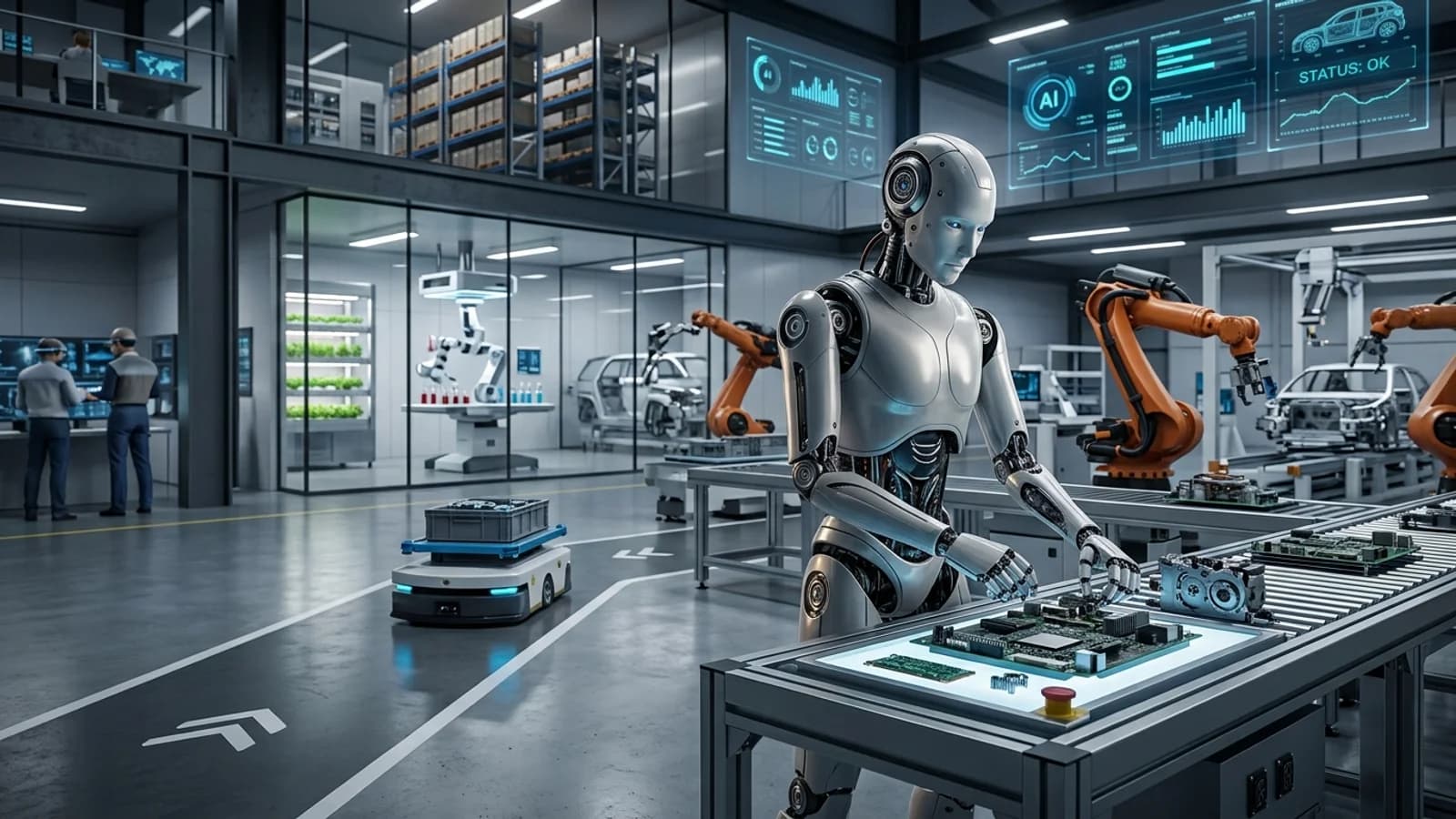
How Smart Robots Are Changing Industries
AI-Powered Robotics
What Is AI-Powered Robotics?
AI-powered robotics combines artificial intelligence with robotic hardware to create machines that can perceive their surroundings, process information, make decisions, and perform physical tasks. Unlike traditional robots that often follow fixed instructions, intelligent robots can use AI technologies to respond to changing environments and situations.
The combination of robotics and artificial intelligence is changing how machines interact with the physical world. Technologies such as computer vision, machine learning, natural language processing, sensor fusion, and AI-based planning are helping robots become more capable and adaptable.
01
Perception
AI helps robots interpret cameras, sensors, and other sources of information to understand objects and environments.
02
Decision-Making
Intelligent systems can analyze available information and select appropriate actions within defined operational boundaries.
03
Learning
Machine learning can help robots improve their performance through training data, demonstrations, simulation, and feedback.
04
Navigation
AI can support robots in understanding locations, avoiding obstacles, and planning routes through changing environments.
05
Natural Interaction
Language and multimodal AI can make it easier for humans to communicate instructions and information to robotic systems.
06
Task Automation
AI enables robots to perform increasingly complex workflows with less reliance on manually defined instructions.
| Traditional Robotics | AI-Powered Robotics | Key Difference |
|---|---|---|
| Fixed instructions | AI-assisted decision-making | Greater flexibility |
| Structured environments | Adaptive environments | Better environmental awareness |
| Limited perception | Computer vision and sensor fusion | Richer understanding of surroundings |
| Explicit programming | Learning-based approaches | Potentially easier adaptation |
Key Takeaway
AI Gives Robots a More Intelligent Layer
Robotics provides the physical capabilities needed to interact with the world, while artificial intelligence provides technologies for perception, learning, reasoning, and decision-making. Together, they create robotic systems that can potentially operate in more dynamic and complex environments.
How It Works
How Does AI Make Robots Smarter?
Artificial intelligence improves robotics by giving machines the ability to process information and respond to their surroundings. Instead of relying entirely on predefined instructions, AI-powered robots can combine data from sensors, cameras, software models, and control systems to determine what action should be taken.
The intelligence of a robot usually comes from several technologies working together. Computer vision helps the robot understand visual information, machine learning supports pattern recognition, planning algorithms help determine actions, and sensor systems provide continuous information about the physical environment.
01
Sense
Cameras and sensors collect information from the environment.
02
Understand
AI models analyze the collected information and identify relevant objects, conditions, or events.
03
Plan
Planning systems determine possible actions based on the current goal and environment.
04
Act
The robot executes an appropriate movement or physical action.
05
Adapt
New sensor information can be used to update the robot's next action.
| AI Technology | What It Does | Robotics Example |
|---|---|---|
| Computer Vision | Processes and interprets visual information. | Object detection and inspection |
| Machine Learning | Learns patterns from data and examples. | Prediction and adaptive behavior |
| Natural Language Processing | Helps systems process human language. | Voice and text-based commands |
| AI Planning | Helps determine sequences of actions. | Task planning and navigation |
| Sensor Fusion | Combines information from multiple sensors. | Environmental awareness and localization |
Practical Example
How an Intelligent Robot Responds to Its Environment
Imagine a warehouse robot transporting an item from one location to another. Its cameras and sensors can provide information about obstacles, people, shelves, and available routes. AI-based perception can interpret this information, while planning and navigation systems can help select an appropriate path. If the environment changes, the robot can update its behavior based on new sensor information.
Core Technologies
Key Technologies Behind AI-Powered Robots
Modern intelligent robots depend on a combination of AI software, sensors, computing hardware, control systems, and robotic mechanisms. No single technology creates an intelligent robot. Instead, different components work together to transform raw information into physical actions.
01
Computer Vision
Computer vision allows robots to process images and video to identify objects, recognize patterns, estimate positions, and understand visual environments.
02
Machine Learning
Machine learning enables robotic systems to identify patterns from data and develop models that support prediction, classification, control, or decision-making.
03
Reinforcement Learning
Reinforcement learning can train robotic systems through interaction and feedback, making it useful for selected control and manipulation problems.
04
Sensor Fusion
Sensor fusion combines information from cameras, depth sensors, lidar, inertial sensors, and other sources to create a more complete understanding of the environment.
05
Natural Language AI
Language models and speech technologies can help robots understand human instructions and support more natural human-robot interaction.
06
Edge AI
Edge computing allows AI models to run closer to the robot, helping reduce communication delays and supporting real-time applications.
07
Motion Planning
Motion-planning systems help robots determine how to move through physical environments while considering obstacles and constraints.
08
Robotics Control
Control systems translate high-level decisions into coordinated movements of motors, joints, wheels, arms, and other robotic hardware.
09
Multimodal AI
Multimodal systems can combine visual, language, audio, and sensor information to support richer understanding and interaction.
| Technology | Primary Function | Example Robotic Use | Importance |
|---|---|---|---|
| Computer Vision | Visual understanding | Object recognition | High |
| Machine Learning | Pattern learning | Prediction and classification | High |
| Sensor Fusion | Combining sensor information | Localization and perception | High |
| Natural Language AI | Language understanding | Human-robot interaction | Growing |
| Edge AI | Local AI inference | Real-time robotic processing | High |
Intelligent Robotics Stack
From Sensors to Physical Action
A typical AI-powered robotic system can be understood as a pipeline: sensors collect information, perception systems interpret that data, AI models help understand the situation, planning systems determine possible actions, and robotic control systems execute those actions. Feedback from the environment can then be used to continuously update the robot's behavior.
Sensors
Perception
AI Models
Planning
Action
Robotics Evolution
AI-Powered Robots vs. Traditional Robots: What Is the Difference?
Traditional robots are generally designed to execute predefined programs under controlled conditions. They are highly effective when tasks are repetitive and predictable, but their behavior can become limited when the environment changes. AI-powered robots add perception, learning, planning, and decision-making capabilities that can make robotic systems more adaptable.
The difference is not simply that one robot uses AI and another does not. Modern robotics often combines conventional control systems with AI components. The important shift is how much intelligence is used to interpret information, select actions, and respond to changing conditions.
TR
Traditional Robotics
Traditional robotic systems typically rely on predefined programs, fixed workflows, and structured operating environments.
- 01 Fixed task sequences
- 02 Predictable operating conditions
- 03 Limited adaptation
- 04 Strong dependence on explicit programming
AI
AI-Powered Robotics
AI-powered robotic systems can combine traditional control with perception, learning, reasoning, and adaptive decision-making.
- 01 Adaptive task execution
- 02 Richer environmental awareness
- 03 Learning-based capabilities
- 04 AI-assisted planning and decisions
| Capability | Traditional Robot | AI-Powered Robot |
|---|---|---|
| Task Execution | Mostly predefined | Can incorporate adaptive behavior |
| Environment | Usually structured | Can handle more variable conditions |
| Perception | Often limited or rule-based | AI-based visual and sensor interpretation |
| Learning | Limited | Machine-learning approaches can be used |
| Interaction | Often specialized interfaces | Can support multimodal interaction |
Important Distinction
AI Does Not Replace Robotics Engineering
AI is one layer of a robotic system rather than a replacement for mechanical engineering, electronics, control systems, sensors, and reliable hardware. The most capable robotic platforms combine these disciplines into a single integrated system.
Computer Vision
How Computer Vision Helps Robots Understand the World
Computer vision is one of the most important AI technologies used in modern robotics. It allows robots to process visual information from cameras and other imaging sensors, helping them identify objects, understand scenes, estimate positions, and recognize changes in their surroundings.
For a robot operating in the physical world, simply receiving an image is not enough. The system must interpret what the image represents and connect that information with its current task. AI-based computer vision can provide the perception layer required for these processes.
01
Object Detection
Vision systems can identify relevant objects within a scene and provide information that other robotic components can use.
02
Object Recognition
AI models can classify objects and distinguish between different categories or visual patterns.
03
Depth Understanding
Depth cameras and related sensors can help robots estimate distances and understand three-dimensional environments.
04
Scene Understanding
AI can help robots interpret relationships between objects, surfaces, obstacles, and other elements within a scene.
05
Visual Inspection
Robots can use computer vision to inspect products, surfaces, parts, and environments for visual patterns or irregularities.
06
Visual Navigation
Visual information can support localization, obstacle awareness, route planning, and movement through physical environments.
Computer Vision Pipeline
From Camera Input to Robotic Action
Step 01
Capture
Cameras collect visual information from the environment.
Step 02
Process
Vision models analyze images and identify meaningful information.
Step 03
Interpret
The system builds an understanding of relevant objects and environmental conditions.
Step 04
Respond
Perception results can be used by planning and control systems.
| Vision Capability | Robotic Application | Potential Benefit |
|---|---|---|
| Object Detection | Object handling | Better task awareness |
| Scene Understanding | Navigation | Improved environmental awareness |
| Visual Inspection | Manufacturing | Automated quality checks |
| Depth Estimation | Manipulation | Better spatial awareness |
Robot Learning
How Machine Learning Is Transforming Robot Behavior
Machine learning is changing robotics by enabling systems to learn patterns and behaviors from data instead of relying entirely on manually written rules. Depending on the application, robots can learn from labeled datasets, demonstrations, simulations, or interaction with their environment.
This approach is particularly useful for tasks that are difficult to describe with simple rules. Object manipulation, visual recognition, navigation, and adaptive control are examples where learning-based techniques can complement traditional robotics methods.
01
Supervised Learning
Models learn from examples containing known inputs and expected outputs. This can support classification, detection, and prediction tasks in robotics.
02
Reinforcement Learning
An agent learns through interaction and feedback, making this approach useful for selected control, movement, and decision-making problems.
03
Learning From Demonstrations
Robots can be trained using demonstrations of desired behavior, reducing the need to manually specify every individual movement.
| Learning Method | Learning Signal | Example Use | Main Advantage |
|---|---|---|---|
| Supervised Learning | Labeled examples | Object classification | Predictable training process |
| Reinforcement Learning | Rewards or feedback | Control and navigation | Learns through interaction |
| Demonstration Learning | Human demonstrations | Manipulation tasks | Can reduce manual programming |
| Simulation-Based Learning | Simulated experience | Motion and control | Enables large-scale experimentation |
Key Insight
Learning Can Make Robots More Adaptable
Machine learning does not automatically make a robot fully autonomous. Instead, it provides methods for improving specific capabilities such as perception, prediction, control, and task execution. Reliable robotics still requires careful integration, testing, safety controls, and hardware engineering.
Intelligent Decision-Making
How AI Helps Robots Make Smarter Decisions
One of the most important differences between conventional automation and AI-powered robotics is the ability to process information before deciding what action to take. Instead of simply executing a fixed sequence, an intelligent robot can evaluate sensor information, identify relevant conditions, and select an action that supports its assigned objective.
AI-based decision-making does not mean that robots can make unlimited independent decisions. In real-world applications, their behavior is usually constrained by predefined goals, safety rules, control systems, and operational boundaries.
01
Observe
Sensors and cameras provide information about the robot's current surroundings and physical state.
02
Interpret
AI models process available information and estimate what is happening in the environment.
03
Plan
Planning systems evaluate possible actions and determine an appropriate sequence for reaching the goal.
04
Execute
The robot's control system converts the selected plan into physical movement or another appropriate action.
| Situation | AI Interpretation | Possible Robot Response |
|---|---|---|
| Obstacle detected | Current route may be blocked | Slow down, stop, or select another route |
| Object location changes | Previous position is no longer accurate | Update the planned movement |
| Unexpected movement detected | Environment has changed | Reassess the situation before continuing |
| Target identified | Relevant task object is available | Begin the appropriate task sequence |
Decision Architecture
From Environmental Data to Physical Action
An intelligent robot can continuously move through a perception, reasoning, planning, and action cycle. New information from sensors can update the robot's understanding of its environment, allowing its planning system to reconsider the next step when conditions change.
Input
Sensor Data
Intelligence
AI Analysis
Planning
Action Selection
Output
Physical Action
Why Decision-Making Matters in Robotics
A robot becomes more useful when it can respond appropriately to situations that were not explicitly represented as a single fixed instruction. AI can provide the intelligence required to interpret changing conditions, while traditional robotics systems provide the precise control needed to safely execute physical actions.
Manufacturing
How AI-Powered Robots Are Transforming Manufacturing
Manufacturing is one of the most established areas for industrial robotics, and artificial intelligence is expanding what these systems can accomplish. AI can improve robotic inspection, object recognition, production monitoring, material handling, and selected assembly tasks.
Instead of limiting robots to highly repetitive operations, manufacturers can combine robotics with computer vision, machine learning, sensor systems, and intelligent planning to support workflows that require greater flexibility and environmental awareness.
01
Automated Inspection
Computer vision can help robots inspect products and components for visual characteristics, defects, or inconsistencies.
02
Intelligent Assembly
AI-assisted perception can help robotic systems identify components and support flexible assembly processes.
03
Material Handling
Intelligent robots can identify, move, sort, and organize materials within manufacturing environments.
04
Predictive Maintenance
AI systems can analyze machine and sensor data to identify patterns that may indicate changing equipment conditions.
05
Production Monitoring
AI can analyze operational information and help identify unusual patterns across production workflows.
06
Flexible Automation
AI-based perception and planning can support manufacturing tasks that involve changing products, layouts, or operating conditions.
| Manufacturing Area | AI Capability | Robotic Function | Potential Value |
|---|---|---|---|
| Quality Inspection | Computer vision | Product inspection | Consistent automated inspection |
| Assembly | Perception and planning | Component handling | Greater task flexibility |
| Logistics | Navigation | Material movement | Improved workflow coordination |
| Maintenance | Data analysis | Monitoring support | Earlier identification of changing conditions |
Manufacturing Impact
From Fixed Automation to Flexible Production
The combination of AI and robotics can help manufacturers move toward more flexible automation. Rather than designing every robotic workflow around a perfectly predictable environment, AI technologies can provide additional perception and adaptation capabilities while conventional robotic control continues to provide precise physical execution.
Healthcare Robotics
How AI-Powered Robotics Is Changing Healthcare
Healthcare is another area where robotics and artificial intelligence can work together to support professionals, patients, logistics, research, and rehabilitation. The role of a healthcare robot varies considerably depending on the application, and systems used in sensitive environments require extensive validation and human oversight.
AI can provide capabilities such as computer vision, navigation, language understanding, data analysis, and adaptive control. Robotics then provides the physical platform through which these capabilities can be applied to specific healthcare workflows.
01
Hospital Logistics
Mobile robots can support the movement of supplies, equipment, and other materials within suitable healthcare facilities.
02
Rehabilitation
Robotic systems can assist selected rehabilitation activities under appropriate professional supervision.
03
Research
Intelligent robotic platforms can support research involving manipulation, movement, perception, and physical interaction.
04
Assistive Systems
Certain robotic systems can assist people with selected physical tasks and activities.
| Application | AI Capability | Robotic Role |
|---|---|---|
| Logistics | Navigation and perception | Moving supplies and materials |
| Rehabilitation | Adaptive control | Supporting selected exercises |
| Research | Learning and perception | Experimental robotic tasks |
| Assistance | Perception and interaction | Physical task assistance |
Healthcare Consideration
Reliability and Human Oversight Remain Essential
Healthcare robotics operates in environments where reliability, privacy, safety, and professional oversight are especially important. AI capabilities should therefore be integrated with appropriate validation, monitoring, human decision-making, and established healthcare procedures rather than treated as a replacement for qualified professionals.
Agriculture
How AI-Powered Robots Are Transforming Agriculture
Agriculture involves large outdoor environments, changing weather, different crop conditions, uneven terrain, and many variables that make automation challenging. AI-powered robotics can help address some of these challenges by combining computer vision, machine learning, navigation, and robotic hardware.
Intelligent agricultural robots can be designed to monitor crops, identify objects, navigate fields, assist with harvesting, and collect useful information. These technologies can complement traditional farming methods by providing more consistent data and targeted automation.
01
Crop Monitoring
AI-powered vision systems can analyze crops and field conditions to identify patterns that may require further attention.
02
Weed Detection
Computer vision can help distinguish crops from unwanted plants and support more targeted agricultural operations.
03
Harvesting Assistance
Robotic systems can use perception and manipulation technologies to support harvesting tasks for suitable crops and environments.
04
Autonomous Navigation
AI-based navigation can help mobile agricultural robots move through fields while responding to terrain and environmental conditions.
05
Plant Inspection
Cameras and AI models can support the identification of visual characteristics across individual plants and larger growing areas.
06
Field Data Collection
Autonomous platforms can collect images, environmental measurements, and location information for agricultural analysis.
| Agricultural Task | AI Technology | Robotic Capability | Potential Benefit |
|---|---|---|---|
| Crop Monitoring | Computer vision | Automated field inspection | More consistent monitoring |
| Weed Detection | Image classification | Target identification | More targeted operations |
| Harvesting | Vision and manipulation | Robotic picking assistance | Automation of selected tasks |
| Navigation | Localization and perception | Autonomous field movement | Reduced manual navigation |
Agriculture Outlook
Toward More Data-Driven Farming
The combination of AI, robotics, sensors, and agricultural data can support a more precise approach to field monitoring and automation. However, agricultural robots must still handle difficult outdoor conditions, variable terrain, weather changes, and differences between crops and growing environments.
Logistics & Warehousing
How AI-Powered Robots Are Changing Logistics and Warehousing
Warehouses and distribution centers contain large numbers of products, workers, shelves, vehicles, and constantly changing workflows. AI-powered robots can help automate movement, sorting, inventory-related tasks, and navigation while responding to changes in their operating environment.
Autonomous mobile robots can combine cameras, lidar, sensors, maps, navigation algorithms, and AI-based perception to move through facilities. Their ability to understand surroundings can help them operate alongside other robotic systems and human workers in appropriately designed environments.
01
Warehouse Navigation
Robots can use sensors and navigation systems to move between locations while responding to obstacles and changing routes.
02
Picking Assistance
AI vision and robotic manipulation can support the identification and handling of selected products.
03
Inventory Monitoring
Robots equipped with cameras and sensors can collect information about inventory locations and warehouse conditions.
04
Material Transport
Autonomous systems can move materials between designated areas throughout suitable warehouse environments.
Intelligent Warehouse Workflow
How an Autonomous Warehouse Robot Operates
01
Receive Task
The robot receives a destination or task from the warehouse system.
02
Understand
Sensors provide information about the current environment.
03
Plan Route
Navigation software determines a suitable route toward the target.
04
Navigate
The robot moves while monitoring its surroundings.
05
Adapt
The robot can update its route when environmental conditions change.
| Logistics Function | AI Capability | Robotic Role | Potential Impact |
|---|---|---|---|
| Navigation | Perception and planning | Autonomous movement | More flexible material transport |
| Inventory | Computer vision | Data collection | Improved inventory visibility |
| Picking | Object recognition | Product handling | Support for selected picking workflows |
| Transportation | Autonomous navigation | Internal delivery | Reduced repetitive manual movement |
Retail
How Smart Robots Are Changing the Retail Industry
Retail environments are highly dynamic. Customers, employees, products, shelves, and store layouts can change throughout the day. AI-powered robots can use perception, navigation, and language technologies to support selected retail operations.
Retail robotics can range from inventory-support robots and autonomous systems to customer-facing platforms. The most useful applications are typically those where robots can perform repetitive physical or information-gathering tasks while people remain responsible for higher-level customer service and operational decisions.
01
Inventory Scanning
Robots can use cameras and sensors to collect information about products, shelves, and store inventory.
02
Store Navigation
Autonomous mobile robots can navigate retail spaces while detecting obstacles and changing conditions.
03
Customer Assistance
Language and conversational AI can support selected customer-facing interactions in suitable environments.
04
Shelf Monitoring
Computer vision can help identify shelf conditions and provide information for inventory management.
| Retail Task | AI Technology | Robotic Capability | Business Value |
|---|---|---|---|
| Inventory | Computer vision | Shelf scanning | Better inventory visibility |
| Customer Support | Natural language AI | Conversational assistance | Additional service support |
| Navigation | Perception and planning | Autonomous movement | Automated store operations |
Retail Outlook
Combining Physical Automation With Intelligent Interaction
AI gives retail robots capabilities beyond simple movement. By combining computer vision, navigation, language understanding, and robotic control, future systems may support a broader range of store operations while remaining focused on clearly defined tasks and responsibilities.
Transportation
How AI-Powered Robotics Is Transforming Transportation
Transportation is becoming increasingly dependent on intelligent perception, navigation, and decision-making systems. AI-powered robotic platforms can process information from cameras, radar, lidar, GPS, and other sensors to understand their surroundings and support autonomous or semi-autonomous movement.
The combination of robotics and AI is particularly important because transportation environments are dynamic. Roads, warehouses, airports, ports, and other operational areas contain moving objects, changing routes, unexpected obstacles, and varying environmental conditions.
01
Autonomous Navigation
AI can help robotic transportation systems understand their surroundings and select appropriate routes within defined operational conditions.
02
Object Detection
Computer vision and other sensing technologies can help identify vehicles, pedestrians, obstacles, road features, and other objects.
03
Route Planning
Intelligent planning systems can evaluate routes and adapt movement when conditions change.
04
Fleet Coordination
AI systems can help coordinate multiple autonomous machines across warehouses, industrial sites, and other controlled environments.
05
Predictive Maintenance
Machine-learning systems can analyze equipment data to identify patterns that may indicate changing vehicle or machine conditions.
06
Traffic Awareness
AI perception systems can process information about nearby objects and traffic conditions to support navigation and planning.
Intelligent Transportation Loop
From Sensors to Autonomous Movement
01
Sense
Collect environmental data.
02
Perceive
Identify relevant objects.
03
Plan
Determine an appropriate route.
04
Control
Execute the planned movement.
05
Reassess
Update actions as conditions change.
| Transportation Area | AI Capability | Robotic Function | Potential Impact |
|---|---|---|---|
| Autonomous Vehicles | Perception and planning | Navigation assistance | More automated transportation |
| Warehousing | Navigation and object detection | Autonomous material movement | More efficient internal logistics |
| Ports | Planning and perception | Automated equipment operations | Support for large-scale logistics |
| Fleet Operations | Data analysis and optimization | Fleet coordination | Better operational planning |
Transportation Outlook
Building More Adaptive Transportation Systems
AI can make robotic transportation systems more capable of responding to changing environments. However, transportation remains a demanding application because perception errors, unexpected conditions, latency, system failures, and safety requirements can have significant consequences.
Construction
How AI-Powered Robots Are Changing Construction
Construction sites are complex environments where workers, machinery, materials, structures, and equipment operate together. Unlike highly controlled factory floors, construction environments can change significantly from one day to another. AI-powered robotics can help introduce automation while providing systems with greater awareness of their surroundings.
AI technologies can support construction robots through computer vision, mapping, navigation, object detection, progress monitoring, and data analysis. These capabilities can be combined with robotic platforms designed for specific construction activities.
01
Site Inspection
Robots equipped with cameras and sensors can collect information about construction sites and structures.
02
Progress Monitoring
AI-based analysis can compare collected site information with planned construction activities.
03
Surveying
Autonomous robotic platforms can collect spatial information across selected construction environments.
04
Material Movement
Mobile robots can support transportation of selected materials around appropriately designed work areas.
05
Robotic Fabrication
Robotic systems can support selected fabrication and construction processes where precision and repeatability are important.
06
Safety Monitoring
Computer vision and sensor systems can support monitoring of selected site conditions and potential hazards.
| Construction Task | AI Capability | Robotic Application | Potential Benefit |
|---|---|---|---|
| Inspection | Computer vision | Automated data collection | More frequent site monitoring |
| Surveying | Mapping and localization | Autonomous site surveying | Faster collection of spatial information |
| Material Handling | Navigation and perception | Robotic transportation | Reduced repetitive movement |
| Progress Tracking | Image and data analysis | Automated monitoring | Better project visibility |
Construction Outlook
Smarter Automation for Dynamic Worksites
Construction robotics has significant potential, but real-world worksites remain difficult environments for autonomous machines. Uneven terrain, changing layouts, weather, moving equipment, and human activity make perception and navigation particularly important. AI can help robots adapt to these conditions, but reliable deployment still requires careful engineering and human oversight.
Final Reflection
AI-Powered Robotics Is Redefining What Robots Can Do
AI-powered robotics represents an important shift in the development of intelligent machines. Traditional robots have typically been designed to perform predefined operations in controlled environments, while modern AI technologies can give robots stronger capabilities in perception, learning, planning, decision-making, and interaction.
Across manufacturing, logistics, agriculture, healthcare, transportation, construction, and other industries, intelligent robots are increasingly being explored for tasks that require physical automation combined with greater environmental awareness. The goal is not simply to create robots that move automatically, but to develop systems that can understand their surroundings and respond appropriately to changing conditions.
01
AI Adds Intelligence
AI enables robots to process information, recognize patterns, interpret environments, and support more adaptive behavior.
02
Robotics Adds Physical Action
Robotics allows intelligent software to interact with the physical world through sensors, motors, manipulators, and mobile platforms.
03
Industries Are Adapting
Businesses are exploring intelligent robots for repetitive, data-intensive, physically demanding, and carefully defined tasks.
04
Challenges Still Matter
Reliability, safety, computing requirements, data, hardware, and real-world uncertainty remain major engineering challenges.
| Traditional Robotics | AI-Powered Robotics | Long-Term Direction |
|---|---|---|
| Predefined instructions | Learning and AI-assisted decision-making | More adaptive task execution |
| Structured environments | Perception of changing surroundings | Greater operation in dynamic environments |
| Limited interaction | Multimodal interaction | More natural human-robot collaboration |
| Task-specific automation | Flexible AI-assisted capabilities | More general-purpose robotic systems |
Final Takeaway
The Future Is Intelligent, Physical, and Collaborative
The future of robotics will likely be shaped by the convergence of artificial intelligence, advanced sensors, robotics hardware, and intelligent software systems. As these technologies continue to develop, robots may become capable of handling increasingly complex tasks while working alongside people in carefully designed environments.
AI-powered robotics is therefore more than a technological upgrade to traditional machines. It represents a broader movement toward physical systems that can perceive, reason, learn, and act. The most successful applications will depend not only on AI capability, but also on reliability, safety, responsible deployment, and thoughtful human-robot collaboration.