ARTICLE
How Large AI Models Could Change Robot Intelligence
Discover how large AI models are transforming robot intelligence, enabling them to understand and act on human instructions more effectively.
Sudais Azlan
17 min read
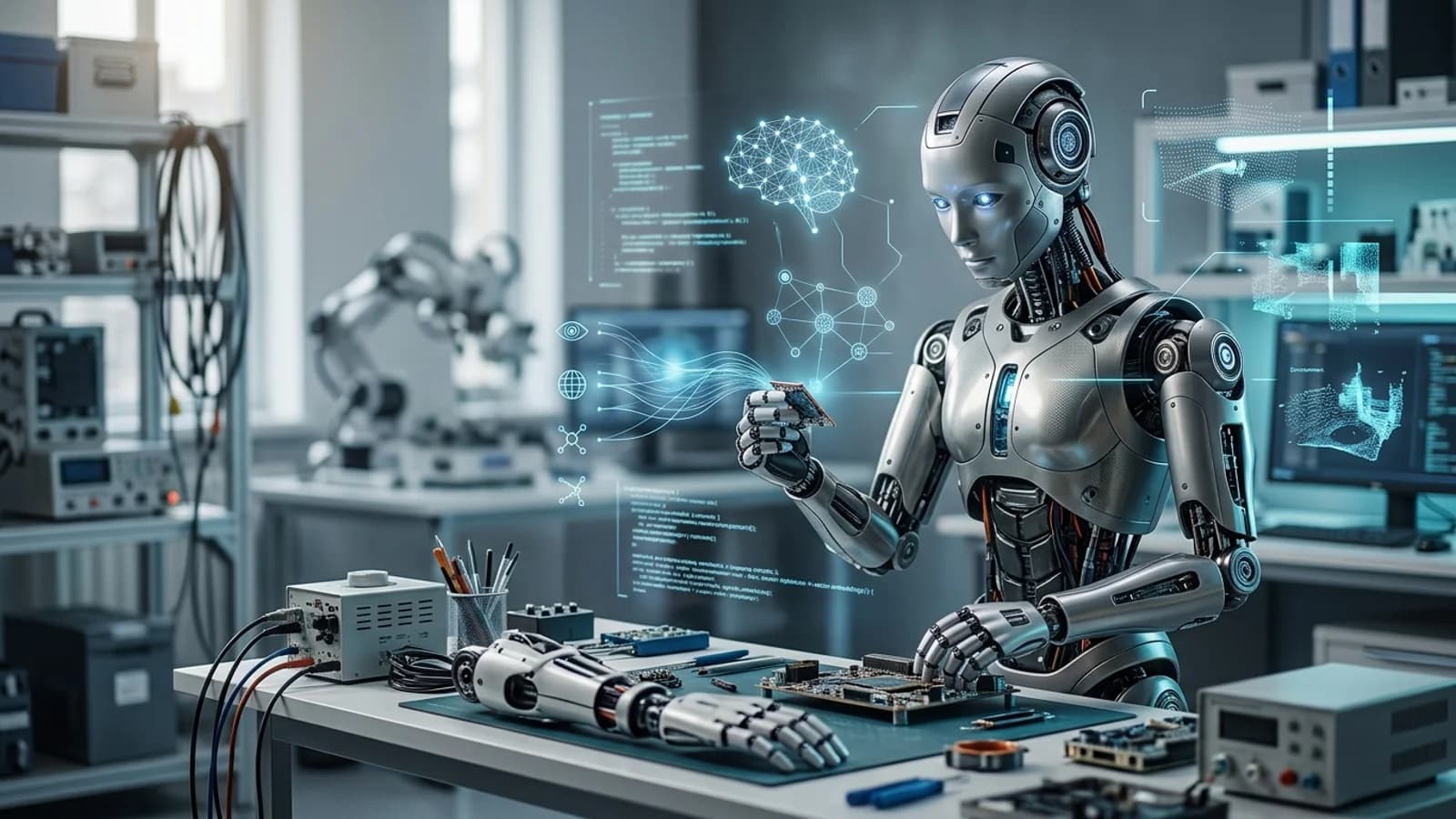
How Large AI Models Could Change Robot Intelligence
Generative AI & Robotics
What Is Generative AI in Robotics?
Generative AI is changing how artificial intelligence systems understand information, generate responses, and solve complex problems. When these capabilities are combined with robotics, they create new possibilities for robots that can interpret instructions, understand their surroundings, plan tasks, and interact with people more naturally.
Traditional robots are often designed around predefined rules and carefully programmed workflows. Generative AI introduces a different approach by allowing advanced AI models to process language, images, sensor information, and other forms of data to generate useful outputs that can support robotic decision-making.
Large AI models could therefore become an important intelligence layer between human instructions and physical robot actions. Instead of simply executing a fixed sequence of commands, future robotic systems may be able to interpret goals and determine appropriate actions within defined constraints.
01
Understand
AI models can interpret language, images, instructions, and other information provided to a robotic system.
02
Reason
Large models can help transform high-level goals into intermediate steps that a robotic system can potentially execute.
03
Generate
Generative models can produce plans, descriptions, commands, or other intermediate outputs for robotic workflows.
04
Act
Robotics software can translate high-level decisions into controlled physical actions through appropriate planning and control systems.
Core Idea
From Programmed Instructions to AI-Assisted Intelligence
The important change is not that generative AI replaces every existing robotics technology. Instead, large AI models can potentially work alongside perception, planning, control, simulation, and sensor systems to provide a more flexible intelligence layer.
Robot Intelligence Architecture
How Large AI Models Could Work With Robots
A large AI model does not directly replace a robot's motors, sensors, or low-level controllers. Instead, it can operate as one component within a larger robotic architecture where different systems perform different responsibilities.
Cameras and other sensors collect information from the environment. Multimodal AI can help interpret that information, while a reasoning or planning system can connect the robot's observations with a human-defined goal. The resulting plan can then be passed to specialized robotics software responsible for safe physical execution.
Robotic AI Pipeline
01
Human Goal
A person provides a natural-language instruction or high-level goal.
02
Perception
Cameras, microphones, and other sensors provide information about the environment.
03
AI Reasoning
A large AI model can interpret the goal and relevant environmental information.
04
Planning
The system can produce or select a sequence of actions for completing the task.
05
Robot Action
Specialized controllers execute appropriate physical actions.
| Component | Main Responsibility | Example Role |
|---|---|---|
| Sensors | Collect environmental information | Cameras, microphones, depth sensors |
| Multimodal AI | Interpret different types of information | Understanding images and language |
| Large AI Model | Reason about goals and context | High-level task reasoning |
| Planner | Convert goals into executable steps | Navigation or manipulation planning |
| Controller | Manage physical robot movement | Motors, joints, and motion control |
Natural Language Robotics
How Generative AI Can Turn Human Instructions Into Robot Actions
One of the most interesting applications of generative AI in robotics is natural-language control. Instead of requiring a user to understand robotics commands or programming interfaces, a large AI model can potentially interpret instructions expressed in everyday language.
For example, a person could give a robot a high-level instruction such as organizing objects on a table. The AI system could interpret the goal, identify relevant objects through visual perception, determine an appropriate sequence of operations, and communicate those actions to the robotics software.
Traditional Approach
Explicit Robot Programming
- 01. Define the task manually.
- 02. Program the required robot movements.
- 03. Configure environmental assumptions.
- 04. Test and adjust the workflow.
Generative AI Approach
Goal-Based Interaction
- 01. User describes the desired outcome.
- 02. AI interprets the instruction and context.
- 03. The system generates an appropriate plan.
- 04. Robotics software validates and executes actions.
Example
From a Simple Instruction to a Robotic Workflow
Step 01
Instruction
The user provides a high-level task.
Step 02
Interpretation
The AI identifies the goal, objects, and relevant context.
Step 03
Planning
The system creates a sequence of possible actions.
Step 04
Execution
Robot controllers execute validated physical movements.
Multimodal Intelligence
Why Multimodal AI Could Make Robots More Intelligent
One of the most important advantages of modern generative AI is its ability to work with multiple types of information. Instead of processing only text, multimodal models can combine language, images, audio, and other forms of information to build a richer understanding of a situation.
This capability is particularly valuable for robotics because robots operate in physical environments. A robot may need to understand what a person says, identify objects through a camera, recognize spatial relationships, and use sensor information before deciding what to do next.
01
Vision
Cameras can provide visual information that helps AI systems identify objects, people, locations, and changes in the environment.
02
Language
Natural-language understanding can allow users to communicate goals and instructions without relying entirely on technical commands.
03
Audio
Audio information can help robots process spoken instructions and recognize relevant sounds within their surroundings.
04
Sensor Data
Sensor information can provide additional details about position, distance, movement, and the robot's physical state.
| Information Type | What the Robot Can Receive | Potential AI Role |
|---|---|---|
| Text | Human instructions and descriptions | Understand goals and task requirements |
| Images | Camera frames and visual observations | Identify objects and environmental context |
| Audio | Speech and environmental sounds | Interpret spoken communication and relevant audio events |
| Sensor Data | Distance, position, motion, and other measurements | Improve situational and spatial awareness |
Key Insight
Robots Could Move From Single-Input Systems to Richer Environmental Understanding
Combining multiple information sources can give an AI-powered robot a broader representation of its environment. This does not automatically make the robot reliable, but it can provide a stronger foundation for perception, reasoning, planning, and human-robot interaction.
Robot Perception
How Generative AI Could Improve Robot Perception
Perception is one of the foundations of robotics. Before a robot can perform a meaningful action, it needs to obtain information about what is around it. Traditional computer vision systems can identify predefined objects or features, but generative and multimodal AI may provide a more flexible way to interpret complex scenes.
A capable AI model could potentially describe a scene, identify important objects, understand relationships between objects, and connect visual observations with a high-level task. This can be particularly useful when the robot encounters objects or situations that were not explicitly programmed into its original workflow.
01
Scene Understanding
AI can help describe the broader context of a visual scene rather than treating every detected object as an isolated element.
02
Object Recognition
Multimodal models can help identify objects and provide semantic information useful for downstream robotic tasks.
03
Spatial Relationships
AI systems can help reason about relationships such as objects being beside, inside, above, or behind other objects.
04
Contextual Interpretation
AI can connect visual observations with the current task and provide more meaningful context for planning.
Perception Pipeline
01
Capture
Sensors collect information from the physical environment.
02
Interpret
AI analyzes the available visual and contextual information.
03
Connect
Observations are connected with the robot's current task or goal.
04
Inform
The resulting information can support planning and decision-making.
Planning & Reasoning
How Large AI Models Could Help Robots Plan Complex Tasks
Planning is the process of determining what actions should happen and in what order. In robotics, planning can involve navigation, object manipulation, task sequencing, resource management, and interaction with the surrounding environment.
Large AI models could contribute by interpreting high-level goals and generating possible task decompositions. However, generated plans still need to be checked against the robot's physical capabilities, environmental constraints, and safety requirements before execution.
STEP 01
Understand the Goal
The AI interprets what the user wants the robot to accomplish.
STEP 02
Break Down the Task
A complex objective can be divided into smaller and more manageable subtasks.
STEP 03
Check Constraints
Proposed actions need to respect available tools, space, timing, and robot capabilities.
STEP 04
Execute Safely
Validated actions are passed to appropriate robotics control systems.
| Task | AI Planning Role | Robotics System Role |
|---|---|---|
| Navigation | Understand destination and task context | Generate and execute safe motion |
| Object Handling | Determine what objects are relevant | Control robotic arms and grippers |
| Multi-Step Tasks | Decompose the overall objective | Execute individual validated actions |
| Adaptation | Reconsider the plan when circumstances change | Update motion and control behavior |
Important Consideration
AI Planning Does Not Mean Autonomous Execution Without Controls
A language or multimodal model may generate a useful plan, but physical robots require additional systems for motion planning, control, verification, monitoring, and safety. The most practical architecture is therefore likely to combine generative AI with specialized robotics components rather than relying on a single model for every operation.
Robot Learning
How Generative AI Could Change the Way Robots Learn
Robot learning has traditionally required carefully collected datasets, demonstrations, simulations, and repeated training. Generative AI could make this process more flexible by helping robotic systems learn from different forms of information, including language, visual examples, demonstrations, and simulated experiences.
Instead of programming every possible situation manually, researchers are exploring approaches where AI models can help robots generalize knowledge across tasks and environments. This could eventually reduce some of the engineering effort required to create task-specific robotic behaviors.
01
Demonstrations
Robots can learn from examples of how humans perform particular physical tasks.
02
Simulation
Simulated environments can provide large numbers of training experiences without requiring every experiment to happen in the physical world.
03
Language
Natural-language descriptions can provide additional information about goals, objects, and desired task outcomes.
04
Feedback
Feedback from successful and unsuccessful attempts can help improve future behavior through appropriate learning systems.
Learning Pipeline
01
Observe
Collect demonstrations and environmental information.
02
Learn
Train or adapt models using suitable learning methods.
03
Simulate
Test behaviors in controlled virtual environments.
04
Evaluate
Measure performance across different scenarios.
05
Improve
Refine the system using additional data and feedback.
Foundation Models
What Are Robotics Foundation Models?
Foundation models are large AI models trained on broad datasets and designed to support many different tasks. In robotics, researchers are exploring how similar ideas can be applied to models that understand visual information, language, actions, and physical environments.
The goal is to move beyond models that are created for only one robot or one narrowly defined task. A robotics foundation model could potentially provide reusable capabilities that can be adapted to different robots, environments, and applications.
Layer 01
Perception
Understand visual and sensor information from physical environments.
Layer 02
Reasoning
Connect observations with goals, context, and possible actions.
Layer 03
Action
Support the generation or selection of appropriate robotic behaviors.
| Traditional Robotics AI | Foundation Model Approach | Potential Benefit |
|---|---|---|
| Often task-specific | Designed for broader capabilities | Greater reuse across applications |
| Narrow training data | Large and diverse datasets | Potentially stronger generalization |
| Separate models for different functions | Shared model capabilities | More integrated AI workflows |
| Manual adaptation | Adaptation or fine-tuning | Potentially faster development |
Why It Matters
Toward More General-Purpose Robot Intelligence
The long-term opportunity is to create AI systems that can transfer useful knowledge between tasks instead of requiring a completely new intelligence system for every robotic application. Achieving this level of generalization remains an active research and engineering challenge.
Human-Robot Interaction
How Generative AI Could Make Human-Robot Interaction More Natural
Traditional robotic interfaces can require users to interact through buttons, predefined commands, programming interfaces, or specialized control systems. Generative AI introduces the possibility of communicating with robots using more natural forms of language and multimodal interaction.
A robot equipped with suitable language and perception systems could potentially understand requests, ask for clarification, explain what it is doing, and respond to changes in the environment. This could make advanced robotic systems easier for non-specialists to interact with.
01
Natural Instructions
Users could communicate high-level goals using everyday language rather than specialized robot commands.
02
Context Awareness
AI can use previous instructions and environmental information to interpret requests in context.
03
Clarification
When a request is ambiguous, an AI system could potentially ask the user for additional information.
04
Explanation
AI-generated explanations could help users understand the intended task and system status.
05
Multimodal Commands
People could potentially combine speech, visual references, gestures, and other inputs when communicating with robots.
06
Adaptive Interaction
The interaction style could adapt to the task, environment, and information available to the robotic system.
Interaction Example
A More Conversational Robot Workflow
Human
Gives the robot a high-level instruction describing the desired task.
AI System
Interprets the request, examines available context, and determines whether additional information is required.
Robot
Executes validated actions through its perception, planning, and control systems.
Real-World Use Cases
Potential Applications of Generative AI in Robotics
Generative AI could influence many areas of robotics, from industrial automation and warehouse operations to research, healthcare support, agriculture, and service robotics. The practical value depends on the reliability of the AI system and the requirements of each environment.
Manufacturing
AI can support inspection, task planning, flexible assembly, and interaction with industrial workflows.
Warehousing
Robots could use AI to understand changing warehouse layouts and coordinate task sequences.
Healthcare
AI-powered robots may assist with logistics, rehabilitation, research, and selected support activities.
Agriculture
Multimodal AI can support crop observation, navigation, inspection, and agricultural automation.
Home Robotics
Household robots could eventually use natural-language interaction and visual understanding for selected domestic tasks.
Education
Intelligent robotic platforms can provide interactive environments for learning robotics, programming, and AI concepts.
Space Exploration
Autonomous systems could help robots interpret environments where communication with humans is limited or delayed.
Research
Researchers can use generative AI to investigate perception, manipulation, planning, and physical intelligence.
| Application | Generative AI Capability | Potential Robotic Benefit |
|---|---|---|
| Manufacturing | Task reasoning and visual understanding | More flexible automation |
| Warehousing | Navigation and task planning | Better adaptation to changing workflows |
| Healthcare | Natural-language interaction | Easier interaction with robotic assistants |
| Agriculture | Visual scene understanding | More intelligent monitoring and automation |
Robotic Manipulation
How Generative AI Could Improve Robot Manipulation
Robot manipulation involves interacting with physical objects using arms, grippers, hands, or other mechanical components. These tasks can be challenging because objects vary in shape, size, position, texture, and weight. Generative AI could help robots connect visual understanding with high-level task requirements.
Instead of treating every manipulation task as a completely predefined sequence, AI systems could potentially identify the relevant objects, understand their relationships, select an appropriate strategy, and communicate the intended behavior to specialized motion-planning systems.
01
Object Understanding
AI can help identify objects and determine which items are relevant to the requested task.
02
Grasp Selection
Visual reasoning can provide useful information for selecting possible ways to approach and manipulate an object.
03
Task Sequencing
Complex manipulation tasks can be divided into smaller actions that can be planned and evaluated individually.
| Manipulation Challenge | Possible AI Contribution | Supporting Robotics System |
|---|---|---|
| Object Identification | Visual and semantic understanding | Vision sensors |
| Task Selection | Interpret user intent and task context | Task planner |
| Motion Generation | Suggest high-level action strategies | Motion planner and controller |
| Adaptation | Reinterpret the situation when conditions change | Real-time perception and control |
Autonomous Navigation
How Large AI Models Could Help Robots Navigate Complex Environments
Navigation is another important area where AI can influence robotic intelligence. A robot needs to understand its surroundings, determine where it is, identify a destination, avoid obstacles, and select a suitable route.
Generative AI could add a higher-level reasoning layer to this process. For example, a robot could receive an instruction describing a destination or objective, combine that instruction with visual observations, and work with conventional navigation systems to determine an appropriate strategy.
Intelligent Navigation Process
01
Observe
Gather information using cameras and other sensors.
02
Understand
Interpret important objects and environmental context.
03
Reason
Connect the environment with the robot's current objective.
04
Plan
Select a suitable route or sequence of navigation actions.
05
Move
Execute movement using dedicated navigation and control systems.
| Navigation Capability | Traditional Approach | Generative AI Contribution |
|---|---|---|
| Destination | Predefined coordinates or waypoints | Interpret natural-language goals |
| Environment | Structured maps and sensor data | Higher-level semantic interpretation |
| Decision-Making | Predefined navigation logic | Context-aware task reasoning |
| Adaptation | Specialized recovery behaviors | Potentially richer interpretation of unexpected situations |
Agentic Robotics
How AI Agents Could Make Robots More Autonomous
Generative AI becomes even more interesting in robotics when combined with agentic systems. An AI agent can be designed to observe information, reason about a goal, select tools or actions, evaluate results, and continue working toward an objective.
In robotics, this architecture could connect large AI models with perception systems, navigation tools, robotic arms, databases, sensors, and other capabilities. The agent would operate at a higher level while specialized systems remain responsible for precise physical control.
01
Observe
Receive information from cameras, sensors, user instructions, and other available sources.
02
Reason
Determine what the current situation means in relation to the robot's objective.
03
Choose a Tool
Select an appropriate capability such as navigation, vision, manipulation, or information retrieval.
04
Act
Request or initiate an appropriate robotic operation through controlled interfaces.
05
Observe Result
Examine whether the previous action produced the expected outcome.
06
Continue or Adapt
Continue the task or revise the plan when new information becomes available.
Agent Loop
Observe → Reason → Act → Evaluate → Repeat
This feedback loop could allow a robot to work through multi-step objectives rather than relying entirely on one predefined sequence. However, every physical action still needs appropriate constraints, validation, monitoring, and safety mechanisms.
AI + Robotics Architecture
Large AI Models Are Not the Same as Robot Controllers
A common misunderstanding is that a large language model or multimodal model can directly control every physical movement of a robot. In practical robotic systems, high-level AI and low-level control usually serve very different purposes.
Large models are useful for language understanding, semantic reasoning, planning, and high-level decision support. Robot controllers are designed for precise and often time-sensitive operations involving motors, joints, velocities, forces, and physical constraints.
| Layer | Main Purpose | Example Responsibility | Typical Priority |
|---|---|---|---|
| Large AI Model | High-level intelligence | Understand goals and context | Reasoning and flexibility |
| Task Planner | Action sequencing | Break a goal into executable subtasks | Planning reliability |
| Motion Planner | Physical trajectory planning | Generate feasible robot movement | Physical feasibility |
| Controller | Low-level robot control | Control motors, joints, and actuators | Precision and responsiveness |
Engineering Principle
Use Each AI Component Where It Is Most Effective
A strong robotics architecture can combine the flexibility of large AI models with the precision of specialized robotics software. This layered design allows high-level intelligence and low-level control to work together instead of forcing one model to handle every responsibility.
Final Perspective
Generative AI Could Redefine What Robot Intelligence Means
Generative AI is introducing a new direction for robotics by connecting language, vision, reasoning, planning, memory, and physical interaction. Instead of designing robots around only predefined instructions, engineers can explore systems that understand broader goals and use multiple AI and robotic capabilities to work toward those goals.
However, large AI models alone will not make robots truly intelligent. Reliable physical intelligence requires the combination of powerful models, accurate perception, efficient planning, robust hardware, real-time control, extensive testing, and carefully designed safety mechanisms.
01
Understand
Large multimodal models can help robots interpret language, images, sensor information, and environmental context.
02
Reason
AI can provide higher-level reasoning and planning capabilities for complex robotic tasks.
03
Act
Specialized robotics systems can transform high-level decisions into controlled physical actions.
04
Adapt
Feedback from sensors and the environment can help robotic systems update their plans when circumstances change.
Key Takeaway
The Future May Be a Partnership Between AI Models and Robotics Systems
The most important development may not be a single model that controls every part of a robot. Instead, the future of robot intelligence could involve layered systems where large AI models provide understanding and reasoning while specialized robotics components provide perception, planning, movement, and safety. This combination could make robots more flexible, useful, and capable of operating across a wider range of real-world environments.