ARTICLE
How Autonomous Robots Understand Their Environment
Discover how autonomous robots perceive their surroundings through sensors and AI, enabling them to navigate effectively.
Sudais Azlan
8 min read
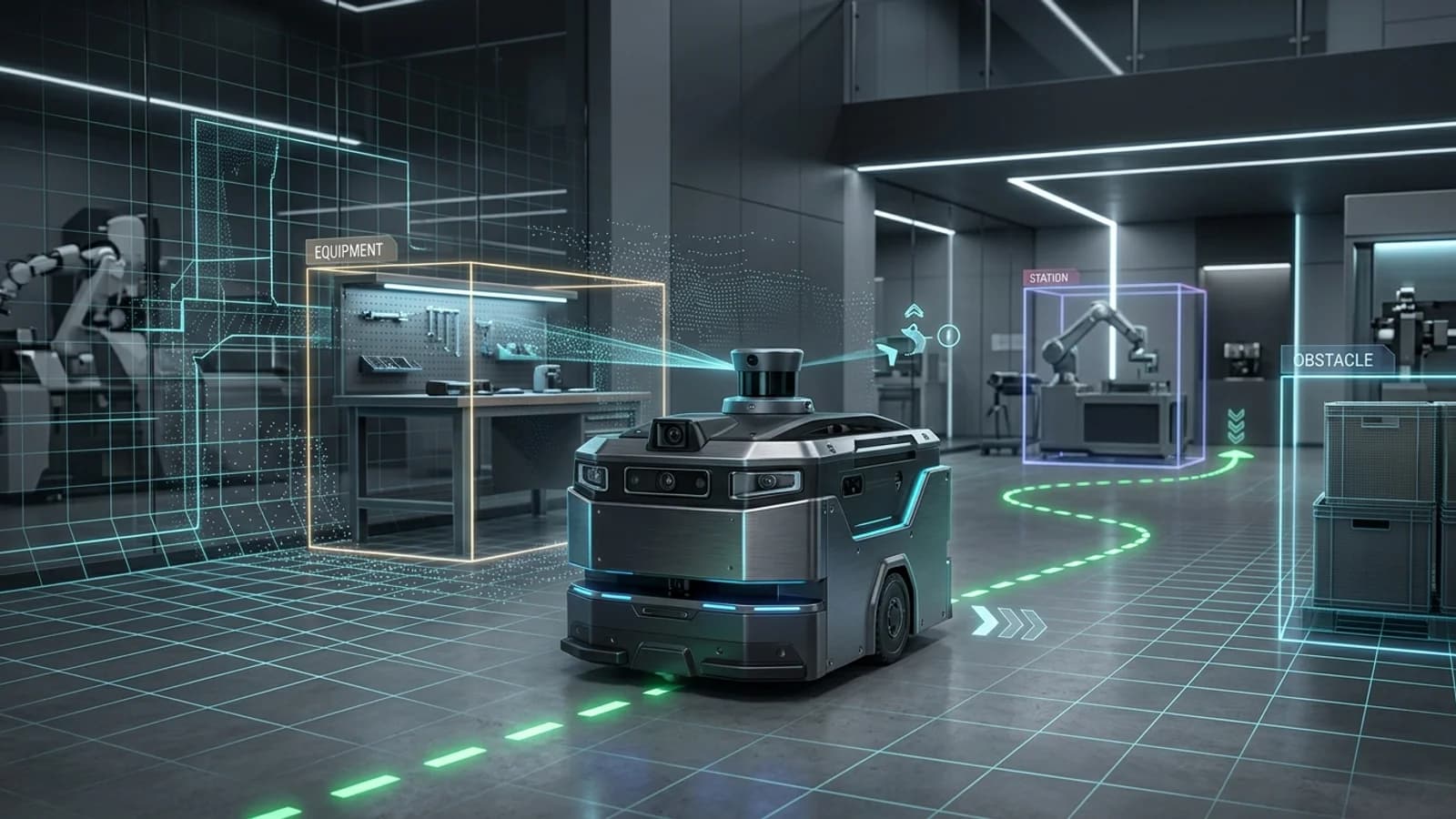
How Autonomous Robots Understand Their Environment
AI & Robotics
Autonomous robots are designed to operate in environments where they cannot rely entirely on predefined instructions. To function effectively, they need to understand what is happening around them, identify important objects and obstacles, determine their position, and continuously respond to changes in their surroundings.
This understanding comes from a combination of sensors, artificial intelligence, computer vision, and algorithms that allow robots to collect and interpret information from the physical world. Instead of simply following a fixed sequence of commands, an autonomous robot can process new information and use it to decide what action should be taken next.
At the core of this process is perception. Sensors provide the robot with information about its environment, while AI systems transform that raw data into meaningful information. Cameras can help identify objects and recognize visual patterns, while technologies such as LiDAR, ultrasonic sensors, and other sensing systems can help the robot detect distance, obstacles, and changes in its surroundings.
In simple terms: autonomous robots understand their environment by collecting information through sensors, interpreting that information with AI, and using the resulting understanding to make decisions and navigate the world around them.
Robot Perception
Sensors That Help Robots Understand Their Environment
Autonomous robots rely on multiple types of sensors to collect information about the world around them. Each sensor provides a different type of data, and combining these sources allows a robot to build a more complete understanding of its surroundings.
| Sensor | What It Detects | Common Use |
|---|---|---|
| Camera | Objects, colors, shapes, movement, and visual patterns | Object recognition and computer vision |
| LiDAR | Distance and three-dimensional information | Mapping and obstacle detection |
| Ultrasonic Sensor | Distance to nearby objects | Short-range obstacle detection |
| IMU | Motion, orientation, and acceleration | Position and movement estimation |
| GPS | Geographic position | Outdoor navigation and positioning |
A single sensor usually cannot provide everything a robot needs. For this reason, autonomous systems often combine information from several sensors. This process, known as sensor fusion, helps the robot make more reliable decisions even when individual sensors have limitations.
Why Multiple Sensors Matter
Imagine a robot moving through a busy environment. A camera may recognize a person, while LiDAR can estimate the person's distance and an IMU can provide information about the robot's own movement. Combining these signals gives the robot a more complete picture of what is happening around it.
AI Perception
How Robots Process Sensor Data
Sensors provide autonomous robots with large amounts of raw information, but collecting data is only the first step. A robot must process this information and convert it into a meaningful representation of the environment before it can make reliable decisions.
Artificial intelligence and robotics algorithms help transform raw sensor measurements into useful information. The robot can identify objects, estimate distances, recognize movement, determine its position, and understand how different elements in the environment relate to one another.
01
Collect
Sensors continuously collect information about objects, distance, movement, position, and other environmental conditions.
02
Interpret
AI and perception algorithms analyze the collected data to identify objects, patterns, obstacles, and important changes in the environment.
03
Understand
The robot combines the processed information to build an internal understanding of its surroundings and determine what is happening around it.
Perception Pipeline
From Raw Data to Environmental Understanding
The perception process can be viewed as a continuous pipeline in which information moves from physical sensors to intelligent interpretation.
Sensors
→
Raw Data
→
AI Processing
→
Understanding
This process happens continuously as the robot moves through its environment. New sensor information can update the robot's understanding, allowing it to respond when objects move, obstacles appear, or the surrounding conditions change.
Computer Vision
How Computer Vision Helps Robots See the World
Computer vision gives autonomous robots the ability to extract meaningful information from images and video. Instead of treating camera input as simple pictures, a robot can use AI models to identify objects, recognize patterns, estimate movement, and understand important features of its surroundings.
01
Object Detection
The robot can identify important objects such as people, vehicles, tools, walls, or other obstacles in its environment.
02
Object Recognition
AI models can classify detected objects and help the robot understand what those objects represent.
03
Scene Understanding
Computer vision can help a robot understand the structure of a scene and determine how different objects are positioned relative to each other.
04
Motion Detection
By analyzing changes between observations, robots can detect movement and respond to objects or people that change position.
From Camera Input to Robot Understanding
A simplified view of how visual information can move through a robot's perception system.
Camera Input
The camera captures images or video from the robot's surroundings.
Visual Processing
Computer vision algorithms process the visual information and extract
useful features.
AI Analysis
AI models analyze the extracted information to recognize objects,
patterns, and relevant environmental conditions.
Robot Response
The resulting information can be passed to navigation and
decision-making systems so the robot can choose an appropriate action.
Key idea: computer vision does not simply give a robot a camera. It helps transform visual data into information that other robotic systems can use for navigation, planning, and decision-making.
Mapping & Localization
How Robots Build Maps and Locate Themselves
Understanding the environment is not only about detecting objects. An autonomous robot also needs to know where it is and how its current position relates to the surrounding environment. Mapping and localization allow the robot to create a representation of its surroundings while estimating its own position within that environment.
One of the important approaches used in autonomous robotics is Simultaneous Localization and Mapping, commonly known as SLAM. SLAM allows a robot to build or update a map while simultaneously estimating its location within that map.
01
Localization
Localization estimates the robot's current position and orientation relative to its environment. This information helps the robot determine where it is before choosing where to move.
02
Mapping
Mapping creates a representation of the environment using information collected from sensors. The map can contain walls, obstacles, landmarks, pathways, and other important features.
The SLAM Process
Building an Understanding While Moving
01
Sense
Sensors collect information about nearby objects and environmental features.
02
Estimate
Algorithms estimate the robot's movement and current position.
03
Map
Environmental information is incorporated into an evolving map.
04
Update
New observations continuously refine the robot's understanding.
Why Localization and Mapping Matter
Navigation: the robot needs an environmental reference to determine where it can move safely.
Path Planning: knowing the environment helps the robot calculate routes toward specific destinations.
Obstacle Avoidance: environmental maps can help the robot recognize areas that should be avoided.
Autonomous Operation: accurate localization and mapping reduce the robot's dependence on constant human guidance.
Key idea: an autonomous robot needs both a map of its environment and an estimate of its own position within that environment. Together, mapping and localization provide an important foundation for intelligent navigation.
Computer Vision
How Computer Vision Helps Robots See the World
Computer vision gives autonomous robots the ability to extract meaningful information from images and video. Instead of treating camera input as simple pictures, a robot can use AI models to identify objects, recognize patterns, estimate movement, and understand important features of its surroundings.
01
Object Detection
The robot can identify important objects such as people, vehicles, tools, walls, or other obstacles in its environment.
02
Object Recognition
AI models can classify detected objects and help the robot understand what those objects represent.
03
Scene Understanding
Computer vision can help a robot understand the structure of a scene and determine how different objects are positioned relative to each other.
04
Motion Detection
By analyzing changes between observations, robots can detect movement and respond to objects or people that change position.
From Camera Input to Robot Understanding
A simplified view of how visual information can move through a robot's perception system.
Camera Input
The camera captures images or video from the robot's surroundings.
Visual Processing
Computer vision algorithms process the visual information and extract
useful features.
AI Analysis
AI models analyze the extracted information to recognize objects,
patterns, and relevant environmental conditions.
Robot Response
The resulting information can be passed to navigation and
decision-making systems so the robot can choose an appropriate action.
Key idea: computer vision does not simply give a robot a camera. It helps transform visual data into information that other robotic systems can use for navigation, planning, and decision-making.
The Bigger Picture
The Future of Autonomous Robot Perception
Autonomous robots are becoming increasingly capable of understanding complex environments by combining sensors, computer vision, mapping, localization, and artificial intelligence. These technologies allow robots to move beyond simple predefined instructions and respond more intelligently to changing conditions in the real world.
As AI models become more capable, robotic perception is expected to become more accurate, adaptive, and efficient. Future autonomous systems may be able to interpret their surroundings at a deeper level, understand complex situations, and make better decisions while operating alongside humans.
01
Better Perception
More capable AI and improved sensors can help robots recognize and interpret increasingly complex environments.
02
Greater Autonomy
Robots can increasingly combine perception, navigation, and decision making to perform tasks with less direct human intervention.
03
Real-World Adaptation
Future robots will need to operate reliably in environments that are dynamic, unpredictable, and shared with people.
Final Takeaway
Perception Is the Foundation of Autonomous Robotics
An autonomous robot cannot make intelligent decisions without first understanding the environment around it. Sensors provide the data, computer vision interprets visual information, mapping and localization provide spatial awareness, and AI brings these capabilities together to support intelligent action.