01
Computer Vision
Helps robots identify objects, people, movement, surfaces, and spatial relationships.
Discover how AI is enhancing robots' capabilities, making them smarter and more adaptive in various industries.
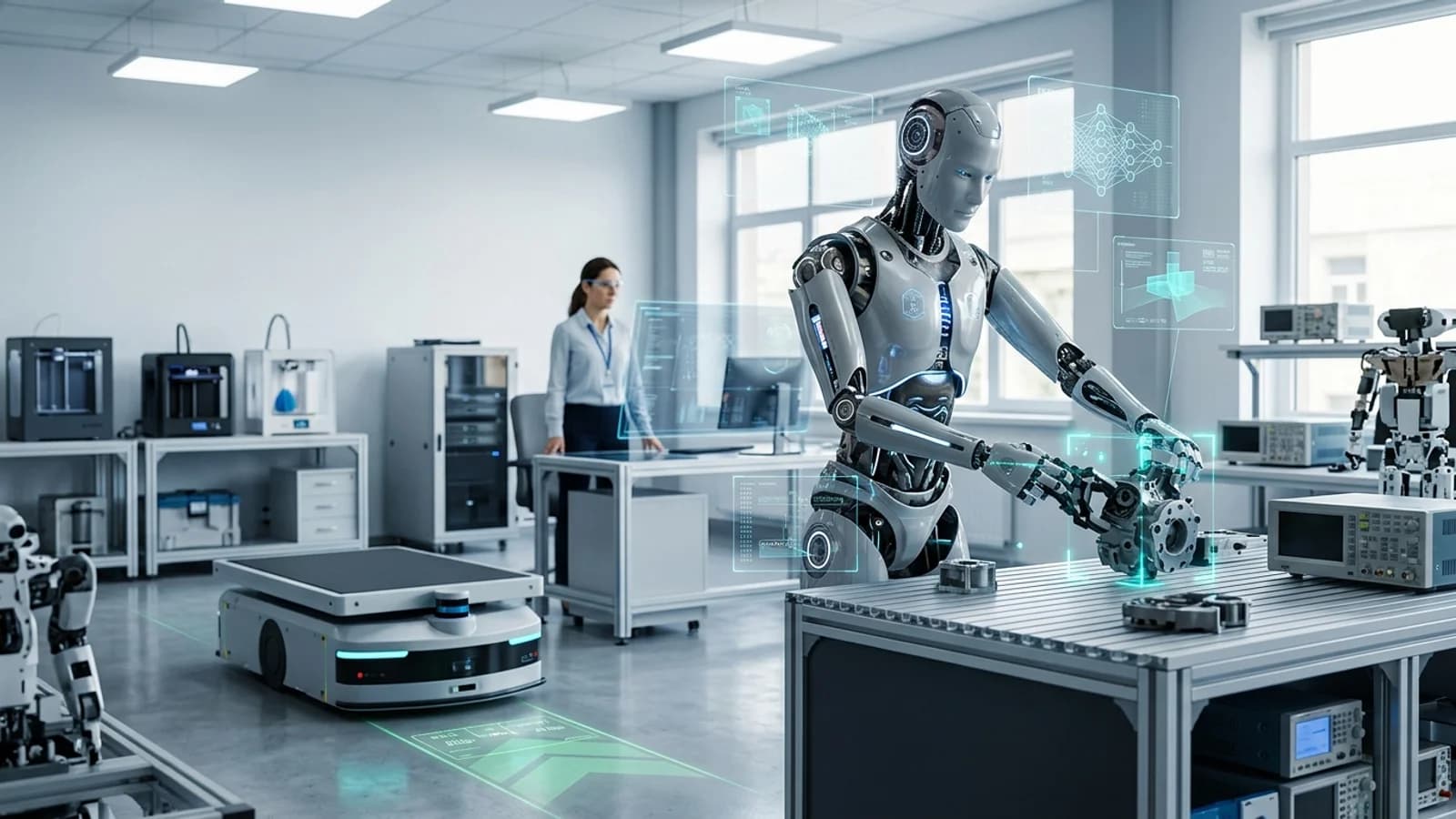
How Artificial Intelligence Is Making Robots Smarter
AI & Robotics
Artificial intelligence is transforming robotics by giving machines the ability to understand their surroundings, process information, recognize patterns, make decisions, and perform tasks with greater flexibility.
Traditional robots are generally designed to perform predefined actions. Modern AI-powered robots can combine computer vision, machine learning, natural language processing, sensor data, and intelligent decision-making to respond to changing environments.
This evolution is creating a new generation of robots that are more adaptive, autonomous, and capable of working alongside humans across manufacturing, healthcare, logistics, agriculture, research, and other industries.
Key Idea
AI does not simply make robots faster. It helps robots understand information, evaluate situations, and determine what action should happen next.
AI & Robotics
AI-powered robots are robotic systems that use artificial intelligence to perceive information, analyze their surroundings, make decisions, and perform tasks with greater flexibility.
Unlike traditional robots that typically execute predefined instructions, AI-powered robots can process information and adapt their behavior based on what they observe.
Artificial intelligence gives robots capabilities such as computer vision, machine learning, natural language understanding, pattern recognition, and intelligent decision-making.
Helps robots understand information collected from cameras, microphones, lidar, and other sensors.
Allows robotic systems to identify patterns from data and improve specific capabilities.
Enables robots to evaluate information and select appropriate actions.
Converts decisions into physical actions through robotic control systems.
Robotics Comparison
One of the most important differences between traditional and AI-powered robots is how they respond to information. Traditional robotic systems often depend heavily on predefined instructions, while AI-powered systems can interpret data and adapt their behavior.
| Capability | Traditional Robot | AI-Powered Robot |
|---|---|---|
| Decision-Making | Mostly predefined rules | AI-assisted decisions |
| Environment | Usually predictable | Can handle changing conditions |
| Learning | Limited | Machine-learning based |
| Perception | Basic sensor processing | AI-based perception |
| Adaptability | Generally limited | Greater adaptability |
Robot Perception
A robot cannot make useful decisions unless it can first understand what is happening around it. AI improves this process by allowing robots to interpret information collected through cameras, microphones, lidar, touch sensors, and other devices.
Helps robots identify objects, people, movement, surfaces, and spatial relationships.
Allows robots to process spoken commands and interact with people through natural language.
Combines information from multiple sensors to create a more reliable representation of the environment.
Real-World Example
A warehouse robot can use cameras and other sensors to recognize shelves, detect obstacles, identify packages, and navigate toward a destination.
Machine Learning
Machine learning allows robots to identify patterns in data instead of depending entirely on manually written rules. This can improve object recognition, prediction, planning, navigation, and control.
Sensors and robotic systems collect information about the environment and previous operations.
Machine-learning models analyze data and identify useful patterns.
The system can estimate possible outcomes or future situations.
The robot evaluates possible actions based on its objective.
The selected action is converted into physical movement.
Additional data can help improve future performance.
Computer Vision
Computer vision enables robots to analyze visual information and transform images or video into useful data. It is one of the most important AI technologies behind modern robotic perception.
Object Detection
Identifies objects within a camera frame and determines where they are located.
Scene Understanding
Helps robots understand the structure and context of an environment.
Object Tracking
Allows robots to monitor moving objects and changing situations.
Human-Robot Interaction
Advances in natural language processing and modern AI models are making human-robot interaction more natural. Instead of requiring users to understand complex robotic commands, intelligent robots can increasingly interpret ordinary language.
A user can provide a high-level instruction. An AI system can interpret the instruction, determine the intended task, break it into smaller steps, and communicate the required actions to the robot.
Intelligent Decision-Making
Intelligence in robotics is not only about seeing or recognizing objects. A robot must also determine what action should happen next. AI can help robotic systems evaluate situations, predict possible outcomes, and select actions according to defined objectives.
| Stage | Robot Question | AI Capability |
|---|---|---|
| Perception | What is happening? | Computer vision and sensors |
| Reasoning | What does it mean? | AI models and reasoning systems |
| Planning | What should I do? | Planning and optimization |
| Control | How should I perform it? | Robotic control systems |
Advanced AI
Reinforcement learning is an approach in which an agent learns to make decisions by interacting with an environment and receiving feedback about its actions. It is particularly useful for studying complex sequential decision-making problems in robotics.
The robot receives information about its current environment and internal state.
The learning system selects an action based on its current policy.
Feedback helps the system evaluate whether an action moved it toward its objective.
Industrial Robotics
Manufacturing is one of the major areas where robotics and artificial intelligence are being combined. AI can help industrial robots inspect products, recognize objects, optimize processes, detect anomalies, and adapt to changing production requirements.
Computer vision can help identify defects and irregularities.
AI models can analyze equipment data to identify potential problems.
Intelligent systems can recognize and handle different objects.
AI can help identify ways to improve robotic workflows.
Healthcare Robotics
AI is also expanding the capabilities of robots used in healthcare. Depending on the application, intelligent robotic systems can assist with rehabilitation, logistics, surgical systems, monitoring, and other carefully controlled tasks.
Intelligent systems can assist rehabilitation programs by adapting certain robotic interactions to user needs.
Autonomous robots can assist with movement of supplies and materials within controlled environments.
Robotic systems can support clinicians in specialized medical procedures under human supervision.
AI-enabled systems can process sensor information and support monitoring workflows.
Logistics & Warehousing
Warehouses contain constantly changing conditions, including moving workers, packages, vehicles, shelves, and inventory. AI can help robots navigate these environments, identify objects, optimize routes, and coordinate tasks.
Perceive
Locate
Plan
Navigate
Deliver
Agricultural Robotics
Agriculture provides another important use case for intelligent robotics. AI can help robotic systems analyze crops, identify objects, navigate fields, and support precision agriculture tasks.
Vision systems can analyze plants and field conditions.
Computer vision can distinguish crops from unwanted vegetation.
Robots can use sensors and AI to navigate agricultural environments.
Generative AI
Generative AI introduces another layer of intelligence to robotics by enabling systems to work with natural language, multimodal information, and higher-level task descriptions.
Natural Language
Users can describe a desired task using natural language instead of manually specifying every low-level action.
Multimodal AI
Modern models can potentially combine language, images, sensor information, and other forms of data for richer task understanding.
Autonomous Systems
Autonomy means that a robotic system can perform some tasks with limited direct human control. AI contributes to autonomy by supporting perception, localization, planning, decision-making, and adaptation.
Step 1
Collect information from the environment.
Step 2
Interpret the available information.
Step 3
Select an appropriate action.
Step 4
Execute the action through the robot.
Benefits
Combining artificial intelligence with robotics can provide several advantages, particularly in environments where tasks require perception, adaptation, prediction, or complex decision-making.
AI can help robots respond to conditions that were not completely specified in advance.
AI-based vision and sensor processing can improve environmental understanding.
Intelligent planning can help optimize certain robotic workflows.
Natural-language interfaces can make some robotic systems easier to interact with.
AI can analyze large amounts of information to support decisions.
Learned models and software can potentially be adapted across different robotic applications.
Challenges
Despite rapid progress, combining AI with physical robots remains a technically challenging problem. Robots must operate in the physical world, where mistakes can have consequences and environments can be unpredictable.
| Challenge | Why It Matters | Example |
|---|---|---|
| Reliability | AI decisions need to be dependable. | Unexpected environmental conditions |
| Safety | Physical systems must operate safely around people. | Human-robot collaboration |
| Data | High-quality training and evaluation data can be difficult to obtain. | Rare physical situations |
| Computing | Advanced AI models can require substantial computational resources. | Real-time robotic inference |
Future of Robotics
The future of robotics is likely to involve deeper integration between artificial intelligence, sensors, robotics hardware, simulation, and increasingly capable foundation models.
Robots will continue improving their ability to understand complex environments.
Human-robot communication may become increasingly natural through language and multimodal interfaces.
Robots may perform increasingly complex tasks with less direct intervention.
AI models and physical robotic systems will increasingly be designed as integrated intelligent systems.
Technology Stack
Modern intelligent robots are not powered by a single AI technology. They typically combine multiple layers of hardware and software.
Cameras, lidar, microphones, force sensors, touch sensors, and other devices collect information from the physical environment.
Computer vision and other AI models interpret raw sensor information.
Planning systems determine possible actions and paths toward a goal.
Control systems translate high-level decisions into physical movement.
Frequently Asked Questions
An intelligent robot can use AI and sensor information to perceive its environment, interpret situations, make decisions, and perform appropriate actions.
AI can improve robotic perception, recognition, planning, decision-making, natural-language interaction, and adaptation.
Not necessarily. Some robots use machine-learning systems that can improve from data, while others rely on models trained beforehand and carefully engineered software.
Common technologies include machine learning, computer vision, reinforcement learning, natural language processing, planning, sensor fusion, and increasingly generative and multimodal AI.
AI-powered robotics is being explored and deployed across manufacturing, logistics, healthcare, agriculture, research, transportation, and other industries.
Conclusion
Artificial intelligence is changing robotics from systems that primarily execute predefined instructions into systems that can increasingly perceive, interpret, plan, and respond to their environments.
Technologies such as computer vision, machine learning, reinforcement learning, natural language processing, sensor fusion, and generative AI are expanding what robots can understand and accomplish.
The most important development is not simply that robots are becoming more powerful. It is that robots are becoming more capable of operating in environments where conditions change and tasks require intelligent decisions.
Final Takeaway
The future of robotics will increasingly depend on the combination of intelligent software, capable hardware, reliable sensors, and safe decision-making systems. AI is becoming one of the key technologies responsible for that transformation.
AI + Robotics
Artificial intelligence and robotics solve different parts of the same problem. Robotics provides the physical body, sensors, motors, and control systems, while AI provides software-based capabilities for perception, learning, reasoning, planning, and decision-making.
When these technologies are integrated, a robot can collect information from the physical world, interpret that information, determine an appropriate response, and execute an action through its hardware.
Sensors collect information from the physical environment.
AI models interpret images, sounds, sensor data, and other inputs.
The system evaluates the current situation and possible responses.
A planning system determines how the robot should achieve its goal.
Motors and actuators execute the selected physical action.
| Robotics Component | Main Responsibility | AI Contribution |
|---|---|---|
| Sensors | Collect information | Interprets sensor information |
| Computing | Processes information | Runs AI models and algorithms |
| Planning | Determines possible actions | Supports intelligent decision-making |
| Actuators | Produce physical movement | Receives commands generated by higher-level systems |
Important Distinction
AI does not replace the physical components of a robot. Instead, it provides intelligent software capabilities that work together with sensors, computing hardware, control systems, motors, and actuators.
Real-World Example
Consider a mobile warehouse robot that needs to move a package from one location to another. Instead of following one completely fixed sequence, an intelligent system can continuously process information about its environment and adjust its behavior.
The system receives a destination or package-handling objective.
Cameras and other sensors collect information about shelves, packages, people, and obstacles.
AI-based perception systems help identify relevant objects and understand the robot's surroundings.
Planning algorithms determine a suitable route while considering the available environment information.
The control system converts the planned behavior into movement through the robot's motors and actuators.
The Intelligence Loop
The important concept is that intelligent robotics is often a continuous loop: perceive → understand → plan → act → observe again. This allows a robot to respond to new information instead of treating the environment as completely static.
AI Infrastructure
AI-powered robots often need to process information quickly. Sending every sensor reading to a remote server can introduce network latency and may not always be practical. Edge computing addresses this challenge by allowing some AI workloads to run closer to the robot.
By processing information locally or near the physical device, robotic systems can reduce dependence on continuous cloud connectivity and respond more quickly to certain environmental changes.
Lower Latency
Local processing can reduce the time required to send data to a remote service and receive a response.
Connectivity
Some robotic functions can continue operating locally when network connectivity is limited.
Data Processing
Sensor data can be processed closer to where it is generated.
| Processing Approach | Where Processing Happens | Typical Advantage |
|---|---|---|
| Cloud Computing | Remote data centers | Access to substantial computing resources |
| Edge Computing | Near the robot or local device | Lower latency for suitable workloads |
| On-Device AI | Directly on robotic hardware | Local inference and reduced network dependence |
Simulation & Training
Training and testing robots directly in the physical world can be expensive, slow, and difficult to scale. Simulation provides a controlled environment where robotic systems can be tested across many different scenarios.
AI models can be trained or evaluated using simulated environments before selected capabilities are deployed to physical robots. This approach can help developers explore navigation, manipulation, perception, and control problems more efficiently.
Simulation
Physical Robot
Sim-to-Real
A major challenge is transferring skills learned in simulation to the physical world. Differences between simulated and real environments can affect how well a trained model performs, making real-world validation an important part of robotics development.
Robot Learning
Another important direction in intelligent robotics is learning from demonstrations. Instead of manually programming every movement, developers can provide examples of how a task should be performed and use those demonstrations as training information.
A human demonstrates a desired task or behavior.
Relevant movement, sensor, or interaction data is collected.
AI techniques can use the collected examples to learn patterns.
The resulting system can be evaluated on related situations.
| Approach | Main Idea | Potential Benefit |
|---|---|---|
| Manual Programming | Developers explicitly define behavior. | Precise control over known tasks. |
| Learning From Demonstration | Robot learns from example behavior. | Can reduce some manual task specification. |
Multimodal AI
Robots interact with the physical world through many forms of information. They may receive visual observations, spoken instructions, sensor measurements, spatial information, and task-related data at the same time.
Multimodal AI is designed to work across multiple types of information. This creates opportunities for robotic systems to connect language and perception with higher-level task planning.
Images and video
Human instructions
Speech and sounds
Physical measurements
Position and environment
Multimodal Intelligence
By combining different inputs, an AI system can potentially build a richer understanding of a task and its surrounding environment.
Collaboration
One of the most important applications of intelligent robotics is collaboration between people and machines. AI can help robots understand objects, recognize activities, interpret instructions, and respond to changing situations.
Collaboration Model
The goal is not necessarily to remove humans from the process. In many applications, the more useful approach is to combine human judgment and supervision with the physical capabilities and computational assistance of intelligent robots.
Safety & Responsible AI
AI-powered robots operate in the physical world, which makes safety an especially important consideration. An AI model that performs well in a software environment still needs careful validation before being trusted with physical actions.
01
Systems need extensive testing across relevant operating conditions.
02
Robot behavior should be monitored during operation.
03
Appropriate applications may require human supervision or intervention.
04
Systems should be designed to handle failures and unexpected conditions safely.
Important
Greater autonomy does not automatically mean greater reliability. Intelligent robots still require appropriate engineering, testing, safeguards, monitoring, and operational constraints.
Key Takeaways
Computer vision and sensor-processing systems help robots interpret their surroundings.
Learning-based approaches can help robots improve specific perception, prediction, and control capabilities.
Perception, planning, and decision-making can work together to support greater robot autonomy.
AI needs sensors, computing hardware, control systems, motors, and actuators to interact with the physical world.
The Big Picture
The future of intelligent robotics depends on bringing together AI models, reliable perception, efficient computing, advanced control, physical hardware, and responsible system design.
Future of Robotics
The future of robotics is increasingly connected to advances in artificial intelligence. As AI models become more capable at understanding visual, language, spatial, and sensor-based information, robots may become better at performing tasks in environments that are less predictable than traditional industrial settings.
The long-term direction is not simply about making robots move faster. It is about creating robotic systems that can understand goals, interpret their surroundings, plan actions, learn from experience, and interact with people more naturally.
Future robots may be designed to handle a broader range of tasks rather than being limited to one highly specific operation.
Advances in language and multimodal AI could make it easier for people to communicate high-level instructions to robots.
Learning from demonstrations, simulation, and real-world feedback may help reduce the amount of manual programming required for some tasks.
Computer vision and multimodal sensing can help robots build richer representations of objects, spaces, and activities.
AI-based planning and reasoning systems may allow robots to make more context-aware decisions within defined operational boundaries.
Robots may increasingly work alongside people in environments where flexibility, assistance, and physical automation are valuable.
| Robotics Today | Emerging Direction | Potential Impact |
|---|---|---|
| Task-specific automation | More flexible task execution | Robots may operate across a wider variety of tasks |
| Fixed or structured environments | Greater environmental awareness | Better operation in changing environments |
| Explicit programming | Learning-based approaches | Potentially faster adaptation to new tasks |
| Limited interaction | Multimodal interaction | More natural human-robot communication |
Future Outlook
The biggest shift may be from robots that are primarily programmed to perform predefined actions toward systems that can understand a goal, reason about their environment, and select appropriate actions. However, achieving reliable physical intelligence remains a significant engineering challenge.
Challenges
Although artificial intelligence is making robots more capable, building reliable AI-powered robots is considerably more difficult than building an AI system that operates only in software. Robots must deal with real-world uncertainty, physical constraints, safety requirements, hardware limitations, and changing environments.
Physical environments contain unexpected objects, movements, lighting conditions, surfaces, and other variables.
AI systems need to produce dependable behavior when the robot encounters situations that differ from its training data.
Advanced AI models can require significant computing resources, which can be difficult to provide on mobile or compact robots.
Developing learning-based robotic systems can require large and diverse datasets, demonstrations, or simulation experiences.
Sensors, batteries, processors, motors, and mechanical components place practical limits on robot capabilities.
AI behavior must be carefully evaluated before robots can safely operate around people or in sensitive environments.
| Challenge | Why It Matters | Development Focus |
|---|---|---|
| Uncertainty | Real environments rarely behave exactly as expected. | Robust perception and planning |
| Latency | Delayed decisions can affect physical behavior. | Efficient inference and edge computing |
| Safety | Physical actions can have real-world consequences. | Testing, monitoring, safeguards, and validation |
| Generalization | Training environments do not represent every real-world situation. | Diverse data, simulation, and real-world evaluation |
Industry Applications
AI-powered robotics is being explored across a wide range of industries. The exact role of AI depends on the environment, task requirements, robot hardware, and level of autonomy needed.
Intelligent robots can support inspection, assembly, material handling, and other industrial workflows.
Robotics can assist with logistics, rehabilitation, research, and selected clinical or support tasks.
AI can support crop monitoring, navigation, inspection, and agricultural automation.
Autonomous mobile robots can assist with movement and organization of goods inside warehouses and distribution environments.
Intelligent robots can support inventory-related tasks, navigation, delivery, and customer-facing services in selected environments.
AI robotics provides platforms for studying perception, manipulation, navigation, learning, and physical intelligence.
AI contributes to perception, navigation, planning, and decision-making in autonomous and semi-autonomous systems.
Autonomous robotic systems can help explore environments where direct human control is difficult or delayed.
| Industry | Example AI Capability | Robotic Role |
|---|---|---|
| Manufacturing | Vision and inspection | Automated production tasks |
| Healthcare | Perception and navigation | Assistance and logistics |
| Agriculture | Image analysis | Monitoring and field automation |
| Logistics | Navigation and planning | Warehouse movement and handling |
Final Thoughts
Artificial intelligence is changing robotics by giving machines stronger capabilities for perception, learning, planning, decision-making, and interaction. Instead of relying only on fixed instructions, modern robots can increasingly use information from sensors and AI models to respond to changing environments.
From manufacturing and logistics to healthcare, agriculture, research, and exploration, AI-powered robots are opening new possibilities for physical automation. Technologies such as computer vision, machine learning, multimodal AI, simulation, edge computing, and intelligent planning are helping developers build increasingly capable robotic systems.
However, smarter robots also require careful engineering. Reliability, safety, computing requirements, data quality, real-world testing, and responsible deployment remain important challenges. The future of robotics will therefore depend not only on more powerful AI models, but also on robust hardware, reliable control systems, effective testing, and thoughtful human oversight.
Final Takeaway
The combination of artificial intelligence and robotics represents a major step toward more intelligent physical systems. As AI and robotic hardware continue to advance, robots may become more capable of understanding their surroundings, working with people, and performing increasingly complex real-world tasks.
Perceive
Understand the environment through sensors and AI.
Decide
Analyze information and select appropriate actions.
Act
Use robotic hardware to perform physical tasks.

Editor in Chief
Software engineer and full-stack developer building modern digital experiences, products, and ideas.
codewithtabish.comReady to do everything better? Get daily tips, tricks, and tech guides from our expert team.
By clicking Sign Up, you confirm you are 16+ and agree to our Terms of Service and Privacy Policy.
Have fun. Be respectful. Feel free to criticize ideas, but not people.