Computer Vision
Computer vision allows robots to interpret visual information. A robot can identify objects, recognize people, estimate distances, and detect changes in its surroundings, giving it a better understanding of the physical world.
Discover how AI is revolutionizing robotics, enabling machines to learn, adapt, and perform tasks with autonomy across various industries.
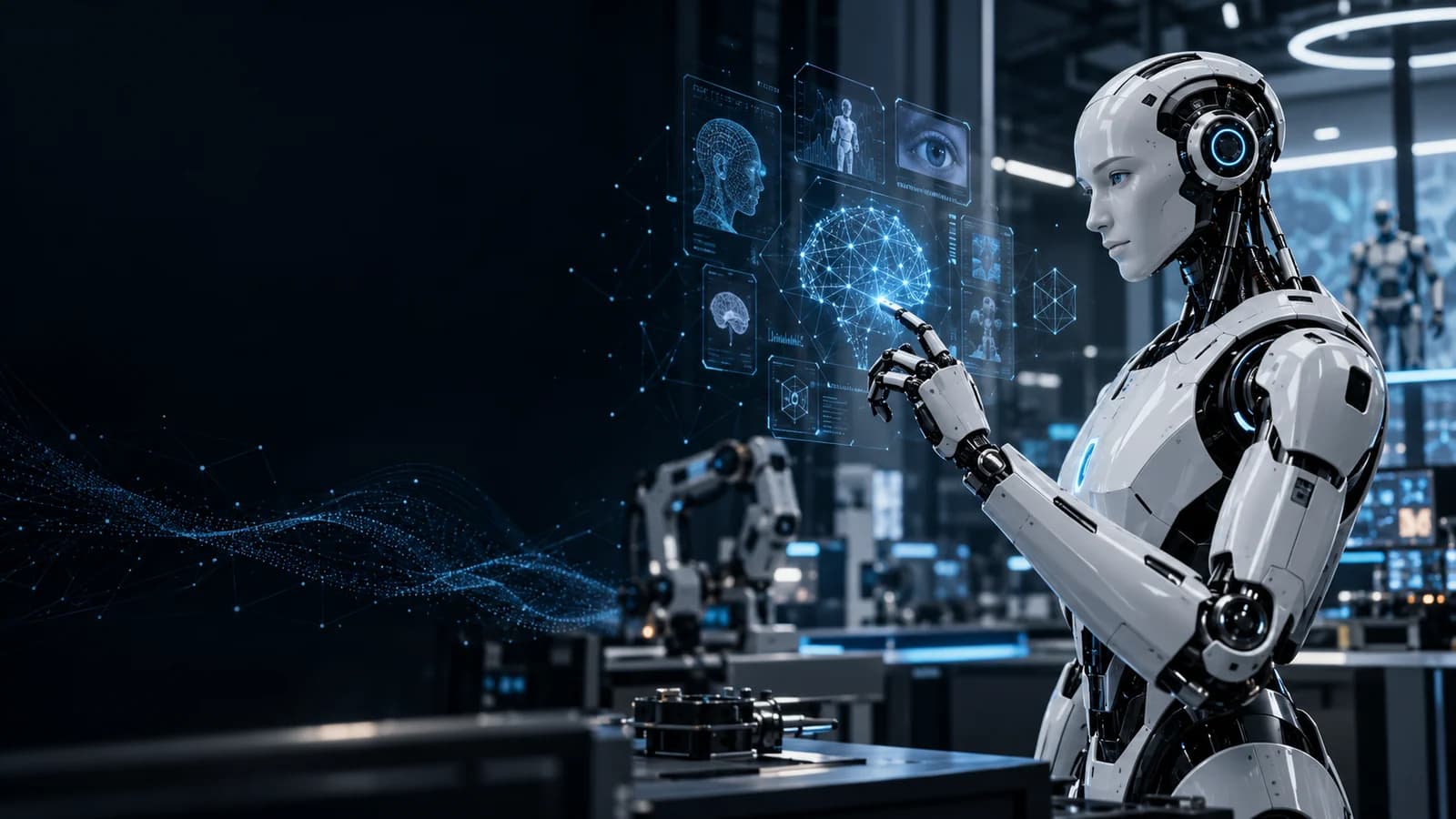
AI Robotics: How Artificial Intelligence Is Transforming the Future of Robots
AI & Robotics
AI robotics is the combination of artificial intelligence and robotics to create machines that can perceive their surroundings, learn from data, make decisions, and perform tasks with increasing levels of autonomy. Unlike traditional robots that typically follow a fixed set of instructions, AI-powered robots can use technologies such as machine learning, computer vision, natural language processing, and sensor data to adapt to changing environments.
This shift is transforming robots from programmable machines into increasingly intelligent systems. A modern robot can recognize objects, understand its environment, plan movements, respond to unexpected situations, and improve its performance over time. These capabilities are opening new possibilities across manufacturing, healthcare, logistics, agriculture, transportation, and everyday consumer applications.
At its core, AI gives robots the ability to interpret information and make decisions, while robotics gives that intelligence a physical form. Together, they are creating a new generation of intelligent machines that can interact with the real world in ways that were previously difficult or impossible to achieve.
In simple terms: traditional robots follow instructions, while AI-powered robots can interpret information, make decisions, and adapt their behavior based on what they encounter.
The Technology Behind It
Artificial intelligence gives robots the ability to process information and respond to the world around them. Instead of relying entirely on predefined instructions, AI-powered robots can combine data from cameras, microphones, lidar, touch sensors, and other inputs to understand their environment and determine what to do next.
Computer vision allows robots to interpret visual information. A robot can identify objects, recognize people, estimate distances, and detect changes in its surroundings, giving it a better understanding of the physical world.
Machine learning enables robots to learn patterns from data and improve their performance. Rather than programming every possible situation, developers can train AI models to recognize patterns and make predictions from previous examples.
Intelligent robots often combine information from multiple sensors to build a more reliable understanding of their surroundings. Combining cameras, lidar, proximity sensors, and other inputs can help robots navigate complex environments more safely and accurately.
AI can help robots evaluate different actions and choose an appropriate response. This is especially important for autonomous robots operating in environments where conditions can change and a fixed sequence of instructions is not enough.
These technologies work together as part of a broader robotic intelligence system. Perception helps a robot understand what is happening, AI models interpret that information, and control systems translate decisions into physical actions. The result is a robot that can operate with greater flexibility and autonomy.
Real-World Applications
AI robotics is already being used in environments where machines need to perceive physical objects, navigate changing conditions, or perform repetitive and precision-sensitive tasks. The technology is not limited to humanoid robots. Autonomous mobile robots, robotic arms, warehouse systems, drones, surgical robots, and agricultural machines are all becoming more capable as AI models improve.
The most practical applications tend to be areas where robots can operate in structured environments or where their ability to work continuously provides a clear advantage. In many cases, AI is not replacing the entire workflow. Instead, it is improving a specific part of a process, such as perception, navigation, inspection, planning, or quality control.
01
Manufacturing has been one of the most established areas for robotics. AI is extending the capabilities of industrial robots by helping them identify objects, detect defects, adapt to variations in production, and perform more flexible tasks. Vision-guided robotic systems can inspect products and adjust their movements based on what they detect.
This is particularly useful when production lines handle different products or when tasks require more flexibility than traditional rule-based automation can provide.
02
Warehouses are another major application for intelligent robots. Autonomous mobile robots can move inventory through facilities, transport goods, and navigate around people and other machines. AI can help these systems plan routes, recognize obstacles, and coordinate movement across increasingly complex environments.
Instead of simply following predetermined paths, modern warehouse robots can use real-time sensor information to adjust their behavior as the environment changes.
03
Healthcare robotics includes surgical systems, rehabilitation devices, hospital delivery robots, and research platforms. AI can assist these systems with tasks such as image analysis, movement planning, and navigation. In medical settings, however, intelligent automation must operate under strict safety, reliability, and regulatory requirements.
This means AI is generally used to assist trained professionals and improve precision or efficiency rather than simply replacing human decision-making.
04
Agriculture presents a challenging environment for robotics because fields are less predictable than factories or warehouses. AI-powered agricultural robots can use cameras and other sensors to identify crops, weeds, and changing field conditions. Autonomous machines can then assist with tasks such as monitoring, harvesting, and targeted treatment.
These systems have the potential to reduce waste and labor requirements while allowing farmers to collect more detailed information about their crops.
Across these industries, the most important change is not simply that robots are becoming more powerful. It is that they are becoming better at operating with less direct human instruction. AI allows robotic systems to interpret sensor data, respond to uncertainty, and adapt their actions to the environment. That shift is gradually expanding the range of tasks that robots can perform outside tightly controlled industrial settings.
The Next Generation
For decades, most industrial robots operated within carefully controlled environments. Their movements were predictable because the machines were programmed to perform specific tasks under specific conditions. That approach remains highly effective, but it becomes much harder to apply when robots have to operate around people, unfamiliar objects, and constantly changing environments.
Artificial intelligence is changing that model. Instead of defining every possible action in advance, engineers can build systems that allow robots to interpret their surroundings and select appropriate actions. This is helping robotics move from rigid automation toward more adaptive forms of autonomy.
An autonomous robot first needs to understand what is happening around it. Cameras, lidar, microphones, force sensors, and other hardware provide raw information about the physical environment. AI models can process this information to identify objects, estimate positions, recognize patterns, and detect changes.
Understanding an environment is only part of the problem. A robot also needs to decide what to do with that information. Planning and control systems can translate an AI-generated understanding of the environment into physical actions, such as moving toward an object, avoiding an obstacle, or changing a planned route.
Physical environments contain far more variation than a conventional software application. Objects can appear in unexpected positions, surfaces can change, and people can move unpredictably. Training and evaluation across diverse scenarios can help robotic systems become more capable of handling this variability.
This perception–decision–action cycle is at the heart of autonomous robotics. The closer AI systems get to reliably completing this loop in unpredictable environments, the more useful robots can become outside the controlled settings where traditional automation has historically dominated.
A Practical Example
The difference between a conventional automated machine and an AI-powered robot becomes clearer when looking at a simple decision cycle. Imagine a mobile robot moving through a warehouse. Its sensors detect an obstacle in front of it, the system interprets that information, and the robot must decide whether to stop, turn, or choose another route.
The example below is intentionally simplified, but it represents the basic logic behind a much larger robotics pipeline. Real systems combine sensor hardware, perception models, planning algorithms, safety constraints, and low-level motor controllers to turn environmental data into physical movement.
// Simplified robot sensor data
const sensors = {
  obstacleDistance: 0.8,
  pathClear: false,
};

if (!sensors.pathClear && sensors.obstacleDistance < 1.0) {
  console.log("Obstacle detected — choosing a new path.");
} else {
  console.log("Path is clear — continue moving.");
}01
Sensors provide information about the robot's surroundings, such as distance to nearby objects, visual features, position, and movement.
02
Software and AI models process that information to determine what is happening and which environmental details matter for the task.
03
Planning and control systems turn the decision into an action, allowing the robot to continue, stop, change direction, or select another route.
In a production robot, this process is considerably more sophisticated than the simplified example above. AI models may interpret camera feeds, estimate the position of objects, predict how people or machines might move, and evaluate multiple possible actions before a controller sends commands to the robot's motors. The important idea is the same: intelligent robotics connects perception and decision-making with physical action.
Why this matters
AI does not make a robot intelligent simply by adding a language model or another software component. The real challenge is building a reliable system that can connect perception, reasoning, planning, and physical control while operating safely in the real world.
The Hard Part
Giving a robot the ability to act autonomously is considerably harder than teaching it to perform a specific task. The physical world is unpredictable, sensors are imperfect, and even a small mistake can have consequences when a machine is operating around people, equipment, or valuable materials. AI can improve a robot's ability to understand and respond to these conditions, but it does not eliminate the underlying engineering challenges.
Reliable autonomous robotics requires several systems to work together at the same time. A robot must perceive its surroundings accurately, interpret incomplete information, make decisions quickly enough to be useful, and execute those decisions through physical hardware. A weakness in any one of these stages can affect the behavior of the entire system.
01
Sensors do not provide a perfect representation of reality. Cameras can be affected by poor lighting, lidar can produce incomplete measurements, and objects may be partially hidden or difficult to distinguish from their surroundings. A robot therefore has to make decisions using information that may be noisy, incomplete, or uncertain.
This is one reason why perception remains such an important part of autonomous robotics. A system that misunderstands the environment can make a perfectly reasonable decision based on incorrect information. Improving perception is therefore not simply about recognizing more objects; it is about building a sufficiently reliable representation of the environment for the task the robot needs to perform.
02
Autonomous robots frequently have to choose an action before they know exactly what will happen next. A warehouse robot may encounter a person blocking its planned route. A delivery robot may find that a previously accessible path is no longer available. An agricultural machine may encounter conditions that were not represented in its training data.
The system must balance competing objectives such as efficiency, safety, accuracy, and the likelihood of success. In practical robotics, this often means combining AI models with planning algorithms, explicit constraints, and conventional control systems rather than expecting a single model to make every decision.
03
Safety becomes especially important when robots operate alongside people. An autonomous system cannot be evaluated only by how often it completes its intended task. Engineers also need to consider how it behaves when something goes wrong, when sensor information is unreliable, or when a person behaves differently from what the system expects.
A useful distinction
Autonomy is not the same as unrestricted independence. In many real-world systems, the safest design combines autonomous behavior with predefined limits, monitoring, human oversight, and reliable fallback mechanisms.
04
AI models can perform extremely well in the conditions represented by their training and evaluation data, yet physical environments constantly produce situations that are difficult to anticipate. Small changes in lighting, object placement, surfaces, weather, or human behavior can create new conditions for a robot to handle.
This makes real-world testing and evaluation essential. A capable robotic system needs to be tested across diverse environments and failure scenarios, not only under ideal conditions. The objective is not simply to make the robot perform well when everything goes according to plan, but to understand how it behaves when reality deviates from that plan.
These challenges explain why progress in AI robotics is measured differently from progress in purely digital AI. A model can generate an impressive response in milliseconds, but a physical robot must turn intelligence into safe and repeatable action. Closing that gap between software capability and dependable physical behavior remains one of the central challenges in the development of autonomous robots.
The Intelligence Stack
An autonomous robot is not powered by a single AI model. Its behavior emerges from several layers of technology working together, from physical sensors and perception systems to planning software and motor controllers. Each layer has a different responsibility, and the reliability of the complete system depends on how well those layers interact.
This architecture also explains why robotics is more demanding than building software that only operates in a digital environment. Information has to move continuously between the physical world and the software controlling the machine. A robot must sense what is happening, understand it quickly enough to matter, choose an appropriate response, and then execute that response through hardware.
The Core Robotics Intelligence Stack
Each layer contributes a different part of the perception-to-action pipeline.
| Layer | Main Responsibility | Typical Technologies |
|---|---|---|
|
01
Sensing
|
Collect information about the physical environment and the robot's own position or movement. | Cameras, lidar, radar, microphones, force sensors, proximity sensors |
|
02
Perception
|
Convert raw sensor measurements into useful information about objects, people, locations, and environmental conditions. | Computer vision, object detection, localization, segmentation, sensor fusion |
|
03
Planning
|
Determine what the robot should do next and select a suitable sequence of actions. | Path planning, motion planning, optimization, decision models |
|
04
Control
|
Translate planned actions into precise physical movements and continuously adjust those movements using feedback. | Motor controllers, feedback loops, actuators, joint control |
|
05
Safety
|
Detect unsafe conditions and constrain, interrupt, or stop robot behavior when necessary. | Safety limits, collision detection, watchdogs, emergency stops, human oversight |
The exact architecture varies by robot, but these layers commonly work together to connect environmental perception with physical action.
The first stage begins with physical sensors. Cameras capture visual information, lidar measures distances, microphones capture sound, and other sensors can provide information about touch, force, orientation, or movement. On their own, these measurements do not provide a complete understanding of the environment.
Perception systems transform those measurements into information that higher-level software can use. Instead of working directly with thousands of raw camera pixels, a planning system might receive a structured representation showing that a person is nearby, an object is blocking the current route, or a particular area is safe to navigate.
Once the robot has a useful representation of its environment, it needs to determine what action should come next. Planning systems consider the robot's current position, its destination, obstacles, physical limitations, and other constraints before selecting a possible course of action.
AI can contribute to this process by helping a robot interpret complex situations or predict what might happen next. However, planning is often combined with explicit rules and optimization methods because physical systems need predictable constraints around speed, movement, collision avoidance, and safety.
A decision is useful only when the robot can execute it reliably. Control systems take a planned movement and convert it into commands for motors, wheels, joints, or other actuators. Feedback from the robot's sensors can then be used to determine whether the movement is occurring as expected.
This creates a continuous feedback loop rather than a simple sequence of commands. The robot acts, observes the result, updates its understanding of the environment, and adjusts its behavior when necessary. That feedback is fundamental to operating in a physical world where conditions can change from one moment to the next.
As these layers become more capable and better integrated, robots can handle increasingly complex environments without requiring a human to specify every individual action. The next step is understanding how these capabilities are changing the kinds of work robots can perform and where the technology is most likely to have its greatest impact.
The Robotics Landscape
AI-powered robots are not a single category of machine. They range from industrial arms that work inside controlled factories to mobile systems that navigate warehouses, autonomous machines that operate outdoors, and humanoid robots designed to interact with environments built for people. What these systems share is the use of AI to interpret information, make decisions, or adapt their behavior rather than relying entirely on fixed instructions.
The differences between these robots are largely determined by where they operate, what they need to accomplish, and how much autonomy the task requires. Understanding these categories makes it easier to see where AI is already practical and where robotics is still an active engineering challenge.
01
Industrial robots are widely used for tasks such as assembly, welding, painting, material handling, and inspection. AI can make these systems more flexible by helping them recognize objects, detect variations, inspect products, and adjust their behavior when production conditions change.
Unlike conventional automation, which may depend on precisely positioned parts and predictable inputs, AI-assisted industrial systems can use vision and other sensor information to respond to greater variation.
02
Autonomous mobile robots, or AMRs, move through environments such as warehouses, distribution centers, hospitals, and industrial facilities. They use sensors and software to understand their surroundings, determine routes, avoid obstacles, and move materials without requiring a person to control every movement.
Their usefulness comes from combining mobility with perception and navigation. Instead of following one permanently fixed route, an AMR can respond to changes in its environment and select another path when conditions require it.
03
Service robots are designed to perform useful tasks outside traditional industrial settings. Examples include robotic vacuum cleaners, delivery systems, hospitality robots, and machines designed to assist people in homes or public spaces.
These environments are often less predictable than factories. AI can therefore help service robots recognize objects, understand locations, interact with people, and adapt their behavior to changing surroundings.
04
Agricultural robots operate in environments where terrain, weather, vegetation, and object locations can vary significantly. AI can help these machines identify crops and weeds, analyze visual information, navigate fields, and support tasks such as monitoring, harvesting, and targeted treatment.
Outdoor autonomy is particularly demanding because the environment cannot be controlled as tightly as a factory floor. Reliable perception and navigation are therefore central to making these systems useful.
05
Medical robotics includes surgical systems, rehabilitation devices, laboratory robots, and other specialized machines. AI can assist with perception, image analysis, planning, and precise movement, although medical applications require particularly strong validation, safety controls, and human oversight.
06
Aerial robots use AI for tasks such as visual inspection, mapping, navigation, object detection, and autonomous flight assistance. Their ability to operate above difficult terrain makes them useful for infrastructure inspection, surveying, agriculture, and other applications.
07
Humanoid robots are designed around a human-like body structure, often with two arms, two legs, and a torso. The goal is not simply appearance; a human-like form can allow a robot to operate in spaces, use tools, and interact with infrastructure originally designed for people.
These systems represent one of the more ambitious directions in robotics because they require perception, balance, manipulation, planning, and control to work together in highly dynamic environments.
As AI becomes more capable, the boundaries between these categories can also become less distinct. A warehouse robot can combine autonomous navigation with manipulation, a drone can use sophisticated perception to operate with limited supervision, and humanoid systems can combine language, vision, planning, and physical control. The common thread is the growing ability to connect digital intelligence with action in the physical world.
The Human Connection
The future of AI robotics is unlikely to be defined by robots simply replacing people. In many environments, the more practical direction is collaboration, where robots handle physical, repetitive, or hazardous tasks while people provide judgment, supervision, creativity, and domain expertise.
This model is already visible in industrial and professional settings. As robots become better at perception, navigation, manipulation, and decision-making, they can take responsibility for specific parts of a workflow while humans remain responsible for goals, exceptions, and decisions that require broader context.
01
Robots can perform repetitive physical tasks consistently and continuously. This can include moving materials, inspecting products, transporting goods, or performing operations that expose workers to unnecessary physical risk.
02
People remain important when situations require context, responsibility, creativity, or decisions that fall outside the robot's operating boundaries. Human oversight can also provide a critical safety layer when autonomous systems encounter unfamiliar conditions.
03
AI can help robots interpret instructions, understand their environment, and communicate information about what they are doing. This creates a more flexible interface between human intentions and physical machine behavior.
Fully autonomous operation is not always the best engineering choice. Some tasks are predictable enough for a robot to perform independently, while others benefit from a human remaining in the loop. Designing the boundary between autonomous action and human intervention is therefore an important part of deploying intelligent robotic systems.
A robot working alongside people must also account for human movement and behavior. Perception systems can help identify people and obstacles, while planning and control systems can maintain appropriate distances, adjust trajectories, or stop when a situation becomes unsafe.
Traditional automation often separates humans and machines: the robot performs a predefined operation while people manage the surrounding workflow. AI robotics is gradually making that boundary more flexible. Robots can interpret changing conditions and operate closer to the way people actually work, provided that appropriate safety and control mechanisms are in place.
This shift could make robotics useful in a much wider range of environments. Instead of redesigning an entire workplace around a rigid machine, organizations can increasingly explore systems that adapt to existing workflows and assist people within them.
As AI robotics develops, the most important question may not be whether robots can work without humans, but how effectively humans and robots can divide responsibilities. That distinction will shape where autonomous machines are practical, how they are deployed, and what role people continue to play alongside them.
Further Reading
AI robotics brings together research and engineering disciplines that span artificial intelligence, computer vision, autonomous navigation, control systems, and physical robotics. The following sources provide useful starting points for exploring the technologies and concepts discussed throughout this article.
Selected Sources
Primary and technical resources for learning more about AI, robotics, and autonomous systems.
National Institute of Standards and Technology — Robotics
Research and technical work covering robotics, autonomous systems, measurement, and standards.
NASA — Robotics
Information about robotic systems used for exploration, scientific missions, and operation in challenging environments.
ROS — Robot Operating System
An open-source ecosystem and framework widely used for developing and integrating robotic software.
NVIDIA — Robotics
Technical resources covering AI-powered robotics, simulation, perception, and physical AI development.
Accessed for background research and technical context. Individual technologies and implementations can change as the field develops.
These resources complement the article's overview and provide deeper technical context for readers who want to explore the foundations of modern robotics and the growing role of artificial intelligence in physical systems.

Editor in Chief
Software engineer and full-stack developer building modern digital experiences, products, and ideas.
codewithtabish.comReady to do everything better? Get daily tips, tricks, and tech guides from our expert team.
By clicking Sign Up, you confirm you are 16+ and agree to our Terms of Service and Privacy Policy.
Have fun. Be respectful. Feel free to criticize ideas, but not people.