ARTICLE
Retrieval-Augmented Generation (RAG): How AI Systems Use External Knowledge
Explore how Retrieval-Augmented Generation enhances AI by integrating external knowledge for improved responses.
Sudais Azlan
23 min read
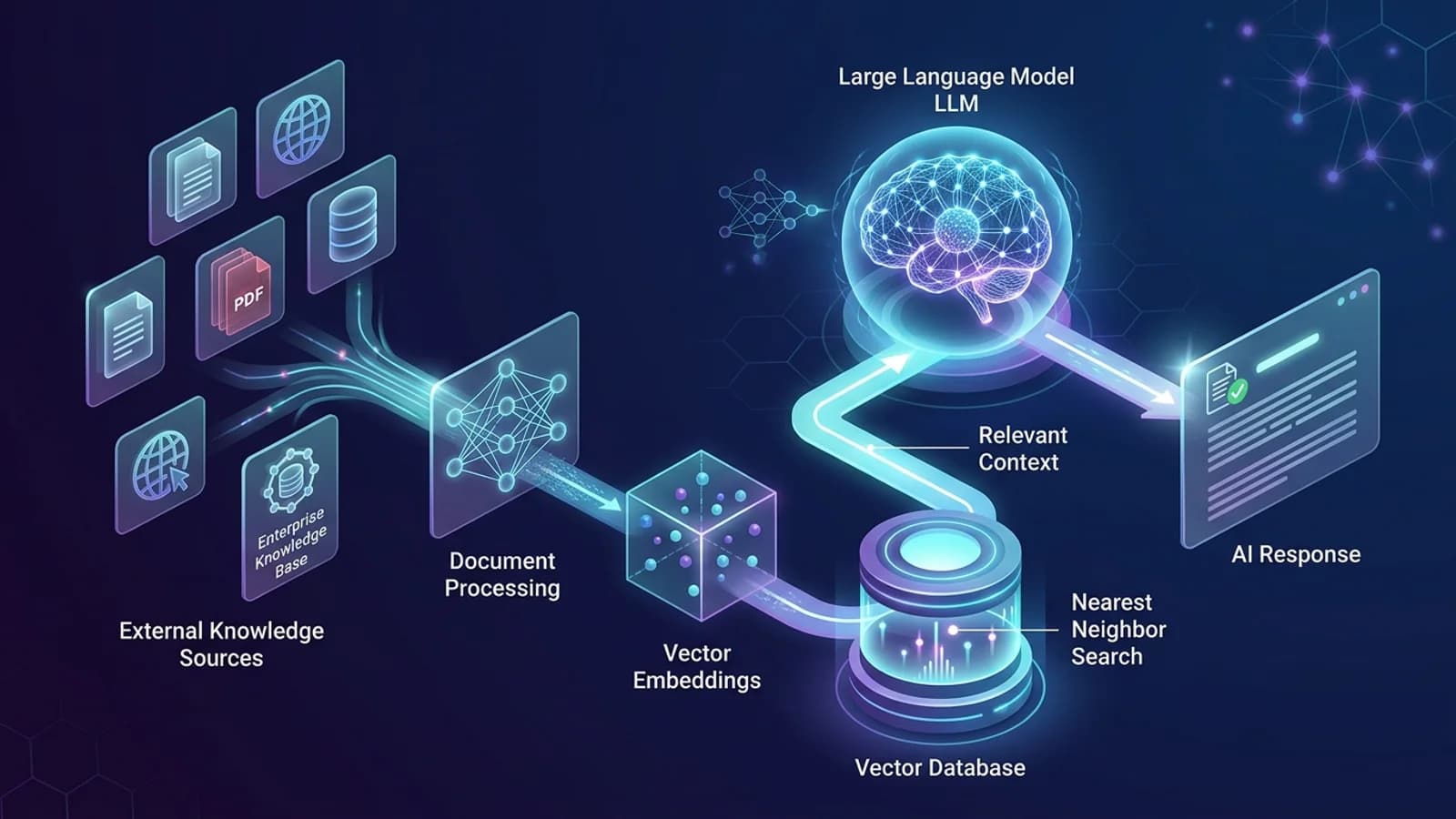
Retrieval-Augmented Generation (RAG): How AI Systems Use External Knowledge
Introduction to Retrieval-Augmented Generation
What Is Retrieval-Augmented Generation (RAG)?
Retrieval-Augmented Generation (RAG) is an AI architecture that combines information retrieval with large language models (LLMs). Instead of relying only on knowledge stored inside a model's parameters, a RAG system retrieves relevant information from external sources and provides that information to the language model before generating an answer.
This approach has become an important technique for building AI systems that need access to private documents, frequently updated information, technical documentation, organizational knowledge, and specialized datasets. RAG allows AI applications to use external knowledge without requiring the language model itself to contain every piece of information.
Core Concept
Retrieve Relevant Knowledge Before Generating an Answer
A typical RAG workflow can be summarized as: user query → retrieval → relevant context → LLM generation → answer. The retrieval stage supplies external knowledge that helps the model produce a more context-aware response.
Why RAG Matters
Why Do Modern AI Systems Need External Knowledge?
Large language models are trained on enormous datasets, but training does not automatically give a model access to every piece of information an organization needs. Knowledge can also change after training, especially in areas such as company policies, product documentation, research, regulations, and internal databases.
RAG addresses this limitation by connecting language models to external knowledge sources. Instead of attempting to encode every possible fact directly into model parameters, applications can retrieve relevant information at query time.
01
Fresh Information
External knowledge sources can be updated without retraining the entire language model.
02
Private Knowledge
Organizations can connect AI applications to internal documents and approved knowledge repositories.
03
Grounded Responses
Retrieved context can help the model generate answers that are more closely connected to the supplied source material.
RAG Architecture
How Does a Retrieval-Augmented Generation System Work?
A RAG pipeline usually contains several connected stages. Documents are prepared and divided into smaller chunks, transformed into numerical representations called embeddings, stored in a searchable system, and retrieved when a user submits a question.
01
Ingest
Collect documents, web pages, PDFs, databases, or other approved knowledge sources.
02
Index
Split information into useful chunks and create embeddings that represent their semantic meaning.
03
Retrieve
Search the indexed knowledge for content that is relevant to the user's question.
04
Generate
Provide retrieved context to the language model so it can generate a context-aware response.
Knowledge Ingestion
Document Ingestion: Preparing Knowledge for RAG
Before a RAG application can retrieve information, the knowledge source must be processed into a format that the retrieval system can efficiently search. This stage is commonly called document ingestion.
| Source | Processing | RAG Use Case |
|---|---|---|
| PDF documents | Text extraction and chunking | Document question answering |
| Web pages | Content extraction and cleaning | Knowledge search |
| Databases | Structured data retrieval | Enterprise AI applications |
| Internal documents | Parsing and indexing | Private knowledge assistants |
Text Chunking
Why Text Chunking Is Important in RAG
Large documents are rarely retrieved as a single block. RAG systems generally divide documents into smaller sections called chunks. Chunking makes it easier to locate specific information and provide the language model with focused context.
Fixed-Size Chunking
Splits text according to a defined character or token size. It is simple and useful for many baseline RAG systems.
Recursive Chunking
Attempts to preserve meaningful boundaries such as paragraphs, sentences, and other structural separators.
Semantic Chunking
Uses semantic relationships between passages to create chunks that are more closely aligned with their meaning.
Engineering Principle
Better chunking does not simply mean smaller chunks. The goal is to create retrieval units that contain enough context to answer a question without introducing unnecessary information.
Vector Embeddings
What Are Embeddings in a RAG Pipeline?
Embeddings convert text into numerical vectors that represent semantic information. When a user asks a question, the question can also be converted into an embedding. The system then compares the query vector with document vectors to identify semantically relevant content.
Document Embedding
Each indexed chunk is transformed into a vector representation and stored alongside its source information.
Query Embedding
The user's question is transformed into a vector so the retrieval system can search for semantically related chunks.
Vector Databases
How Vector Databases Support RAG Applications
Vector databases are commonly used to store embeddings and associated metadata so that relevant information can be retrieved efficiently. Instead of searching only for exact keywords, vector search can identify content based on semantic similarity.
| Component | Purpose |
|---|---|
| Vector | Numerical representation of text meaning |
| Metadata | Source, document, page, category, or other contextual information |
| Similarity Search | Finds vectors that are most relevant to a query vector |
Information Retrieval
How Does Retrieval Find the Right Information?
Retrieval is the central stage that connects a user's question with external knowledge. The retriever searches the indexed knowledge base and returns a selected number of relevant passages, often controlled by a parameter such as top-k.
User Query
→
Query Embedding
→
Similarity Search
→
Top-K Context
Retrieval Optimization
Reranking: Improving the Quality of Retrieved Context
Initial retrieval may return several potentially relevant passages, but they are not always equally useful. A reranking stage can evaluate the retrieved candidates more carefully and place the most relevant passages closer to the top of the context supplied to the language model.
STEP 01
Broad Retrieval
Retrieve a larger set of candidate passages from the knowledge base.
STEP 02
Relevance Scoring
Evaluate how strongly each candidate matches the user's query.
STEP 03
Context Selection
Pass the strongest results to the generation stage.
Advanced Retrieval
Hybrid Search Combines Semantic and Keyword Retrieval
Semantic vector search is powerful for understanding meaning, but exact terms can also be important. Hybrid retrieval combines semantic search with keyword-based techniques so that a RAG application can handle both conceptual questions and precise terms such as product names, identifiers, technical expressions, and error codes.
Semantic Search
Focuses on conceptual and semantic similarity between the query and stored content.
Keyword Search
Focuses on exact or lexical matches that may be critical for precise terminology.
RAG vs Fine-Tuning
RAG vs Fine-Tuning: What Is the Difference?
RAG and fine-tuning solve different problems. RAG primarily provides a model with external context at inference time, while fine-tuning changes model behavior by training it further on selected examples or datasets. Choosing between them depends on whether the goal is knowledge access, behavioral adaptation, or a combination of both.
| RAG | Fine-Tuning | Best Fit |
|---|---|---|
| Retrieves external information | Updates learned model behavior | Frequently changing knowledge |
| Knowledge can be updated through the retrieval layer | Requires additional training | Specialized behavior and output patterns |
| Useful for private knowledge bases | Useful for adapting model behavior | Sometimes both approaches are combined |
Accuracy and Reliability
Can RAG Reduce AI Hallucinations?
RAG can help reduce unsupported answers by supplying relevant source material to the language model. However, retrieval alone does not guarantee factual accuracy. Poor chunking, irrelevant retrieval, incomplete sources, incorrect prompts, and model limitations can still produce unreliable responses.
A Reliable RAG System Requires More Than a Vector Database
- High-quality source documents
- Appropriate chunking strategies
- Effective retrieval and ranking
- Clear generation instructions
- Source attribution and evaluation
Real-World Applications
Real-World Use Cases of Retrieval-Augmented Generation
RAG is especially useful when an AI application needs to answer questions using a defined collection of external information. This makes the architecture valuable across enterprise, education, research, customer support, software development, and knowledge-management applications.
Enterprise Search
Search internal documentation, policies, reports, and company knowledge through natural-language questions.
Customer Support
Ground support assistants in product documentation and approved troubleshooting information.
Research Assistants
Retrieve relevant passages from research papers, reports, and specialized knowledge collections.
Document AI
Enable users to interact with large collections of PDFs, manuals, contracts, and other documents.
RAG Evaluation
How Do Engineers Evaluate a RAG System?
Building a RAG pipeline is only the beginning. Production systems need evaluation to determine whether retrieval returns useful information and whether the generated answer accurately reflects that information.
Retrieval Quality
Measures whether relevant documents and passages are being retrieved.
Answer Relevance
Measures whether the generated response actually addresses the user's question.
Faithfulness
Measures whether the generated answer is supported by the retrieved context.
Final Reflection
Retrieval-Augmented Generation Is Connecting AI Models to Real-World Knowledge
Retrieval-Augmented Generation represents an important shift in how intelligent applications use large language models. Instead of expecting a model to contain every piece of knowledge internally, RAG allows an AI system to retrieve relevant information from external sources and use it as context during response generation.
The strength of RAG comes from the combination of multiple engineering components: reliable data ingestion, thoughtful chunking, high-quality embeddings, efficient retrieval, reranking, strong prompting, and careful evaluation. Each component influences the quality of the final AI experience.
01
External Knowledge
RAG connects language models with information that exists outside their internal model parameters.
02
Retrieval Matters
The quality and relevance of retrieved context strongly influence the quality of the generated response.
03
RAG Is Not Perfect
Retrieval can improve grounding, but system design and evaluation are still essential for reliable AI applications.
04
Production Requires Engineering
Scalable RAG applications require careful attention to data quality, latency, security, evaluation, and user experience.
| Traditional LLM Application | RAG-Powered AI Application | Long-Term Direction |
|---|---|---|
| Primarily relies on model knowledge | Uses retrieved external context | AI systems connected to dynamic knowledge sources |
| Knowledge updates may require additional model work | Knowledge can often be updated through the retrieval layer | More maintainable knowledge-driven applications |
| Limited access to private organizational information | Can retrieve approved private documents and databases | More capable enterprise AI systems |
| Generation without application-specific context | Generation grounded in retrieved information | More context-aware AI assistants and agents |
Final Takeaway
The Future of AI Will Be Connected to Knowledge
Retrieval-Augmented Generation is more than a technique for searching documents. It is an architectural approach for connecting powerful language models with information that is specific, private, current, and relevant to a particular application.
As AI applications become more sophisticated, RAG can serve as a foundation for knowledge assistants, enterprise search systems, research tools, customer-support applications, document intelligence, and agentic AI workflows. The strongest systems will not depend on the language model alone; they will combine capable models with high-quality retrieval, trustworthy data, robust evaluation, and responsible engineering.
Advanced RAG Architecture
How Advanced RAG Architectures Improve AI Knowledge Retrieval
Basic Retrieval-Augmented Generation systems can retrieve relevant documents and provide them to a large language model, but production AI applications often require more sophisticated retrieval strategies. Advanced RAG architectures introduce query transformation, filtering, reranking, metadata awareness, contextual compression, and evaluation mechanisms to improve the quality of retrieved knowledge.
The objective is not simply to retrieve more information. A well-designed RAG architecture should retrieve the right information, preserve the necessary context, minimize irrelevant content, and provide the language model with evidence that is useful for answering the user's question.
Advanced Retrieval Pipeline
User Query
→
Query Processing
→
Hybrid Retrieval
→
Reranking
→
Context Selection
→
LLM Response
01
Query Transformation
The original user question can be rewritten or expanded into a form that is easier for the retrieval system to search effectively.
02
Metadata Filtering
Metadata such as document type, date, category, department, or source can narrow the search space before semantic retrieval.
03
Contextual Compression
Retrieved passages can be reduced to the most useful information, helping minimize unnecessary context before generation.
04
Hybrid Retrieval
Semantic and lexical search can work together to improve retrieval across conceptual questions and exact terminology.
05
Reranking
Candidate documents can be reordered according to their relevance before they are passed to the language model.
06
Continuous Evaluation
Retrieval and generation quality can be evaluated continuously using representative questions and measurable quality signals.
| Basic RAG | Advanced RAG | Engineering Benefit |
|---|---|---|
| Direct query-to-vector search | Query rewriting and transformation | Better retrieval for complex questions |
| Single retrieval strategy | Hybrid and multi-stage retrieval | More robust search performance |
| Retrieved documents passed directly to the model | Reranking and contextual compression | Higher-quality context |
| Limited metadata usage | Metadata-aware retrieval | More precise information filtering |
Key Insight
Better RAG Is About Better Context, Not Simply More Context
One of the most important principles in RAG engineering is that increasing the amount of retrieved text does not automatically improve an AI system. Excessive or irrelevant context can make it harder for a language model to identify the information that actually matters. Advanced retrieval therefore focuses on selecting high-quality evidence that is directly connected to the user's question.
For production-grade RAG applications, retrieval quality should be treated as a core engineering problem. Strong indexing, intelligent search strategies, relevance ranking, context management, and systematic evaluation can work together to create more reliable knowledge-grounded AI systems.
RAG and Large Language Models
How RAG Works Together With Large Language Models
Retrieval-Augmented Generation becomes powerful when a retrieval system and a large language model work together. The retrieval layer is responsible for finding relevant external knowledge, while the language model uses that information to understand the question and generate a natural-language response.
This separation of responsibilities allows developers to build AI applications where the language model provides reasoning and language capabilities while the retrieval system provides application-specific knowledge. The result is an architecture that can be adapted to different domains without requiring the entire model to be retrained whenever the underlying knowledge changes.
AI
What the Language Model Does
- Understands the user's natural-language question.
- Interprets the retrieved information.
- Connects multiple pieces of context.
- Generates a natural-language response.
- Follows instructions provided by the application.
RAG
What the Retrieval Layer Does
- Searches external knowledge sources.
- Finds information related to the user's query.
- Applies filters and relevance ranking.
- Supplies useful context to the language model.
- Connects the model with application-specific information.
End-to-End Flow
From User Question to Knowledge-Grounded Answer
Step 01
User Query
The user submits a question in natural language.
Step 02
Retrieval
The system searches its external knowledge base.
Step 03
Context
Relevant passages are selected and added to the prompt.
Step 04
Generation
The LLM interprets the query and retrieved context.
Step 05
Response
The application returns a knowledge-grounded answer.
Context Construction
Retrieved Documents Become Part of the Model's Working Context
A RAG application normally constructs a prompt containing the user's question, relevant retrieved passages, and instructions describing how the model should use that information. The language model then processes this combined context when generating its response.
Conceptual Prompt Structure
System Instructions
+
Retrieved Context
+
User Question
↓
Large Language Model
↓
Generated Response
Important Engineering Consideration
The LLM Does Not Automatically Know Whether Retrieved Information Is Correct
Retrieval provides evidence, but the overall quality of the answer still depends on the quality of the retrieved documents, the prompt design, the model's ability to interpret context, and the application's evaluation process. A production RAG system should therefore treat retrieval, context construction, and generation as separate components that can each be tested and improved.
| Component | Primary Responsibility | Main Engineering Goal |
|---|---|---|
| Data Layer | Stores application knowledge | High-quality and trustworthy information |
| Retrieval Layer | Finds relevant information | High retrieval precision and recall |
| Context Layer | Organizes retrieved information | Relevant and efficient model context |
| LLM Layer | Interprets context and generates language | Relevant, coherent, and grounded responses |
RAG Data Pipeline
Building the RAG Data Pipeline: From Documents to Searchable Knowledge
A reliable Retrieval-Augmented Generation system begins long before a user asks a question. The underlying knowledge must first be collected, cleaned, transformed, divided into meaningful chunks, embedded, and indexed. This complete process is commonly referred to as the RAG data pipeline.
The quality of this pipeline directly affects retrieval quality and, ultimately, the accuracy of AI-generated responses. Even a powerful language model can produce weak answers when the knowledge base contains incomplete, duplicated, poorly structured, or irrelevant information.
RAG Data Flow
From Raw Data to AI-Ready Knowledge
Data Sources
→
Extraction
→
Cleaning
→
Chunking
→
Embeddings
→
Vector Index
01
Collect Data
Gather PDFs, websites, documentation, databases, reports, FAQs, manuals, and other approved sources of knowledge.
02
Extract Content
Convert source files and structured resources into text or structured information that downstream processing components can understand.
03
Clean the Data
Remove unnecessary formatting, duplicate content, broken text, irrelevant sections, and other noise that can reduce retrieval quality.
04
Create Chunks
Divide documents into meaningful sections while preserving enough surrounding context for accurate retrieval.
05
Generate Embeddings
Convert each chunk into a numerical vector representation that can be compared with future user queries.
06
Index Knowledge
Store embeddings, source content, and metadata in a searchable vector or hybrid retrieval system.
Data Quality Principle
Better Source Data Produces Better Retrieval
RAG quality is strongly influenced by the information entering the system. If source documents are outdated, duplicated, incomplete, or poorly extracted, retrieval may return weak context regardless of how sophisticated the vector database or language model is.
For production systems, data ingestion should therefore be treated as an ongoing engineering process rather than a one-time setup task. Knowledge sources may need validation, versioning, deduplication, metadata management, and scheduled updates.
| Data Source | Common Challenge | RAG Engineering Consideration |
|---|---|---|
| PDF Files | Complex layouts and extraction errors | Preserve document structure and useful metadata |
| Websites | Navigation elements and irrelevant content | Extract and clean the primary content |
| Databases | Structured and changing records | Use appropriate retrieval and synchronization strategies |
| Internal Documents | Access control and sensitive information | Apply permissions, metadata, and secure retrieval policies |
Metadata
Why Metadata Matters in RAG
Metadata can identify where a chunk came from and provide additional information such as document title, page number, date, category, author, department, or access level.
Maintainability
RAG Knowledge Bases Need Continuous Updates
When source information changes, the indexing pipeline should be able to identify affected content and update the knowledge base without unnecessarily rebuilding unrelated information.
Final Takeaway
A Strong RAG System Starts With a Strong Knowledge Pipeline
Retrieval-Augmented Generation is often described in terms of embeddings, vector databases, and language models, but the quality of the underlying data pipeline is equally important. A carefully designed ingestion process ensures that the information available to the retrieval system is clean, meaningful, searchable, and properly associated with its source metadata.
For engineers building production RAG applications, the data pipeline should be designed for accuracy, scalability, security, observability, and continuous updates. When these foundations are strong, retrieval systems can provide language models with better context and help create more useful knowledge-grounded AI applications.
RAG Security and Privacy
Security and Privacy Challenges in Retrieval-Augmented Generation
Retrieval-Augmented Generation can connect AI applications to private documents, enterprise databases, internal documentation, and other sensitive knowledge sources. This creates significant opportunities for organizations, but it also introduces security and privacy considerations that must be addressed before deploying a RAG system in production.
A secure RAG architecture must protect information throughout the entire pipeline, including document ingestion, storage, retrieval, prompt construction, model processing, logging, and response delivery. Security should therefore be treated as an architectural requirement rather than an additional feature added after development.
01
Data Access
Ensure users can retrieve only the documents and information they are authorized to access.
02
Data Protection
Protect documents, embeddings, metadata, credentials, and other sensitive information throughout the system.
03
Prompt Security
Prevent untrusted retrieved content from manipulating application instructions or influencing the system in unintended ways.
04
Monitoring
Monitor retrieval behavior, access patterns, errors, and unusual activity without unnecessarily exposing sensitive information.
Access Control
Retrieval Should Respect User Permissions
One of the most important security requirements for enterprise RAG is ensuring that retrieval does not expose information a user is not authorized to see. A document may be relevant to a question while still being inaccessible to the person asking it.
Permission-aware retrieval can use identity, roles, document metadata, department information, or other authorization attributes to restrict the search space before sensitive information reaches the language model.
| Security Risk | Potential Impact | Engineering Response |
|---|---|---|
| Unauthorized Retrieval | Users may receive information outside their permissions. | Apply authorization-aware filtering before retrieval. |
| Sensitive Data Exposure | Private information may appear in generated responses or logs. | Minimize sensitive data exposure and protect application logs. |
| Malicious Content | Untrusted documents may contain instructions that interfere with application behavior. | Validate sources and separate retrieved content from system instructions. |
| Excessive Logging | Debug information may unintentionally contain private content. | Use controlled logging and redact sensitive information where appropriate. |
Prompt Injection Awareness
Retrieved Content Should Be Treated as Untrusted Data
A RAG system may retrieve content from sources that were not originally written as AI instructions. If that content contains text designed to influence the model's behavior, the application may face prompt injection risks. Developers should therefore clearly separate system instructions from retrieved content and apply appropriate validation and access controls.
Security is especially important when RAG systems retrieve information from large collections of user-generated or externally sourced content. The retrieval layer should not automatically treat every retrieved sentence as a trusted instruction.
Data Minimization
Retrieve and process only the information necessary for the requested task whenever practical.
Controlled Access
Use authentication and authorization mechanisms to control access to protected knowledge sources.
Secure Operations
Protect databases, vector indexes, credentials, APIs, logs, and infrastructure used by the RAG application.
Final Takeaway
Secure RAG Requires Protection Across the Entire AI Pipeline
Retrieval-Augmented Generation can unlock valuable private and enterprise knowledge, but connecting an AI model to external data also increases the responsibility of the engineering team. Security controls must extend from data ingestion and vector storage to retrieval, context construction, model interaction, logging, and response delivery.
A production-ready RAG system should therefore be designed around least-privilege access, trustworthy data sources, secure infrastructure, careful monitoring, and privacy-aware data handling. When security is treated as a core part of the architecture, organizations can build knowledge-grounded AI systems with greater confidence and control.
RAG Performance and Scalability
How to Build Fast, Scalable, and Reliable RAG Systems
A Retrieval-Augmented Generation system may work well with a small collection of documents, but production environments introduce new engineering challenges. As the knowledge base grows and more users send queries simultaneously, retrieval latency, database performance, model response time, infrastructure costs, and system reliability become increasingly important.
Building scalable RAG applications therefore requires more than choosing a fast language model. Engineers must optimize the entire pipeline, from document indexing and vector search to context construction, model inference, caching, monitoring, and API infrastructure.
01
Retrieval Latency
Search should return relevant context quickly enough to support a responsive AI application.
02
Model Latency
The language model must process the query and retrieved context while maintaining an acceptable response time.
03
Infrastructure Cost
Embedding, storage, retrieval, inference, and network operations can all contribute to the overall cost of a RAG application.
04
Reliability
Production systems need monitoring, fault handling, recovery strategies, and predictable behavior under changing workloads.
Performance Pipeline
Every Stage Contributes to End-to-End Response Time
API Request
→
Query Processing
→
Retrieval
→
Context Construction
→
LLM Inference
→
Response
Optimize Retrieval
Use appropriate indexing methods, retrieval parameters, metadata filters, and search strategies to reduce unnecessary search work while maintaining useful recall.
Control Context Size
Sending excessive retrieved text to the language model can increase processing time and cost. Context should be selected carefully.
Use Caching Strategically
Frequently repeated operations may benefit from caching, reducing unnecessary computation and improving response speed.
Monitor the Pipeline
Track retrieval latency, model latency, errors, token usage, and response quality to identify performance bottlenecks.
| Challenge | Why It Matters | Common Engineering Approach |
|---|---|---|
| Large Knowledge Base | Searching more information can increase retrieval complexity. | Efficient indexes, filtering, and appropriate vector search. |
| High Query Volume | Concurrent users can increase infrastructure pressure. | Horizontal scaling, load balancing, and asynchronous processing. |
| Large Context | More tokens can increase model processing time and cost. | Reranking, compression, and context selection. |
| Repeated Queries | Identical or similar requests may repeatedly consume resources. | Query, retrieval, or response caching where appropriate. |
Observability
Measure the RAG Pipeline Before Optimizing It
Performance optimization is most effective when engineers can identify exactly where time and resources are being consumed. Monitoring should provide visibility into each major stage of the application rather than measuring only the final response time.
Retrieval Time
Measures how long the search stage takes.
Generation Time
Measures language-model response latency.
Token Usage
Helps identify context and generation costs.
Error Rate
Identifies failures across the application pipeline.
Final Takeaway
Scalable RAG Requires End-to-End Engineering
A RAG application becomes production-ready when it can deliver useful answers consistently while handling realistic workloads. This requires engineers to consider retrieval performance, model latency, context size, infrastructure capacity, caching, monitoring, and operational reliability as parts of one connected system.
The goal is not simply to make a RAG pipeline faster. A strong production architecture balances speed, retrieval quality, answer accuracy, infrastructure cost, security, and scalability. This balance allows organizations to move from experimental RAG prototypes toward dependable AI knowledge systems.
Final Reflection
Retrieval-Augmented Generation Is Connecting AI With the Knowledge It Needs
Retrieval-Augmented Generation represents an important architectural approach for building AI systems that can work with information outside the knowledge encoded in a language model. Instead of depending entirely on model training, RAG applications retrieve relevant information from external sources and provide that context to the model at response time.
This approach can make AI applications more useful for domain-specific knowledge, frequently changing information, internal documentation, enterprise search, customer support, research, and many other use cases. However, successful RAG systems depend on more than simply connecting a vector database to an LLM. Data quality, chunking, embeddings, retrieval, reranking, context management, security, evaluation, and system performance all contribute to the final result.
01
External Knowledge Matters
RAG allows AI applications to retrieve information from external knowledge sources when generating responses.
02
Retrieval Quality Is Critical
The quality and relevance of retrieved context strongly influence the usefulness of the generated answer.
03
RAG Is an Engineering System
Production RAG requires thoughtful data pipelines, retrieval strategies, model integration, evaluation, security, and monitoring.
04
Grounded AI Is the Goal
The objective is to provide language models with relevant evidence so applications can produce more useful and knowledge-grounded answers.
| Traditional LLM Application | RAG-Based AI Application | Long-Term Benefit |
|---|---|---|
| Primarily relies on model knowledge | Combines model capabilities with retrieved external knowledge | Better support for specialized information |
| Knowledge updates may require model changes | External knowledge can be updated independently | More flexible knowledge management |
| Limited direct connection to private data | Can retrieve authorized application-specific information | More useful enterprise and domain-specific applications |
| Generation-focused architecture | Retrieval plus generation architecture | More controllable knowledge-grounded workflows |
Final Takeaway
The Future of AI Is Not Only About Bigger Models
The development of modern AI systems is increasingly focused on how models interact with tools, data, applications, and external knowledge. Retrieval-Augmented Generation is an important part of this evolution because it provides a practical architecture for connecting language models with information that can be searched and updated outside the model itself.
For developers and AI engineers, understanding RAG means understanding the complete journey from data ingestion and document processing to retrieval, context construction, generation, evaluation, security, and deployment. When these components are designed together, RAG can become a strong foundation for building reliable, scalable, and knowledge-grounded AI applications.