ARTICLE
How Autonomous AI Systems Are Learning to Plan, Reason, and Take Action
Explore how autonomous AI systems learn to plan, reason, and take action effectively.
Sudais Azlan
32 min read
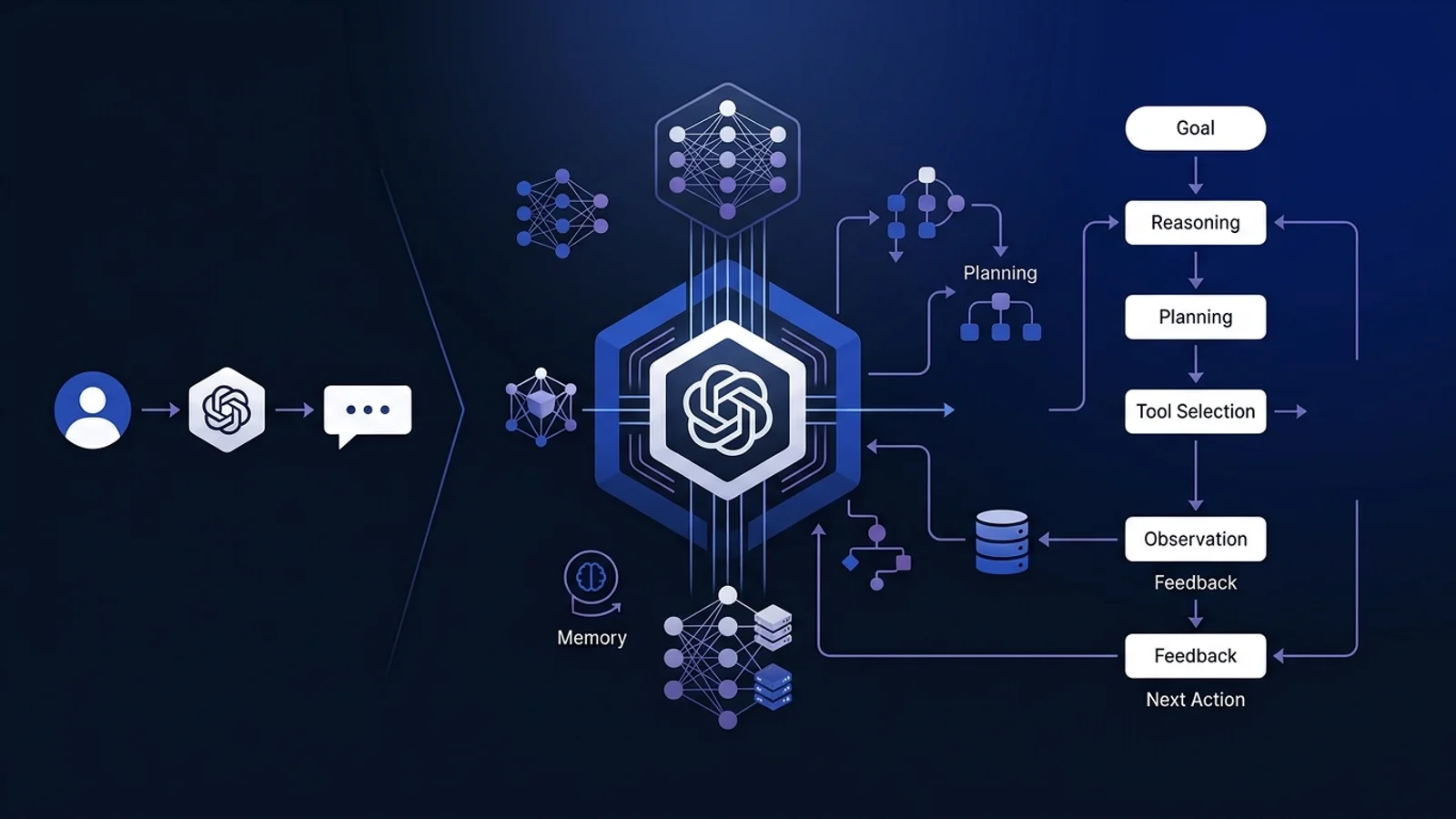
How Autonomous AI Systems Are Learning to Plan, Reason, and Take Action
AI & AI Research
What Are AI Agents?
AI agents are artificial intelligence systems designed to pursue goals by understanding a task, reasoning about what needs to be done, selecting appropriate actions, using available tools, observing the results, and adapting their behavior when necessary. Unlike conventional AI applications that typically produce a response after receiving a single input, an AI agent can operate through a continuous decision-making process in which the system determines what action should happen next based on the current state of the task.
Modern AI agents are commonly built around large language models or other foundation models that provide capabilities such as language understanding, reasoning, planning, and decision-making. However, the underlying model is only one component of an agentic system. A complete AI agent may also include memory, external tools, retrieval systems, APIs, execution environments, planning mechanisms, and feedback loops that allow the system to interact with information and software outside the model itself.
The defining characteristic of an AI agent is therefore not simply that it can generate text or answer questions. An agent is designed to take actions toward a goal. For example, instead of only explaining how to analyze a dataset, an AI agent could inspect the available data, select an appropriate analysis method, execute code, examine the results, identify potential problems, and continue working until it reaches a defined objective. This ability to connect reasoning with action is what distinguishes agent-based systems from many traditional AI applications.
| System | Primary Role | Typical Behavior |
|---|---|---|
| Traditional Software | Executes explicitly defined instructions and rules. | Follows predetermined logic for known inputs and conditions. |
| Traditional AI Model | Performs a specific prediction, classification, generation, or analytical task. | Usually receives an input and produces an output. |
| Language Model | Understands and generates language based on learned patterns and representations. | Generates responses, code, explanations, summaries, and other content from prompts. |
| AI Agent | Pursues a goal by reasoning, planning, selecting actions, and interacting with tools or environments. | Can perform multiple actions, observe results, and adapt its approach throughout a task. |
AI Agents Are More Than Large Language Models
It is important to distinguish an AI agent from the language model that may power it. A large language model can generate highly capable responses, but by itself it does not necessarily have persistent memory, access to external systems, the ability to execute actions, or an explicit mechanism for managing a long-running objective. An agentic architecture adds these capabilities around the model so that it can operate as part of a broader computational system.
This distinction becomes particularly important in practical AI engineering. A production-grade agent may need to retrieve information from a database, call an external API, execute a program, inspect a file, interact with a business application, or request additional information before it can complete a task. The language model can help determine what should happen, while the surrounding agent architecture provides the mechanisms required to actually perform those operations.
Core Principle
Goal
Define the objective
Reason
Determine what to do
Act
Use tools or take action
Observe
Examine the result
↓
Refine or Complete
Continue the task when the objective has not yet been achieved
Why AI Agents Matter in Modern AI Research
The growing interest in AI agents reflects a broader shift in artificial intelligence research: from systems that primarily generate information to systems that can use information to accomplish objectives. This shift combines several research areas, including reasoning, planning, memory, reinforcement learning, tool use, retrieval-augmented generation, and human-computer interaction.
Agentic systems are particularly promising for tasks that cannot be completed through a single model response. Software engineering, research assistance, data analysis, business automation, scientific workflows, and complex information retrieval often involve multiple dependent operations. An AI agent can potentially coordinate these operations and dynamically determine the next step based on what it learns during execution.
At the same time, autonomy introduces new engineering and research challenges. An agent that can independently select tools and perform actions must also be able to handle uncertainty, recover from errors, protect sensitive information, avoid unsafe actions, and recognize when it should ask for human intervention. As a result, research into AI agents is not only focused on making systems more capable, but also on making them reliable, controllable, observable, and safe to deploy.
Reasoning
Think
Analyze information and determine an appropriate approach to the task.
Planning
Decide
Organize actions and determine what should happen next.
Tools
Act
Interact with APIs, databases, software, and external environments.
Feedback
Adapt
Use observations and results to refine the next action.
In simple terms: an AI agent is not simply an AI model that gives an answer. It is a broader system that can understand a goal, reason about the problem, decide what to do, use tools to take action, observe what happened, and continue adapting until the task is completed or human assistance is required.
AI & AI Research
How AI Agents Differ From Traditional AI Systems
AI agents represent a significant evolution from traditional AI systems because they are designed to operate around goals rather than simply produce an output for a single input. Conventional AI applications usually follow a relatively predictable pattern: data is provided to a model, the model processes that information, and an output is returned. AI agents can extend this pattern by maintaining a task state, deciding what action to take next, interacting with external tools, and using the results of those actions to determine subsequent steps.
The distinction becomes particularly important when comparing AI agents with modern chatbots and large language models. A language model can understand instructions and generate sophisticated responses, but generation alone does not make a system an autonomous agent. An agentic system adds an orchestration layer around the underlying model that allows it to plan, invoke tools, observe outcomes, maintain relevant state, and continue working toward a defined objective.
| Capability | Traditional AI | Language Model | AI Agent |
|---|---|---|---|
| Primary Objective | Perform a defined prediction or task. | Understand and generate information. | Pursue a goal through reasoning and actions. |
| Decision-Making | Usually defined by rules or model predictions. | Primarily generates the next response or token sequence. | Selects actions based on the current task state and objective. |
| Tool Usage | Usually predefined within the application. | May generate instructions for tools when integrated with an external system. | Can dynamically select and invoke tools as part of task execution. |
| Memory | Typically determined by application design. | Primarily operates within its provided context. | Can incorporate short-term state and persistent external memory. |
| Interaction With Environment | Usually limited to predefined inputs and outputs. | Primarily communicates through generated content. | Can observe external results and modify its next action. |
| Task Execution | Generally executes a predefined workflow. | Usually responds to an individual request. | Can execute multiple dependent steps toward a goal. |
AI Agents vs. Chatbots
The difference between an AI agent and a chatbot is especially important because the two concepts are often used interchangeably. A chatbot is primarily designed to communicate with a user through conversational interactions. It can answer questions, generate content, summarize information, and perform many other language-based tasks. However, a chatbot does not necessarily have the ability to independently execute a multi-step objective.
An AI agent can include a conversational interface, but conversation is only one part of the system. The agent can interpret a user's objective, determine the required steps, call external services, inspect the returned information, and continue the workflow. In this sense, the fundamental difference is not whether the system can communicate, but whether it can connect reasoning and decision-making with meaningful actions.
Traditional Chatbot
Responds to the User
User asks a question
↓
Model generates response
↓
Conversation continues
AI Agent
Works Toward a Goal
User defines an objective
↓
Agent plans the task
↓
Agent uses tools and takes actions
↓
Agent observes results and adapts
From Single Responses to Autonomous Workflows
The most important architectural shift introduced by AI agents is the transition from single-turn generation to iterative task execution. A conventional model can often be represented as an input-output function: the system receives information and produces a response. An agent introduces a loop in which the result of one action becomes information that influences the next decision.
Agentic Workflow
1
Understand
Interpret the objective and identify the task requirements.
2
Plan
Determine the sequence of actions required to reach the goal.
3
Act
Select tools, execute actions, and interact with external systems.
4
Observe
Evaluate the result and determine whether another action is necessary.
Observe
→
Reason
→
Act Again
This iterative structure allows agents to handle tasks where the correct next step cannot be determined entirely in advance. For example, a research agent may discover during information retrieval that the available evidence is incomplete. Instead of immediately returning an answer, the system can recognize the missing information, perform another search, compare the new evidence, and continue the workflow.
This ability to respond to changing information is one of the defining characteristics of agentic AI. The system is not simply executing a fixed sequence of instructions; it can use observations from the environment to influence subsequent decisions. However, the degree of autonomy depends on the architecture and safeguards implemented by the developer. Many production systems deliberately restrict which tools an agent can access, which actions require approval, and how long an agent can operate without human supervision.
Key distinction: a language model primarily generates information, while an AI agent combines model capabilities with planning, tools, memory, and feedback mechanisms to pursue a goal through a sequence of actions.
SEO insight: understanding this distinction is essential when discussing AI agents, agentic AI, and autonomous AI systems. These terms are related, but they describe broader system behavior rather than simply referring to a more capable language model.
AI & AI Research
How Do AI Agents Work?
AI agents work by combining an artificial intelligence model with a structured process for understanding goals, reasoning about problems, planning actions, interacting with external tools, observing results, and adapting subsequent decisions. Instead of treating every request as a single input followed by a single output, an agent can operate through an iterative workflow in which each action produces new information that influences what the system does next.
At the center of many modern AI agents is a foundation model, such as a large language model, that provides capabilities for understanding instructions, reasoning over information, generating structured outputs, and selecting possible actions. The surrounding agent architecture then connects this model to memory, tools, external data sources, execution environments, and control mechanisms. Together, these components transform a model capable of generating responses into a system capable of completing multi-step tasks.
The exact implementation varies between AI agent systems, but most architectures can be understood through a common cycle: perceive, reason, plan, act, observe, and adapt . The cycle may execute only a few times for a simple task or continue through many iterations when the objective requires research, computation, verification, or interaction with multiple external systems.
The AI Agent Loop
01
Perceive
The agent receives the user's objective and gathers relevant information from its context, memory, tools, or environment.
02
Reason
The system analyzes the available information and determines what needs to happen to make progress toward the objective.
03
Plan
The agent determines an appropriate sequence of operations and selects the resources or tools required for the next step.
04
Act
The agent invokes a tool, calls an API, executes code, retrieves information, or performs another permitted action.
05
Observe
The system examines the result of its action and compares the new state with the requirements of the original task.
06
Adapt
The agent either continues with another action, changes its strategy, requests assistance, or concludes that the objective has been met.
Step 1: Understanding the Goal
Every agentic workflow begins with an objective. The objective may come directly from a user, another software system, a scheduled event, or an automated workflow. Before taking action, the agent must determine what successful completion means and identify the constraints that apply to the task.
For example, a user might ask an AI research agent to investigate a technical topic and produce a structured report. The agent must recognize that the task involves more than generating text. It may need to identify credible sources, retrieve information, compare evidence, organize the findings, and verify that the final report satisfies the requested requirements.
Step 2: Reasoning About the Task
After understanding the objective, the agent reasons about how the task can be completed. This stage may involve decomposing a complex objective into smaller subtasks, identifying missing information, determining dependencies between operations, and deciding which actions are likely to produce useful results.
Reasoning is particularly important when the agent cannot know the correct sequence of actions in advance. If an initial search produces incomplete information, for example, the agent may determine that another retrieval operation is necessary before it can proceed. This makes agentic reasoning different from a fixed workflow in which every operation has already been predetermined by a developer.
| Stage | Key Question | Example |
|---|---|---|
| Goal | What must be accomplished? | Research and summarize a technical topic. |
| Reasoning | What information and steps are required? | Identify important concepts and missing evidence. |
| Planning | What should happen first, second, and next? | Search sources before writing the final analysis. |
| Action | Which tool or operation should be executed? | Query a search system or retrieve documents. |
| Observation | What happened after the action? | Determine whether the retrieved information is sufficient. |
| Adaptation | Should the agent continue, change direction, or finish? | Perform another search if important evidence is missing. |
Step 3: Planning and Selecting an Action
Once the agent has determined what needs to happen, it selects an appropriate action. Depending on the system, available actions might include retrieving information, querying a database, calling an API, executing code, manipulating a file, sending information to another service, or asking the user for clarification.
Tool selection is a critical capability because the agent must connect an abstract objective with a concrete operation. If the task requires current information, a search tool may be more appropriate than relying entirely on the model's internal knowledge. If numerical computation is required, an execution environment may be more reliable than asking the language model to perform the calculation internally.
Example
AI Research Agent
Suppose a user asks an AI agent to compare several machine learning algorithms for a specific application.
1. Understand
Identify the algorithms, application requirements, and comparison criteria.
2. Plan
Determine which information must be collected and how it should be compared.
3. Retrieve
Search relevant technical documentation and research sources.
4. Evaluate
Compare the collected evidence against the requirements.
5. Refine
Retrieve additional information if important evidence is missing.
6. Complete
Produce a structured comparison supported by the collected evidence.
Step 4: Taking Action Through Tools
After selecting an action, the agent communicates with the appropriate tool through a defined interface. The tool performs the requested operation and returns a result that becomes part of the agent's updated state.
This creates an important separation between reasoning and execution. The model may decide that a database query is necessary, but the actual database operation is performed by the connected tool or application. This architecture allows AI agents to interact with systems that the underlying model could not directly access on its own.
Step 5: Observing the Result
An action is not necessarily the end of the workflow. The agent must often inspect the result before deciding what to do next. The returned information may confirm that the operation succeeded, reveal an error, provide new information, or indicate that the original plan needs to change.
Observation is therefore one of the most important differences between a fixed automation pipeline and an adaptive AI agent. The agent can use feedback from the environment to modify its subsequent behavior rather than blindly continuing through a predefined sequence.
Step 6: Adapting or Completing the Task
After observing the result, the agent evaluates whether the original objective has been satisfied. If the task is complete, the system can produce its final output. If important requirements remain unresolved, the agent can select another action and continue the loop.
This iterative behavior enables AI agents to handle tasks with uncertain intermediate outcomes. However, additional autonomy also introduces additional risks. Agents can select inappropriate tools, misunderstand results, repeat unsuccessful actions, or continue operating when human intervention would be more appropriate. For this reason, practical agent architectures require boundaries, validation mechanisms, monitoring, and carefully defined permissions.
Complete Agent Cycle
User Goal
Understand & Reason
Plan Next Action
Select & Use Tool
Observe Result
Complete or Re-enter the Loop
This loop forms the conceptual foundation of many agentic AI architectures. More advanced systems can extend it with persistent memory, specialized planning modules, retrieval-augmented generation, multiple agents, verification systems, and human approval mechanisms. These components allow an agent to operate across increasingly complex workflows while maintaining greater control over how decisions and actions are performed.
Key takeaway: AI agents work through an iterative cycle of understanding, reasoning, planning, action, observation, and adaptation. The underlying AI model provides intelligence for interpreting the task and selecting possible actions, while tools, memory, execution environments, and control mechanisms allow the agent to interact with the world and work toward a concrete objective.
AI & AI Research
What Are the Core Components of an AI Agent?
An AI agent is not a single model or algorithm. It is a complete software system composed of multiple components that work together to transform a user objective into a sequence of decisions and actions. While the exact architecture differs between implementations, modern agentic systems commonly combine a foundation model with memory, planning mechanisms, external tools, retrieval systems, an execution environment, and feedback or evaluation mechanisms.
Understanding these components is essential for understanding how AI agents work in practice. A large language model may provide the reasoning and language capabilities, but the surrounding components determine what the agent can remember, which systems it can access, what actions it is allowed to perform, and how it responds when those actions produce unexpected results.
| Component | Primary Function | Example | Why It Matters |
|---|---|---|---|
| Foundation Model | Understands instructions, reasons over information, and generates structured outputs. | Large language model or multimodal foundation model. | Provides the core intelligence used for decision-making. |
| Memory | Stores and retrieves information relevant to the current or future tasks. | Conversation history, database, or vector store. | Allows the system to maintain useful context beyond a single interaction. |
| Planning | Breaks objectives into manageable steps and determines what should happen next. | Task decomposition or multi-step planning. | Helps agents handle complex tasks instead of producing only a single response. |
| Tools | Allows the agent to interact with external systems and perform operations. | APIs, search, databases, calculators, or code execution. | Extends the capabilities of the underlying model beyond text generation. |
| Retrieval | Finds relevant information from external knowledge sources. | RAG pipeline, search engine, or document database. | Provides additional information that may not exist in the model's immediate context. |
| Execution Environment | Executes actions requested by the agent. | Python runtime, sandbox, browser, or external application. | Converts the agent's decisions into real computational operations. |
| Feedback & Evaluation | Determines whether an action produced an acceptable result. | Validators, tests, reward signals, or human approval. | Helps the system detect errors and decide whether to continue, retry, or stop. |
| Orchestration Layer | Coordinates the model, tools, memory, and workflow logic. | Agent runtime or application control loop. | Connects individual components into a functioning agentic system. |
1. Foundation Model: The Intelligence Layer
The foundation model is often the central reasoning and language component of an AI agent. In many modern systems, this role is performed by a large language model, although multimodal models can also be used when the agent needs to process images, audio, video, documents, or other forms of data.
The model interprets the objective, analyzes available information, determines possible next actions, and produces structured instructions for the surrounding system. Importantly, the model does not necessarily execute those actions itself. Instead, it can request that the orchestration layer invoke a particular tool with specific parameters.
Concept
Model
Decides what may need to happen.
↓
Orchestrator
Coordinates the requested operation.
↓
Tool
Performs the actual external operation.
2. Memory: Maintaining Context and Knowledge
Memory allows an AI agent to retain or retrieve information that can be useful during task execution. Without an appropriate memory mechanism, an agent may have difficulty maintaining information across multiple steps or separate interactions.
Agent memory can take several forms. Short-term memory may contain the current conversation and intermediate task state, while long-term memory can store information in external databases or retrieval systems. Vector databases are frequently used in retrieval-based architectures because they allow information to be searched according to semantic similarity.
Short-Term Memory
Current Context
- • Current conversation
- • Active task state
- • Recent tool results
- • Intermediate decisions
Long-Term Memory
Persistent Knowledge
- • Historical information
- • User preferences
- • Previous task results
- • External knowledge stores
3. Planning: Breaking Complex Goals Into Actions
Planning allows an agent to transform a high-level objective into a sequence of smaller operations. This becomes important when completing the task requires several dependent actions or when the correct sequence cannot be determined entirely in advance.
A planning mechanism may decompose a task into subtasks, identify required resources, establish dependencies, and determine which operation should be performed next. More advanced architectures may also revise the plan when an intermediate action produces an unexpected result.
4. Tools: Connecting AI Agents to the Outside World
Tools give AI agents capabilities that are not available through language generation alone. A tool can be a function, API, database interface, search system, code interpreter, browser, file system, or another software service.
For example, an agent that needs to calculate a large numerical expression can use a computational tool instead of relying entirely on generated arithmetic. Similarly, an agent that needs current information can use a retrieval or search tool rather than assuming that information learned during model training is sufficient.
| Tool Type | Typical Purpose | Example Agent Task |
|---|---|---|
| Search | Retrieve current or external information. | Research a new technology. |
| Database | Query structured or persistent information. | Retrieve customer or product records. |
| Code Execution | Perform calculations or execute programs. | Analyze a dataset or test generated code. |
| API | Interact with external software services. | Create an event or retrieve application data. |
| File System | Read, analyze, or modify permitted files. | Analyze a CSV or generate a report. |
5. Feedback and Evaluation: Knowing Whether an Action Worked
An agent needs some mechanism for determining whether its actions produced useful results. This may involve explicit validators, automated tests, external reward signals, rule-based checks, human approval, or comparison against the original task requirements.
Evaluation is particularly important for autonomous systems because an incorrect action can influence every subsequent step. If an agent accepts an invalid intermediate result as correct, the system may continue building on that error. Reliable agent architectures therefore attempt to introduce verification points throughout the workflow rather than waiting until the very end to evaluate the result.
Key principle: an AI agent becomes useful through the combination of its components. The model provides reasoning capabilities, memory provides relevant context, planning organizes the task, tools enable external actions, and evaluation determines whether those actions produced acceptable results.
These components are not necessarily independent modules in every system. Some implementations combine planning and reasoning within the model, while others use specialized controllers or software components to manage them separately. The architecture depends on the task, reliability requirements, latency constraints, available tools, security boundaries, and level of autonomy required.
In simple terms: an AI agent can be thought of as an intelligent system built around a model. The model helps it decide what to do, memory helps it remember or retrieve information, planning helps organize the work, tools let it perform actions, and feedback helps it determine whether it is moving toward the correct result.
AI & AI Research
AI Agent Architecture: How the Components Work Together
Understanding the individual components of an AI agent is only the first step. The more important question is how those components communicate with one another during real task execution. An AI agent architecture defines how the model, memory, planning logic, tools, external systems, and evaluation mechanisms are connected into a coordinated workflow.
Unlike a simple machine learning pipeline that may process an input and produce a prediction, an agentic architecture is usually dynamic. The system can decide what information it needs, select an appropriate tool, execute an operation, inspect the result, and determine whether another step is required. This creates a feedback-driven architecture in which the final result may depend on decisions made during execution.
High-Level Architecture
Input Layer
User Goal / Task
Defines what the agent is expected to accomplish.
↓
Intelligence Layer
Foundation Model
Interprets the objective, reasons over available information, and determines possible next actions.
↓
Memory
Provides relevant context and previously stored information.
Planning
Determines task decomposition and the next operation.
Orchestration
Coordinates models, tools, state, and execution.
↓
Search
Retrieves external information.
APIs
Connects the agent to external services.
Execution
Performs computation or other permitted operations.
↓
Observation Layer
Results & Feedback
The agent evaluates what happened and decides whether to continue, revise the plan, retry, request assistance, or finish.
↻ Feedback returns to the reasoning loop
The Architecture Layer
The architecture layer determines how the different parts of the agent communicate. It is responsible for maintaining task state, routing requests, managing tool calls, handling returned results, and controlling the overall execution loop.
In production systems, this layer is particularly important because it establishes boundaries around what the model is allowed to do. The model may suggest an action, but the orchestration layer can validate the request, check permissions, execute the tool, and return only the appropriate result to the model.
The Agent Execution Flow
An agent typically begins with a goal, constructs an internal representation of the task, determines a possible action, executes that action, and receives an observation. The observation is then returned to the reasoning process, allowing the agent to determine what should happen next.
01
Goal
Define the desired outcome.
02
Decide
Determine the next useful action.
03
Execute
Invoke the selected operation.
04
Observe
Evaluate the result and continue.
The Tool Layer
Tools provide the connection between an AI agent and external capabilities. Rather than giving the model unrestricted access to a system, applications can expose specific operations through controlled interfaces.
| Tool | Capability | Example |
|---|---|---|
| Search | Information retrieval | Research current information |
| Database | Data access | Query application records |
| Code Runtime | Computation | Analyze data |
| API | External services | Interact with another application |
The Memory Layer
Memory allows an agent to preserve useful information across its execution. This can include the current conversation, intermediate results, previous decisions, retrieved documents, or persistent information stored outside the model.
Working Memory
Information required for the current task.
Conversation Memory
Previous interactions and relevant dialogue context.
Persistent Memory
Information retained in external storage for future tasks.
The Feedback Layer
Feedback closes the agent loop. After performing an action, the system receives an observation and evaluates whether the result satisfies the current objective. If it does not, the agent can revise its plan, select another tool, retry the operation, or request human assistance.
Action
→
Result
→
Evaluation
→
Next Decision
How the Components Communicate
The components of an AI agent are most useful when they operate as a coordinated system. A typical workflow begins when the user provides a goal. The orchestration layer passes the relevant context to the model. The model determines whether additional information is required and may request a memory lookup or tool invocation.
The selected tool then performs the operation and returns its result to the orchestration layer. That result becomes a new observation available to the model. The model can then determine whether the task is complete or whether another action should be performed.
| Step | System Component | Operation | Output |
|---|---|---|---|
| 1 | User Interface | Receives the task. | User objective. |
| 2 | Orchestrator | Builds the execution context. | Structured agent state. |
| 3 | Foundation Model | Reasons and selects a possible action. | Decision or tool request. |
| 4 | Tool Layer | Executes the requested operation. | Tool result. |
| 5 | Observation Layer | Evaluates the returned information. | Updated task state. |
| 6 | Agent Loop | Continues or terminates execution. | Final answer or next action. |
Why AI Agent Architecture Matters
The architecture determines much more than the capabilities of an AI agent. It also affects reliability, latency, cost, security, observability, scalability, and the degree of autonomy the system can safely provide. Giving an agent access to more tools does not automatically make it more capable; poorly controlled tool access can instead increase the number of ways the system can fail.
Production-grade agent systems therefore need clearly defined interfaces, permission boundaries, validation mechanisms, logging, error handling, and monitoring. The goal is not simply to create an agent that can perform many actions, but to create one that can perform appropriate actions reliably within clearly defined constraints.
| Architectural Concern | Key Question | Why It Matters |
|---|---|---|
| Reliability | Can the agent produce consistent results? | Reduces failures in real-world workflows. |
| Security | What actions is the agent permitted to perform? | Limits dangerous or unauthorized operations. |
| Cost | How much computation does each task require? | Prevents unnecessarily expensive agent loops. |
| Observability | Can developers understand what the agent did? | Makes debugging and monitoring possible. |
| Scalability | Can the architecture support larger workloads? | Determines whether the system can move beyond prototypes. |
Key takeaway: an AI agent is best understood as an interconnected architecture rather than a single AI model. The foundation model provides intelligence, orchestration coordinates execution, memory supplies context, tools provide external capabilities, and feedback allows the system to adapt its behavior based on what actually happens.
What comes next: once the architecture is understood, the next major question is how an AI agent decides what to do first, what to do next, and when to change its strategy. This leads directly to one of the most important concepts in agentic AI: AI agent planning and task decomposition.
AI & AI Research
AI Agent Planning: How Agents Break Complex Goals Into Smaller Tasks
Planning is one of the most important capabilities in an AI agent because real-world objectives are rarely solved through a single operation. A complex request may require research, information retrieval, computation, decision-making, verification, and several dependent actions before a useful result can be produced. AI agent planning provides a structured mechanism for turning a high-level objective into a sequence of smaller, manageable operations.
Instead of immediately attempting to produce a final answer, an agent can first determine what must be accomplished, identify the information and tools required, establish dependencies between subtasks, and select an appropriate execution strategy. This allows the system to approach complex problems as a collection of connected steps rather than treating the entire objective as a single prediction.
Agent planning is closely related to reasoning, but the two concepts are not identical. Reasoning helps the system determine what makes sense, while planning focuses on organizing actions toward a desired outcome. In practical agentic systems, reasoning and planning frequently interact: the agent may create a plan, execute part of it, observe the result, and then revise the plan when new information becomes available.
Agent Planning Workflow
Step 01
Define the Goal
Understand the desired outcome, constraints, and success criteria.
↓
Step 02
Decompose the Task
Break the objective into smaller subtasks that can be executed or evaluated independently.
↓
Information
Determine what knowledge must be retrieved.
Tools
Identify which capabilities are required.
Dependencies
Determine which steps depend on earlier results.
↓
Step 03
Execute the Plan
Perform the selected actions and collect intermediate results.
↓
Step 04
Evaluate & Replan
Check the results and modify the strategy when the original plan is incomplete, incorrect, or no longer appropriate.
What Does Planning Mean in an AI Agent?
In an AI agent, planning refers to the process of determining a useful sequence of actions for reaching a specified objective. The plan can be explicit, where the system creates a visible sequence of steps, or implicit, where the model determines the next action dynamically as the task progresses.
Planning becomes especially valuable when tasks contain dependencies. For example, an agent cannot summarize a collection of documents before retrieving those documents, and it cannot reliably compare the results until the relevant information has been collected and organized.
Task Decomposition
Task decomposition converts a broad objective into smaller subtasks. This makes a complex workflow easier to execute, evaluate, and recover from when something goes wrong.
Example: Research Task
Main Goal
Produce a technical report about AI agents.
↓
Subtask 1
Identify important concepts.
Subtask 2
Retrieve relevant information.
Subtask 3
Compare and evaluate evidence.
Subtask 4
Organize and generate the final report.
Common AI Agent Planning Strategies
Different tasks require different planning approaches. Some workflows can be represented as a simple sequence, while others require branching, iteration, or continuous replanning.
| Strategy | Description | Best Used For | Limitation |
|---|---|---|---|
| Sequential Planning | Executes tasks in a predetermined or logically ordered sequence. | Structured workflows with clear dependencies. | Less flexible when unexpected results occur. |
| Hierarchical Planning | Breaks a large objective into goals, subtasks, and smaller operations. | Large and complex objectives. | Planning overhead can increase with task complexity. |
| Iterative Planning | Creates or adjusts the next step after observing previous results. | Uncertain or dynamic environments. | Can require more model calls and computation. |
| Conditional Planning | Selects different actions depending on observed conditions. | Workflows with multiple possible outcomes. | More difficult to design and validate. |
| Reactive Planning | Focuses on selecting the most appropriate next action based on the current state. | Fast-changing environments. | May lack long-term strategic coordination. |
Dynamic Replanning
One of the defining characteristics of advanced AI agents is the ability to modify a plan when circumstances change. A plan created before execution may become invalid when a tool returns an unexpected result, required information is unavailable, or a dependency fails.
Rather than treating the original plan as immutable, the agent can incorporate the new observation into its current state and determine a different next step.
Initial Plan
Execute Action
Unexpected Result
Evaluate New State
Revise Plan
AI Agent Planning vs. Reasoning
Planning and reasoning are closely connected, but they serve different purposes inside an agentic system. Reasoning concerns the process of analyzing information and determining what makes sense. Planning concerns organizing actions so that those decisions can lead toward a desired outcome.
| Aspect | Reasoning | Planning |
|---|---|---|
| Main Question | What makes sense? | What should happen next? |
| Primary Focus | Analysis and decision-making. | Sequence and organization of actions. |
| Output | Conclusion, decision, or possible action. | Action sequence or execution strategy. |
| Relationship | Helps determine appropriate decisions. | Organizes those decisions into an actionable workflow. |
A Real-World Example of AI Agent Planning
Consider an AI research agent asked to prepare a technical comparison of several machine learning frameworks. The request appears simple at first, but completing it reliably requires multiple dependent operations.
| Stage | Agent Action | Expected Result |
|---|---|---|
| Goal Analysis | Identify frameworks and comparison criteria. | Clear task definition. |
| Research | Retrieve relevant technical information. | Evidence for comparison. |
| Evaluation | Compare the retrieved information against the criteria. | Structured findings. |
| Gap Detection | Identify missing or uncertain information. | Additional research requirements. |
| Replanning | Perform additional retrieval where necessary. | More complete evidence. |
| Synthesis | Organize the final analysis. | Completed technical report. |
Important Distinction
Planning Does Not Mean Perfect Prediction
An AI agent does not need to predict every future state before beginning a task. In many practical systems, planning is deliberately iterative. The agent creates a useful initial strategy, executes one or more steps, observes what happens, and updates its plan using the newly available information.
This is particularly useful in environments where information changes, external tools can fail, or intermediate results cannot be known in advance. The ability to revise a plan is therefore often more valuable than creating an extremely detailed plan that cannot adapt.
Why Planning Makes AI Agents More Capable
01
Handles Complexity
Large objectives can be divided into smaller operations that are easier to execute and evaluate.
02
Improves Organization
Dependencies and required actions can be organized before execution.
03
Enables Adaptation
Plans can change when new information or unexpected results appear.
04
Supports Tool Use
The agent can determine when external tools are required for specific subtasks.
05
Enables Verification
Intermediate results can be evaluated before the workflow continues.
06
Supports Autonomy
The system can make progress through multiple dependent operations without requiring a new instruction after every step.
Limitations and Risks of AI Agent Planning
Planning does not automatically guarantee correct behavior. An agent can create an inefficient plan, select an inappropriate tool, misunderstand an intermediate result, or repeatedly attempt an unsuccessful strategy. Increasing the number of planning steps can also increase latency, computational cost, and opportunities for error.
| Risk | What Can Happen | Mitigation |
|---|---|---|
| Poor Planning | The agent chooses inefficient or irrelevant steps. | Planning constraints and validation. |
| Tool Errors | External operations return failures or unexpected results. | Error handling and controlled retries. |
| Infinite Loops | The agent repeatedly performs similar actions without progress. | Step limits, state checks, and termination rules. |
| High Cost | Excessive model and tool calls increase resource consumption. | Efficient planning and execution limits. |
| Incorrect Decisions | A mistaken intermediate assumption affects later actions. | Verification, evaluation, and human approval where appropriate. |
Key takeaway: AI agent planning transforms a high-level objective into a structured sequence of actions. Effective agents do not simply create a plan and follow it blindly; they can use intermediate results to evaluate progress, revise their strategy, and select new actions when necessary. This combination of task decomposition, planning, execution, observation, and replanning is a fundamental building block of modern agentic AI.
What comes next: planning determines what an agent should do, but the agent still needs a way to interact with the outside world. The next section explores AI agent tools and tool calling — how agents use APIs, databases, search systems, code execution, and other external capabilities to turn decisions into real actions.