|
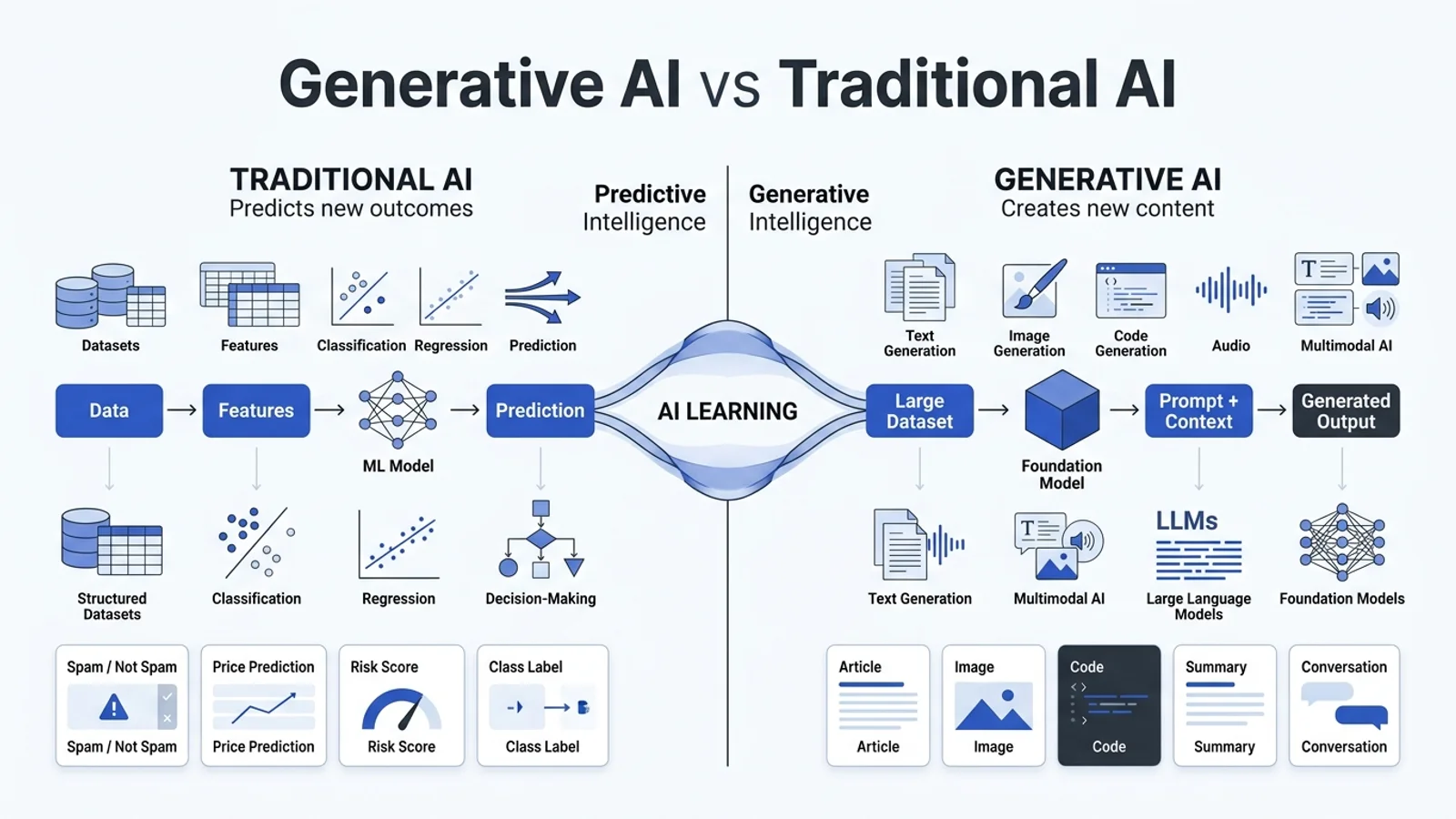
Primary Objective
|
Predict, classify, rank, detect, or support decisions.
|
Generate new content or responses based on learned patterns and
provided context.
|
|
Typical Output
|
Labels, probabilities, numerical predictions, rankings, or
decisions.
|
Text, images, audio, video, code, structured content, or other
generated outputs.
|
|
Learning Objective
|
Often learns a mapping from input features to a target output.
|
Learns patterns and representations that can be used to generate
new outputs.
|
|
Common Data
|
Often structured datasets, labeled examples, or task-specific
data.
|
Often very large datasets containing text, images, audio, video,
code, or combinations of modalities.
|
|
User Interaction
|
Frequently uses structured inputs and predefined interfaces.
|
Can support natural-language prompts and multimodal interaction.
|
|
Task Flexibility
|
Usually optimized for a specific task or set of related tasks.
|
Foundation models can support multiple tasks through prompting,
retrieval, tools, or fine-tuning.
|
|
Evaluation
|
Often measured with metrics such as accuracy, precision, recall,
F1, MAE, MSE, or RMSE.
|
May require evaluation of relevance, quality, factuality,
helpfulness, safety, and consistency.
|
|
Common Failure
|
Incorrect predictions, poor classification, bias, or
overfitting.
|
Hallucinations, irrelevant generation, unsafe outputs, or
incorrect information.
|
|
Deployment
|
Can often be deployed as relatively small specialized models.
|
Can require significant inference infrastructure depending on
model size and workload.
|
|
Example
|
Predict whether a customer will cancel a subscription.
|
Generate a personalized response explaining how the customer can
resolve an issue.
|