ARTICLE
Generative AI Architecture: A Complete Guide to Building Modern AI Systems
Explore Retrieval-Augmented Generation (RAG) and how it enhances modern AI systems by integrating external knowledge.
Sudais Azlan
23 min read
Generative AI Architecture: A Complete Guide to Building Modern AI Systems
Introduction to RAG
What Is Retrieval-Augmented Generation (RAG)?
Retrieval-Augmented Generation (RAG) is an AI architecture that combines information retrieval with generative artificial intelligence. Instead of relying entirely on the knowledge stored inside a large language model, a RAG system retrieves relevant information from external sources and provides that information to the model as context before generating a response.
This architecture allows AI applications to work with private, specialized, current, or frequently changing information. External knowledge can come from PDFs, websites, databases, documentation, enterprise knowledge bases, product catalogs, research papers, or other structured and unstructured data sources.
Core RAG Workflow
From User Query to Knowledge-Grounded Response
01
User Query
The user submits a question or request to the AI application.
02
Retrieval
The system searches external knowledge for relevant information.
03
Context
Relevant retrieved content is prepared as context for the model.
04
Generation
The language model processes the query together with retrieved context.
05
Response
The system returns a response grounded in the available knowledge.
01
External Knowledge
RAG allows an AI system to retrieve information from external knowledge sources instead of depending exclusively on information learned during model training.
02
Domain-Specific Context
Organizations can connect language models with their own documents, policies, technical resources, databases, and specialized knowledge.
03
Flexible Knowledge Updates
External knowledge can often be updated without retraining the entire language model, making RAG practical for applications with changing information.
| Capability | Traditional LLM | RAG Architecture |
|---|---|---|
| Primary Knowledge | Information learned during training | Model knowledge combined with retrieved information |
| Private Data | Not automatically available | Can retrieve application-specific and private information |
| Knowledge Updates | May require model updates or additional training | External knowledge can be updated independently |
| Processing Flow | Prompt → Language Model → Response | Query → Retrieval → Context → Language Model → Response |
Key Insight
RAG Connects Large Language Models With External Knowledge
The fundamental idea behind Retrieval-Augmented Generation is to give a language model access to relevant information at the time a question is answered. Instead of treating the model as the only source of knowledge, RAG introduces a retrieval layer that can search and supply useful context from external data.
This makes RAG an important foundation for modern AI applications that need to work with specialized documents, organizational knowledge, frequently changing information, and large collections of external data.
Why RAG Matters
Why Retrieval-Augmented Generation Is Important for Modern AI Systems
Large language models have transformed how people interact with artificial intelligence, but a standalone language model does not automatically have access to every source of information an application may need. Businesses, researchers, and developers often work with private documents, internal knowledge, technical documentation, databases, and information that changes over time. Retrieval-Augmented Generation provides an architectural approach for connecting these knowledge sources with generative AI.
Instead of attempting to place every piece of information directly inside the model, a RAG application can retrieve relevant content when a user submits a query. The retrieved information is then incorporated into the model's context, allowing the AI system to generate a response using both its language capabilities and the information supplied by the retrieval layer.
01
Access to Private Knowledge
RAG can connect AI applications with organization-specific documents, internal resources, product information, policies, and other private knowledge sources.
02
More Relevant Context
Retrieval allows the system to select information that is relevant to a specific query rather than presenting the model with an entire knowledge collection.
03
Easier Knowledge Maintenance
Updating the external knowledge base can be simpler than retraining a large language model whenever application-specific information changes.
04
Better Grounding
Relevant retrieved information gives the generation process additional evidence and context, which can help produce more useful and knowledge-grounded responses.
The Core Problem
A Language Model Cannot Automatically Know Every Application's Data
Consider an organization that has thousands of internal documents containing product specifications, employee policies, engineering documentation, support procedures, and operational information. A general-purpose language model may be capable of understanding the language used in these documents, but that does not mean the model automatically has access to the organization's latest private knowledge.
A RAG architecture addresses this problem by creating a separate knowledge pipeline. Documents can be collected, processed, divided into smaller chunks, converted into searchable representations, stored in a retrieval system, and then searched when users ask questions.
Without RAG
The application primarily sends the user's prompt to the language model and receives a generated response.
With RAG
The application retrieves relevant information and supplies it to the language model as additional context.
Result
The AI system can answer questions using information from its connected knowledge sources.
| Application | Knowledge Source | RAG Benefit |
|---|---|---|
| Enterprise Search | Internal documents and company knowledge | Natural-language access to organizational information |
| Customer Support | Product documentation and support articles | Context-aware answers based on available documentation |
| Research Assistant | Research papers and knowledge repositories | Faster discovery and synthesis of relevant information |
| Technical Assistant | APIs, manuals, source documentation, and technical guides | More targeted responses using technical context |
Important Distinction
RAG Is an Architecture, Not a Replacement for the Language Model
Retrieval-Augmented Generation does not replace the reasoning and language-generation capabilities of an LLM. Instead, it adds a retrieval layer around the model so that relevant external information can become part of the generation process.
This distinction is important when designing production AI systems. Strong RAG applications require both a capable generation model and a well-designed retrieval pipeline. Poor document processing or irrelevant retrieval can reduce response quality even when the underlying language model is highly capable.
RAG Architecture
How RAG Architecture Works: From Documents to AI Responses
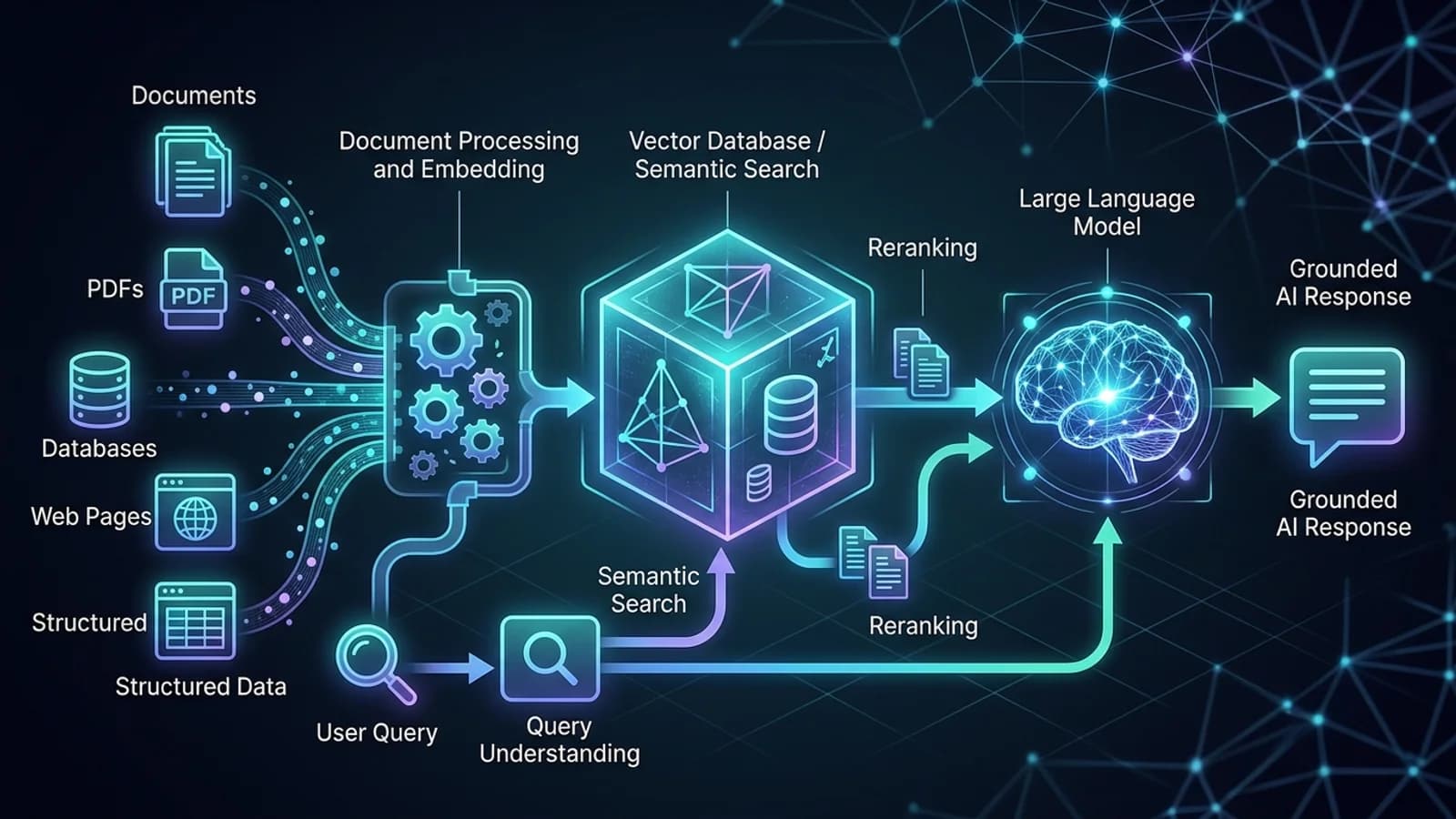
A Retrieval-Augmented Generation system is not a single component. It is an architecture made up of several connected stages that transform raw information into searchable knowledge and then use that knowledge during response generation. A typical RAG pipeline includes document ingestion, text processing, chunking, embedding generation, vector or hybrid retrieval, context construction, and language model generation.
Understanding these components is essential for designing reliable RAG applications. Retrieval quality depends heavily on how documents are prepared and indexed, while generation quality depends on how accurately the retrieved information is selected and presented to the language model.
Architecture Overview
The End-to-End RAG Pipeline
01
Data Ingestion
Documents and other information sources are collected and loaded into the RAG pipeline.
02
Document Processing
Raw content is cleaned, normalized, structured, and divided into useful sections or chunks.
03
Embeddings & Indexing
Text chunks are converted into searchable representations and stored in an appropriate retrieval index.
04
Query Processing
The user's question is transformed into a form suitable for retrieving relevant knowledge.
05
Retrieval
The system searches the indexed knowledge and selects content that is relevant to the user's query.
06
Context Construction
Retrieved content is organized into a context that can be supplied to the language model.
07
LLM Generation
The language model uses the query and retrieved context to generate a response.
08
Response & Evaluation
The final answer can be evaluated for relevance, accuracy, grounding, and overall response quality.
Indexing Pipeline
Preparing Knowledge Before Users Ask Questions
The indexing pipeline prepares external knowledge for efficient retrieval. Documents are loaded, processed, divided into meaningful chunks, converted into embeddings, and stored together with useful metadata.
Documents
PDFs, web pages, databases, manuals, and other sources.
Chunks
Smaller sections designed to preserve useful semantic context.
Embeddings
Numerical representations used to support semantic retrieval.
Index
Searchable storage containing vectors, text, and metadata.
Query Pipeline
Retrieving Knowledge at Query Time
The query pipeline runs when a user interacts with the AI application. The system analyzes the question, searches the knowledge index, selects relevant content, and places that content into the context supplied to the language model.
User Question
The user provides a natural-language query.
Search
The retrieval system identifies potentially relevant content.
Context Selection
The most useful retrieved information is selected for generation.
Generation
The LLM generates an answer using the query and retrieved context.
| Component | Primary Role | Why It Matters |
|---|---|---|
| Document Loader | Imports information from external sources | Provides the initial data for the knowledge pipeline |
| Text Splitter | Divides large documents into smaller chunks | Helps retrieval operate on manageable and relevant sections |
| Embedding Model | Converts text into numerical representations | Enables semantic similarity-based retrieval |
| Vector Store | Stores and searches vector representations | Provides efficient access to relevant knowledge |
| Retriever | Selects relevant documents or chunks | Determines what information reaches the language model |
| Language Model | Generates the final natural-language response | Converts the query and retrieved context into an answer |
Architecture Insight
RAG Quality Depends on the Entire Pipeline
A RAG system should be treated as an end-to-end information pipeline rather than simply a language model connected to a vector database. Document quality, chunking strategy, embedding quality, indexing, retrieval configuration, context construction, prompting, and generation all influence the final result.
This is why production RAG engineering requires careful attention to both retrieval and generation. A powerful language model cannot fully compensate for irrelevant or incomplete retrieved context, while an excellent retrieval system cannot produce a useful natural-language response without an effective generation component.
RAG Architecture
How RAG Architecture Works: From Documents to AI Responses
A Retrieval-Augmented Generation system is not a single component. It is an architecture made up of several connected stages that transform raw information into searchable knowledge and then use that knowledge during response generation. A typical RAG pipeline includes document ingestion, text processing, chunking, embedding generation, vector or hybrid retrieval, context construction, and language model generation.
Understanding these components is essential for designing reliable RAG applications. Retrieval quality depends heavily on how documents are prepared and indexed, while generation quality depends on how accurately the retrieved information is selected and presented to the language model.
Architecture Overview
The End-to-End RAG Pipeline
01
Data Ingestion
Documents and other information sources are collected and loaded into the RAG pipeline.
02
Document Processing
Raw content is cleaned, normalized, structured, and divided into useful sections or chunks.
03
Embeddings & Indexing
Text chunks are converted into searchable representations and stored in an appropriate retrieval index.
04
Query Processing
The user's question is transformed into a form suitable for retrieving relevant knowledge.
05
Retrieval
The system searches the indexed knowledge and selects content that is relevant to the user's query.
06
Context Construction
Retrieved content is organized into a context that can be supplied to the language model.
07
LLM Generation
The language model uses the query and retrieved context to generate a response.
08
Response & Evaluation
The final answer can be evaluated for relevance, accuracy, grounding, and overall response quality.
Indexing Pipeline
Preparing Knowledge Before Users Ask Questions
The indexing pipeline prepares external knowledge for efficient retrieval. Documents are loaded, processed, divided into meaningful chunks, converted into embeddings, and stored together with useful metadata.
Documents
PDFs, web pages, databases, manuals, and other sources.
Chunks
Smaller sections designed to preserve useful semantic context.
Embeddings
Numerical representations used to support semantic retrieval.
Index
Searchable storage containing vectors, text, and metadata.
Query Pipeline
Retrieving Knowledge at Query Time
The query pipeline runs when a user interacts with the AI application. The system analyzes the question, searches the knowledge index, selects relevant content, and places that content into the context supplied to the language model.
User Question
The user provides a natural-language query.
Search
The retrieval system identifies potentially relevant content.
Context Selection
The most useful retrieved information is selected for generation.
Generation
The LLM generates an answer using the query and retrieved context.
| Component | Primary Role | Why It Matters |
|---|---|---|
| Document Loader | Imports information from external sources | Provides the initial data for the knowledge pipeline |
| Text Splitter | Divides large documents into smaller chunks | Helps retrieval operate on manageable and relevant sections |
| Embedding Model | Converts text into numerical representations | Enables semantic similarity-based retrieval |
| Vector Store | Stores and searches vector representations | Provides efficient access to relevant knowledge |
| Retriever | Selects relevant documents or chunks | Determines what information reaches the language model |
| Language Model | Generates the final natural-language response | Converts the query and retrieved context into an answer |
Architecture Insight
RAG Quality Depends on the Entire Pipeline
A RAG system should be treated as an end-to-end information pipeline rather than simply a language model connected to a vector database. Document quality, chunking strategy, embedding quality, indexing, retrieval configuration, context construction, prompting, and generation all influence the final result.
This is why production RAG engineering requires careful attention to both retrieval and generation. A powerful language model cannot fully compensate for irrelevant or incomplete retrieved context, while an excellent retrieval system cannot produce a useful natural-language response without an effective generation component.
Document Ingestion & Chunking
Document Ingestion and Chunking: Preparing Knowledge for RAG
Before a Retrieval-Augmented Generation system can retrieve useful information, the application's knowledge sources must be converted into a format that can be processed and searched efficiently. This stage is known as document ingestion. It typically involves collecting documents, extracting their content, cleaning the extracted information, preserving important metadata, and preparing the resulting text for chunking and indexing.
Document ingestion is especially important because real-world data is rarely organized specifically for an AI retrieval pipeline. A knowledge base may contain PDFs, HTML pages, Markdown files, Word documents, emails, spreadsheets, database records, technical manuals, and other sources. Each format can require a different extraction and preprocessing strategy.
Ingestion Pipeline
From Raw Documents to Searchable Knowledge
01
Collect
Gather documents and data from the application's approved knowledge sources.
02
Extract
Extract meaningful text, tables, headings, and other useful content from each source.
03
Clean
Remove unnecessary formatting, duplicated content, and extraction artifacts while preserving useful meaning.
04
Chunk
Divide large documents into smaller sections that can be retrieved independently.
05
Enrich
Attach metadata such as document titles, sections, source identifiers, timestamps, or access information.
Chunking
Why Large Documents Are Split Into Smaller Chunks
A complete document is often too large and too broad to retrieve as a single unit. Chunking divides the document into smaller pieces so that the retrieval system can identify the specific sections that are most relevant to a user's question.
Good chunks should contain enough information to preserve their meaning while remaining focused enough to support accurate retrieval. The ideal chunk size depends on the document structure, language model context limits, retrieval method, and application requirements.
Chunk Metadata
Metadata Helps Retrieved Content Keep Its Meaning
A chunk should not always be treated as an isolated block of text. Metadata can preserve important information about where that chunk came from and how it relates to the original document.
Document Title
Identifies the original knowledge source.
Section or Heading
Provides structural context for the retrieved content.
Source Identifier
Helps trace the chunk back to its original source.
Timestamp
Can help distinguish newer information from outdated content.
| Chunking Strategy | How It Works | Best Use |
|---|---|---|
| Fixed-Size Chunking | Splits text according to a predefined character or token size. | Simple documents and straightforward retrieval pipelines. |
| Recursive Chunking | Uses multiple separators to divide text while attempting to preserve meaningful structure. | General-purpose documents with paragraphs and sections. |
| Semantic Chunking | Attempts to group text according to semantic relationships. | Content where meaning and topic boundaries are important. |
| Structure-Based Chunking | Uses headings, sections, paragraphs, tables, or document structure to define chunks. | Technical documentation, reports, manuals, and structured content. |
Chunk Size Tradeoff
Smaller Chunks Are Not Always Better
Chunk size creates an important tradeoff in RAG system design. Very small chunks can make retrieval highly focused, but they may remove surrounding context that is necessary to understand the information. Very large chunks can preserve more context, but they may contain unrelated information and consume more of the language model's context window.
Too Small
Important relationships between sentences or sections may be lost.
Balanced
Chunks preserve enough meaning while remaining focused and retrievable.
Too Large
Retrieval may return excessive or less relevant information.
Engineering Best Practices
Build Chunks Around Meaning, Not Just Size
Preserve Context
Keep related sentences, paragraphs, and sections together whenever possible.
Preserve Metadata
Store useful source and structural information with each chunk.
Test Different Strategies
Evaluate chunk sizes and splitting methods against real application queries rather than relying on a universal configuration.
Evaluate Retrieval Quality
Measure whether the chunks returned by the system actually contain the information required to answer user questions.
Key Insight
High-Quality RAG Starts With High-Quality Knowledge Preparation
Document ingestion and chunking form the foundation of a RAG pipeline. If important information is lost during extraction, poorly divided during chunking, or separated from useful metadata, the retrieval system may struggle to find the right context later.
For this reason, professional RAG engineering should treat document processing as a core part of the AI architecture rather than as a simple preprocessing step. Better source preparation leads to more meaningful retrieval, stronger context, and a more reliable foundation for knowledge-grounded generation.
Embeddings & Vector Databases
Embeddings and Vector Databases: How RAG Finds Relevant Knowledge
After documents have been cleaned and divided into meaningful chunks, a RAG system needs a way to represent those chunks so that relevant information can be discovered efficiently. This is where embeddings and vector databases become important. Embeddings convert text into numerical representations that capture semantic relationships, while vector databases provide specialized infrastructure for storing and searching those representations.
The combination of embeddings and vector search allows a RAG application to search by meaning rather than depending only on exact keyword matches. When a user asks a question, the query can be converted into an embedding and compared with stored document embeddings to identify content that is semantically related to the request.
Semantic Search Flow
From Text to Meaning-Based Retrieval
01
Document Chunk
A meaningful section of a document is prepared for indexing.
02
Embedding Model
The text is transformed into a numerical vector representation.
03
Vector Storage
The vector and its metadata are stored in a searchable index.
04
Query Embedding
The user's question is converted into a vector using the embedding model.
05
Similarity Search
The system compares the query vector with stored vectors to find relevant information.
Embeddings
What Are Text Embeddings?
A text embedding is a numerical representation of text produced by an embedding model. Instead of representing a sentence only as a sequence of words, an embedding maps the text into a vector space where related pieces of information can be positioned closer together according to their learned semantic relationships.
For example, two questions can use completely different words while expressing a similar idea. Semantic embeddings can help a retrieval system recognize this relationship and identify relevant documents even when the exact wording does not match.
Vector Databases
What Does a Vector Database Do?
A vector database or vector-capable search system stores embedding vectors together with associated text and metadata. It provides search mechanisms designed to identify vectors that are similar to a query vector.
In a RAG application, the vector database acts as an important retrieval layer between the external knowledge base and the language model. It helps the system quickly identify potentially useful documents or chunks that can later be included in the model's context.
| Similarity Method | Basic Idea | RAG Consideration |
|---|---|---|
| Cosine Similarity | Measures the angle between vectors. | Commonly used for comparing semantic embeddings. |
| Dot Product | Calculates a product between vector dimensions. | Often used when embedding models and indexes are configured for inner-product search. |
| Euclidean Distance | Measures geometric distance between vectors. | Can be useful depending on the embedding model and vector index. |
Metadata Filtering
Vector Similarity Is Only One Part of Modern Retrieval
A production RAG system does not always need to search every document. Metadata can be used to restrict retrieval to relevant sources, departments, dates, document types, products, permissions, or other application-specific categories.
Source
Search only within selected documents or knowledge collections.
Date
Restrict retrieval to information from a relevant time period.
Category
Filter results by product, department, topic, or document type.
Access
Apply authorization rules before exposing retrieved information.
Storage Choices
Choosing a Vector Storage Architecture
RAG applications can use dedicated vector databases, existing databases with vector extensions, search engines with vector capabilities, or specialized indexing libraries. The right choice depends on data size, latency requirements, filtering needs, operational complexity, and the existing technology stack.
| Architecture | Strength | Consideration |
|---|---|---|
| Dedicated Vector Database | Purpose-built vector search capabilities | Adds another infrastructure component |
| Vector-Enabled Relational Database | Combines structured data and vector search | Performance depends on workload and database configuration |
| Search Engine | Can combine keyword and semantic retrieval | May require more advanced search configuration |
Embedding Model
Choose an embedding model that performs well for the language, domain, and retrieval tasks used by the application.
Index Configuration
Index settings influence search speed, memory usage, scalability, and retrieval quality.
Metadata Design
Well-designed metadata enables filtering, source tracking, access control, and more precise retrieval.
Retrieval Evaluation
Search quality should be tested using representative queries and measurable retrieval metrics.
Key Insight
Good Embeddings Enable Better Semantic Retrieval
Embeddings provide the semantic representation that allows a RAG system to compare user queries with stored knowledge. Vector databases and vector-capable search systems then make it possible to efficiently find relevant content at query time.
However, embeddings alone do not guarantee high-quality RAG. The embedding model, chunking strategy, metadata, indexing method, similarity metric, filtering strategy, and retrieval configuration must work together. In professional RAG systems, vector search is one important component of a broader retrieval architecture.
Retrieval Strategies
RAG Retrieval Strategies: How AI Systems Find the Right Information
Retrieval is one of the most important stages in a Retrieval-Augmented Generation pipeline because the language model can only work with the information that reaches its context. A retrieval system must therefore identify documents or chunks that are relevant to the user's question, while avoiding unnecessary or unrelated content.
There is no single retrieval strategy that works perfectly for every RAG application. Depending on the data and query types, systems may use semantic vector search, keyword search, metadata filtering, hybrid retrieval, reranking, query expansion, or combinations of these methods. Professional RAG architectures often combine several retrieval techniques to improve both recall and precision.
Retrieval Pipeline
From User Question to Relevant Context
01
Query
The user submits a natural-language question.
02
Search
One or more retrieval methods search the knowledge index.
03
Candidate Results
Potentially relevant chunks are collected for further processing.
04
Reranking
Results can be reordered according to their relevance to the query.
05
Context
The strongest results are selected for the language model's context.
Semantic Retrieval
Searching by Meaning Rather Than Exact Words
Semantic retrieval uses embeddings to identify content that is conceptually related to a query. This can be useful when the wording of the user's question differs from the wording used in the source documents.
For example, a user might ask about reducing application response time while a technical document discusses performance optimization. Semantic retrieval can recognize the relationship between these concepts even when the exact words are different.
Keyword Retrieval
Exact Terms Still Matter
Keyword-based retrieval searches for specific terms, phrases, names, identifiers, and other lexical patterns. It can be especially useful when queries contain exact product names, technical identifiers, version numbers, error codes, or specialized terminology.
Keyword search and semantic search solve different retrieval problems, which is why many production systems combine them instead of treating one as a complete replacement for the other.
Hybrid Retrieval
Combining Keyword and Semantic Search
Hybrid retrieval combines lexical search with semantic retrieval to improve the range of relevant information that can be discovered. A keyword system can capture exact terminology, while vector search can identify semantically related concepts.
Keyword Search
Strong for exact words, names, identifiers, codes, and phrases.
Vector Search
Strong for semantic similarity and concept-level relationships.
Hybrid Search
Combines both approaches to handle a wider variety of user queries.
Reranking
Why Reranking Can Improve Retrieval Precision
Initial retrieval is often optimized for speed and broad recall. A reranker can then examine the candidate results more carefully and reorder them according to their relevance to the user's question. This creates a two-stage retrieval architecture in which a fast search identifies candidates and a more focused model or scoring method selects the strongest results.
Stage 1
Broad Retrieval
Retrieve a larger set of potentially relevant chunks.
Stage 2
Relevance Scoring
Analyze the relationship between each candidate and the query.
Stage 3
Reordering
Rank candidate documents according to their relevance.
Stage 4
Context Selection
Pass the strongest results to the generation model.
| Strategy | Main Strength | Potential Limitation | Common Use |
|---|---|---|---|
| Vector Search | Semantic similarity | May miss exact identifiers or rare terms | General semantic retrieval |
| Keyword Search | Exact terminology | Less effective when wording differs significantly | Names, codes, identifiers, exact phrases |
| Hybrid Search | Combines lexical and semantic signals | More complex ranking and configuration | Production knowledge retrieval |
| Reranking | Improves ordering of retrieved candidates | Adds processing cost and latency | High-value or precision-sensitive retrieval |
Retrieval Quality
Recall and Precision Are Critical RAG Metrics
A useful retrieval system must balance recall and precision. Recall describes how effectively the system finds information that is actually relevant, while precision focuses on how much of the retrieved content is relevant. Increasing one without considering the other can negatively affect the final context supplied to the language model.
R
Retrieval Recall
Focuses on whether the system successfully discovers the relevant information needed to answer the query.
P
Retrieval Precision
Focuses on whether the retrieved results are actually relevant instead of filling the context with unrelated information.
Key Insight
Better Retrieval Produces Better Context for Generation
Retrieval is the bridge between external knowledge and the language model. A RAG system should therefore be designed around the actual information needs of its users rather than relying on a single search technique for every situation.
Semantic search, keyword search, hybrid retrieval, metadata filtering, query expansion, and reranking can be combined to create increasingly sophisticated retrieval pipelines. The objective is not simply to retrieve more documents, but to retrieve the right information with enough precision and context for the generation model to produce a useful response.
References & Further Reading
Continue Exploring Retrieval-Augmented Generation
Retrieval-Augmented Generation is a broad AI architecture that combines information retrieval with large language models. Understanding the complete RAG workflow—from document ingestion and chunking to embeddings, vector search, query transformation, reranking, context construction, and grounded generation—provides a strong foundation for building reliable knowledge-aware AI applications.
As RAG systems become more advanced, developers increasingly need to think beyond basic vector search. Production-quality systems require careful attention to retrieval quality, data freshness, metadata, evaluation, latency, security, observability, and the relationship between retrieved evidence and generated answers.
01
Retrieval
Learn how search systems identify relevant information from external knowledge sources.
02
Embeddings
Understand how text can be represented as vectors for semantic similarity and retrieval.
03
Generation
Explore how retrieved context is supplied to language models to generate knowledge-grounded responses.
04
Evaluation
Measure retrieval relevance, answer quality, faithfulness, latency, and overall system performance.
Final Reflection
RAG Is More Than Connecting a Vector Database to an LLM
A reliable Retrieval-Augmented Generation system is an end-to-end architecture in which every stage influences the final answer. Poor document processing can weaken retrieval, weak retrieval can provide irrelevant context, and poor context construction can reduce the quality of generation even when the underlying language model is highly capable.
The strongest RAG implementations therefore treat retrieval as a complete engineering discipline. By combining high-quality data preparation, effective embeddings, appropriate search strategies, intelligent query processing, reranking, evaluation, and responsible system design, developers can build AI applications that use external knowledge more effectively and produce responses grounded in relevant information.