ARTICLE
The Latest Developments Shaping Artificial Intelligence
Explore the latest AI developments influencing technology and business.
Sudais Azlan
15 min read
The Latest Developments Shaping Artificial Intelligence
AI Industry News
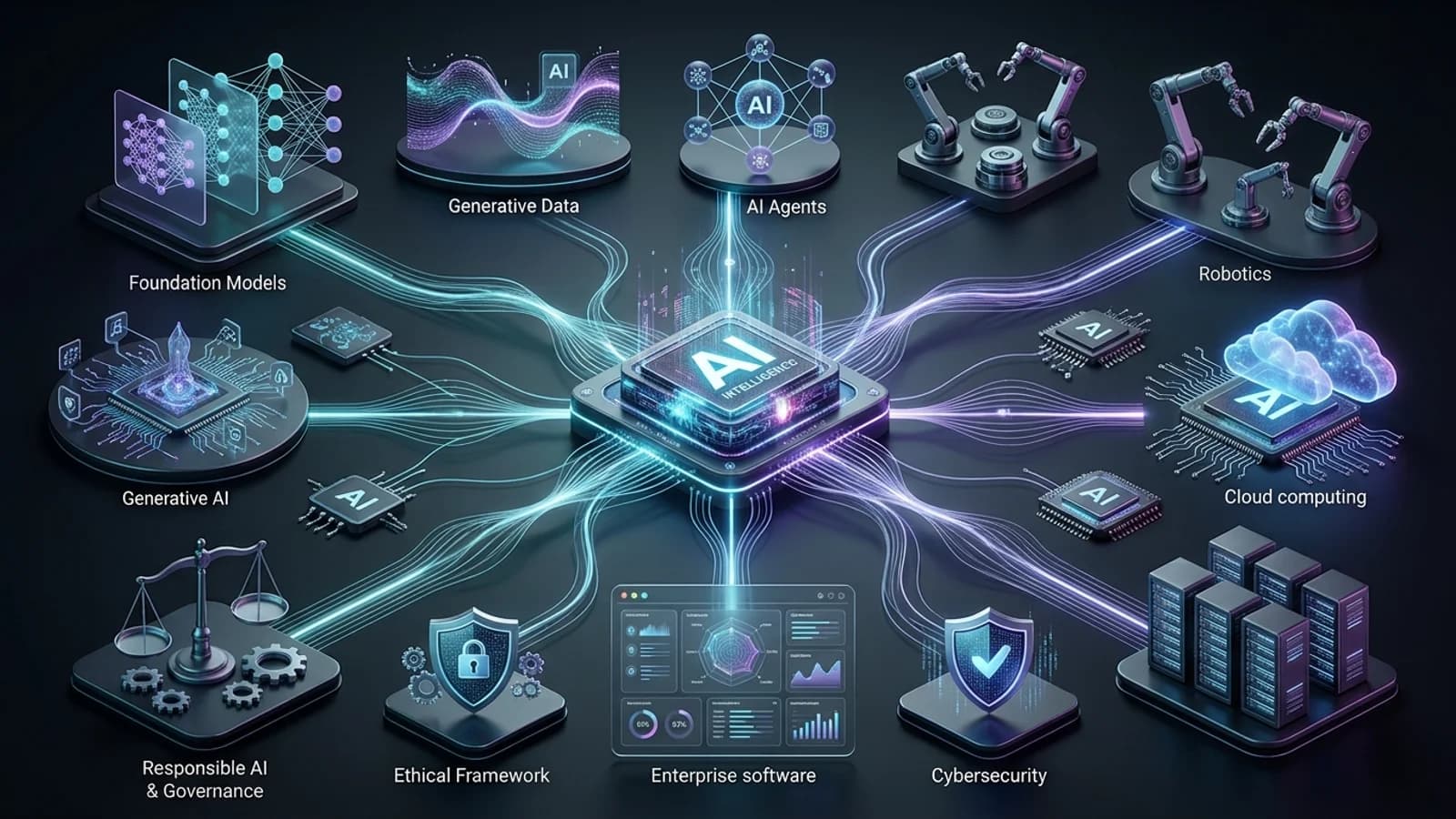
Artificial intelligence is developing at an extraordinary pace, with new models, products, research breakthroughs, infrastructure investments, and industry applications emerging across the technology landscape. From generative AI and multimodal systems to AI agents, robotics, and enterprise automation, these developments are changing how organizations build products, analyze information, and interact with intelligent software.
Following AI industry news is therefore about more than tracking the release of another model. The most important developments often involve improvements in reasoning, AI infrastructure, model efficiency, agentic systems, multimodal capabilities, responsible AI, and the growing integration of artificial intelligence into real-world products and workflows.
This guide provides a structured overview of the major areas shaping the artificial intelligence industry and explains why these developments matter for businesses, developers, researchers, students, and everyday users.
01
Foundation Models
New generations of language, vision, audio, and multimodal models are expanding what AI systems can understand, generate, and reason about.
02
AI Agents
Agentic AI systems are moving beyond simple responses toward planning, tool use, task execution, and multi-step problem solving.
03
AI Infrastructure
Computing hardware, data centers, networking, chips, and cloud infrastructure remain essential to scaling modern AI systems.
04
Responsible AI
Safety, privacy, transparency, evaluation, governance, and responsible deployment are becoming increasingly important as AI adoption grows.
Industry Perspective
AI Progress Is Becoming a Full Technology-Industry Transformation
The AI industry is no longer defined by model development alone. Progress increasingly depends on the interaction between advanced models, computing infrastructure, software platforms, specialized applications, data, research, and responsible deployment. Understanding these connections makes it easier to distinguish short-term headlines from developments that could have lasting impact.
AI Model Developments
How New AI Models Are Expanding the Capabilities of Artificial Intelligence
One of the most important areas to watch in AI industry news is the continued development of increasingly capable foundation models. Modern AI systems are moving beyond basic text generation toward stronger reasoning, multimodal understanding, longer context, improved tool use, and more reliable performance across complex tasks.
This evolution is also changing how developers build AI applications. Instead of creating separate systems for every individual task, organizations can increasingly build applications around general-purpose models and connect them to specialized tools, private data, software systems, and business workflows.
01
Better Reasoning
Newer models are increasingly designed to handle complex reasoning, planning, analysis, and multi-step problem-solving tasks.
02
Multimodal Intelligence
AI models are increasingly capable of working across text, images, audio, video, and other forms of information within connected workflows.
03
Longer Context
Larger context capabilities can help models process more information within a single task, supporting document analysis and complex workflows.
04
Efficient AI
Improvements in model architecture, inference, and hardware are helping make advanced AI capabilities more practical and cost efficient.
Evolution of AI Models
From Content Generation to More Capable AI Systems
01
Generate
Produce text, images, audio, code, and other forms of digital content.
02
Understand
Interpret multiple types of information and connect related concepts.
03
Reason
Analyze complex problems and work through multi-step tasks.
04
Act
Connect with tools and software systems to complete useful real-world workflows.
| AI Development | What Is Changing | Potential Industry Impact |
|---|---|---|
| Reasoning | More sophisticated analysis and multi-step problem solving | More capable business and technical applications |
| Multimodality | Multiple information types handled within one system | More natural AI interfaces and broader applications |
| Tool Use | Models can interact with external tools and software | More automated and agentic workflows |
| Efficiency | Improved inference and specialized model deployment | Lower barriers to practical AI adoption |
Key Takeaway
The AI Model Race Is Becoming a Capability Race
The significance of new AI models is not determined only by benchmark scores or parameter counts. The broader question is what these systems can reliably do in real applications. Reasoning, multimodal understanding, tool use, efficiency, and integration with software ecosystems are becoming increasingly important measures of practical AI progress.
Agentic AI
AI Agents Are Moving Artificial Intelligence From Answers to Actions
One of the most closely watched developments in the artificial intelligence industry is the growth of AI agents. Unlike traditional conversational systems that primarily respond to individual prompts, agentic systems are designed to handle multi-step tasks by planning, using tools, accessing information, and interacting with software environments.
This shift could significantly change how organizations use AI. Instead of treating artificial intelligence as a standalone chatbot, businesses can integrate AI agents into workflows such as research, customer support, software development, data analysis, operations, and internal knowledge management.
01
Planning
AI agents can break larger objectives into smaller steps and determine a sequence of actions for completing a task.
02
Tool Use
Agents can be connected to search systems, databases, APIs, code environments, and other software tools.
03
Multi-Step Execution
Instead of stopping after one response, agents can perform multiple connected operations toward a defined objective.
04
Human Oversight
Reliable agentic systems still require appropriate permissions, monitoring, evaluation, and human review for important actions.
Agent Workflow
How an AI Agent Can Approach a Complex Task
01
Understand
Interpret the user's objective, constraints, available information, and expected outcome.
02
Plan
Determine the steps and tools required to move from the request to the desired result.
03
Execute
Call appropriate tools, retrieve information, process data, or interact with connected applications.
04
Evaluate
Check intermediate results and determine whether additional actions are required.
05
Complete
Return the final result or request human approval before performing sensitive or consequential actions.
| Industry Workflow | Potential AI Agent Role | Important Requirement |
|---|---|---|
| Software Development | Analyze tasks, write code, run tests, and assist with debugging | Strong testing and code review |
| Research | Search information, organize findings, and prepare research summaries | Source verification and citation accuracy |
| Customer Support | Retrieve knowledge and assist with customer requests | Escalation and human oversight |
| Business Operations | Coordinate repetitive multi-step workflows across software tools | Access control, monitoring, and reliable execution |
Opportunity
AI Agents Could Automate Entire Workflows
The major opportunity is not simply automating one isolated action. Agentic AI could coordinate multiple steps across different systems, allowing organizations to redesign workflows around intelligent software that can adapt to changing information and requirements.
Challenge
Reliability Matters More When AI Can Take Action
An incorrect answer is one problem; an incorrect action can create a much larger operational risk. Agentic systems therefore require carefully defined permissions, testing, monitoring, safeguards, and appropriate human approval.
Key Takeaway
The Next Stage of AI Is About Completing Useful Work
AI agents represent an important direction in artificial intelligence because they connect model intelligence with tools, data, software, and real-world workflows. As these systems become more reliable, the focus of AI development may increasingly shift from generating individual responses toward completing meaningful multi-step tasks.
AI Infrastructure
AI Infrastructure: Why Computing Power Is Driving the Next Wave of AI
Behind every advanced artificial intelligence system is a large infrastructure ecosystem that includes specialized processors, data centers, networking systems, cloud platforms, storage, and energy. As AI models become more capable and organizations deploy them at larger scale, infrastructure has become one of the most important areas of the AI industry.
The AI infrastructure race is not only about building larger models. Companies are also working to improve inference speed, reduce computing costs, increase energy efficiency, and make advanced AI capabilities available through scalable cloud and on-device systems.
01
AI Chips
Specialized processors provide the computational performance needed to train and run increasingly demanding AI models.
02
Data Centers
Large-scale data centers provide the computing, networking, cooling, storage, and operational infrastructure required for AI workloads.
03
Cloud AI
Cloud platforms allow developers and organizations to access advanced AI computing without building all infrastructure themselves.
04
Efficient Inference
Model optimization and hardware improvements can reduce latency, operating costs, and the resources required to deliver AI responses.
AI Infrastructure Stack
The Technology Stack Behind Modern AI
01
Hardware
Accelerators and processors provide the raw computational capacity required by AI workloads.
02
Networking
High-speed networking connects large numbers of computing resources for distributed AI workloads.
03
Data
Storage and data pipelines provide the information required for training, evaluation, retrieval, and application workflows.
04
Models
Foundation and specialized models transform computational resources and data into useful AI capabilities.
05
Applications
AI applications expose these capabilities through products, services, agents, and business workflows.
| Infrastructure Area | Primary Role | Why It Matters |
|---|---|---|
| AI Accelerators | Perform large-scale mathematical computations | Determines available AI performance and scalability |
| Data Centers | Host and operate large computing systems | Enables large-scale training and AI deployment |
| Cloud Platforms | Provide on-demand access to computing and AI services | Makes advanced AI accessible to more developers and businesses |
| Optimization | Improve model speed, efficiency, and resource usage | Helps reduce the cost of real-world AI deployment |
Scaling Challenge
More Capable AI Requires More Efficient Computing
As AI workloads become larger and more complex, organizations need infrastructure that can scale while maintaining acceptable cost, performance, reliability, and energy efficiency. This makes hardware and infrastructure innovation a central part of AI industry progress.
Efficiency
Smaller and More Efficient Models Matter Too
AI progress is not limited to increasingly large systems. Efficient models, optimized inference, specialized hardware, and edge AI can make advanced capabilities practical in applications where computing resources, latency, privacy, or operating costs are important.
Key Takeaway
AI Innovation Depends on the Infrastructure Behind It
The future of artificial intelligence will depend not only on better algorithms and models, but also on the infrastructure that makes those systems affordable, scalable, reliable, and accessible. Advances in chips, data centers, cloud platforms, networking, and model efficiency will continue to shape how quickly AI can move from research into practical applications.
AI Industry Adoption
How Artificial Intelligence Is Transforming Industries and Business Workflows
Artificial intelligence is increasingly moving from experimental projects into practical business applications. Organizations across healthcare, finance, manufacturing, retail, education, software development, media, logistics, and professional services are exploring AI to improve productivity, automate repetitive processes, analyze information, and support decision-making.
The most meaningful AI adoption is not necessarily about replacing an entire job or business process. In many cases, organizations are using AI to assist people with specific tasks, accelerate workflows, surface useful information, and provide new capabilities that were previously expensive or difficult to deliver.
01
Healthcare
AI can assist with medical research, document analysis, imaging workflows, administrative tasks, and decision-support systems under appropriate professional oversight.
02
Finance
Financial organizations are exploring AI for document processing, fraud detection, customer service, risk analysis, and operational automation.
03
Manufacturing
AI can support predictive maintenance, quality inspection, production optimization, robotics, and intelligent industrial operations.
04
Software Development
AI coding systems can assist developers with code generation, debugging, documentation, testing, code explanation, and software development workflows.
Business Adoption
A Practical Path From AI Experimentation to Production
01
Identify
Find repetitive, information-heavy, or time-consuming workflows where AI could provide measurable value.
02
Experiment
Test AI capabilities using controlled experiments and realistic business scenarios.
03
Evaluate
Measure accuracy, reliability, cost, productivity, and user experience before wider deployment.
04
Integrate
Connect AI with existing data, applications, APIs, and business processes.
05
Monitor
Continuously evaluate performance, security, cost, and reliability after deployment.
| Industry | AI Applications | Primary Opportunity | Key Consideration |
|---|---|---|---|
| Healthcare | Research, imaging, documentation, decision support | Improved efficiency and information analysis | Safety, privacy, and professional oversight |
| Finance | Fraud detection, analysis, customer support | Automation and faster information processing | Security, accuracy, and regulatory requirements |
| Manufacturing | Robotics, inspection, optimization, maintenance | Productivity and operational efficiency | Reliability and physical-world safety |
| Software | Coding, testing, debugging, documentation | Faster development and engineering assistance | Code quality, security, and human review |
Productivity
AI Is Becoming a Workplace Productivity Layer
AI assistants can help employees summarize information, draft documents, analyze data, search internal knowledge, generate content, and automate repetitive tasks. The strongest implementations connect these capabilities directly to the workflows employees already use.
Transformation
The Biggest Impact May Come From Workflow Redesign
Simply adding a chatbot to an existing process does not automatically create meaningful transformation. Organizations may achieve greater value by redesigning workflows around AI while keeping humans involved where judgment, accountability, creativity, and domain expertise are essential.
Key Takeaway
AI Adoption Is Shifting From Experiments Toward Real-World Workflows
The next stage of AI adoption will depend on how effectively organizations turn model capabilities into reliable products and measurable business outcomes. Companies that combine strong AI technology with appropriate data, workflow design, evaluation, security, and human oversight will be better positioned to capture sustainable value from artificial intelligence.
Responsible AI
Responsible AI: Why Safety, Regulation, and Trust Matter More Than Ever
As artificial intelligence becomes more capable and more deeply integrated into products and organizations, responsible AI has become a central part of the industry conversation. Developers and businesses must consider not only what an AI system can do, but also how reliably, safely, transparently, and responsibly it is deployed.
Issues such as privacy, security, bias, misinformation, intellectual property, model evaluation, transparency, and human oversight are becoming increasingly important. At the same time, governments and organizations around the world are developing frameworks and regulations intended to encourage responsible development and deployment of AI systems.
01
AI Safety
Safety research focuses on understanding model behavior, reducing harmful failures, and improving the reliability of increasingly capable AI systems.
02
Privacy
Organizations need appropriate controls for protecting personal, confidential, and sensitive information used by AI applications.
03
Transparency
Clear documentation, evaluations, and communication can help users understand the capabilities and limitations of AI systems.
04
Governance
Governance establishes policies, responsibilities, evaluation processes, and controls for deploying AI responsibly.
Responsible AI Framework
What Organizations Should Consider Before Deploying AI
01
Purpose
Clearly define what the AI system is intended to accomplish and where it should not be used.
02
Data
Identify what data is being used and establish appropriate privacy, security, and quality controls.
03
Evaluation
Test accuracy, reliability, safety, bias, and failure cases before and after deployment.
04
Oversight
Define when humans should review, approve, correct, or override AI-generated outputs and actions.
05
Monitoring
Continuously monitor real-world performance and update controls as models, data, and use cases change.
| AI Risk Area | Potential Issue | Responsible Practice |
|---|---|---|
| Incorrect Outputs | AI may produce inaccurate or misleading information | Evaluation, verification, and human review |
| Privacy | Sensitive information may be exposed or handled improperly | Data governance, access controls, and privacy safeguards |
| Bias | AI outputs may reflect limitations in training data or system design | Testing across relevant scenarios and continuous evaluation |
| Autonomous Actions | AI agents may take unintended actions | Permissions, guardrails, monitoring, and approval mechanisms |
Regulation
AI Regulation Is Becoming Part of Technology Strategy
As governments introduce or develop AI-related rules, organizations increasingly need to consider regulatory requirements alongside technical design. Compliance, documentation, risk assessment, and governance can become important parts of building and deploying AI products.
Trust
Trust Will Influence Long-Term AI Adoption
Technical capability alone does not guarantee successful AI adoption. Users and organizations also need confidence that AI systems are secure, dependable, understandable, and appropriately governed. Building this trust will be essential as AI becomes part of more important workflows.
Key Takeaway
Responsible AI Is Becoming a Core Part of AI Engineering
The future of artificial intelligence will depend on more than increasing model capability. Safety, privacy, transparency, governance, evaluation, and human oversight will play an increasingly important role in determining which AI systems can be trusted and deployed at meaningful scale.
Final Reflection
The AI Industry Is Entering a New Era of Intelligent Systems
The latest developments in artificial intelligence show that the industry is moving beyond simple experimentation toward increasingly capable, multimodal, agentic, and production-ready AI systems. Advances in foundation models, AI agents, computing infrastructure, enterprise adoption, and responsible AI are all contributing to a rapidly changing technology landscape.
For developers, businesses, researchers, and technology professionals, understanding these trends is becoming increasingly important. The most valuable AI developments will not necessarily be the ones that generate the most attention, but those that provide reliable capabilities, measurable value, improved productivity, and practical solutions to real-world problems.
01
Models Are Becoming More Capable
Foundation models are expanding their reasoning, multimodal, generation, and tool-use capabilities.
02
AI Agents Are Expanding Automation
Agentic systems are connecting AI models with tools, data, software, and multi-step workflows.
03
Infrastructure Remains Critical
Chips, data centers, cloud platforms, networking, and efficient inference are essential to scaling AI.
04
Responsible AI Matters
Safety, privacy, governance, transparency, and human oversight will remain essential as AI adoption grows.
| AI Industry Area | Current Direction | Long-Term Importance |
|---|---|---|
| Foundation Models | Stronger reasoning and multimodal capabilities | More capable general-purpose AI systems |
| AI Agents | More planning, tool use, and task execution | Greater workflow automation |
| AI Infrastructure | Increasing investment in computing and efficiency | Enables AI to scale economically |
| Responsible AI | Greater focus on safety, governance, and regulation | Builds trust and supports sustainable adoption |
Final Takeaway
The Future of AI Will Be Defined by Capability, Reliability, and Impact
Artificial intelligence is developing across multiple connected dimensions. Better models are enabling more advanced applications, powerful infrastructure is making those systems scalable, and AI agents are opening new possibilities for automated workflows. At the same time, responsible development is becoming essential for ensuring that these technologies are deployed safely and effectively.
Keeping up with AI industry news therefore means looking beyond individual product announcements and understanding the broader direction of the technology. The organizations and professionals that focus on practical value, continuous learning, responsible implementation, and measurable outcomes will be better prepared for the next stage of artificial intelligence.