ARTICLE
The Latest Developments in Artificial Intelligence
Explore the latest advancements in artificial intelligence, from generative models to multimodal systems, revolutionizing technology and industry.
Sudais Azlan
16 min read
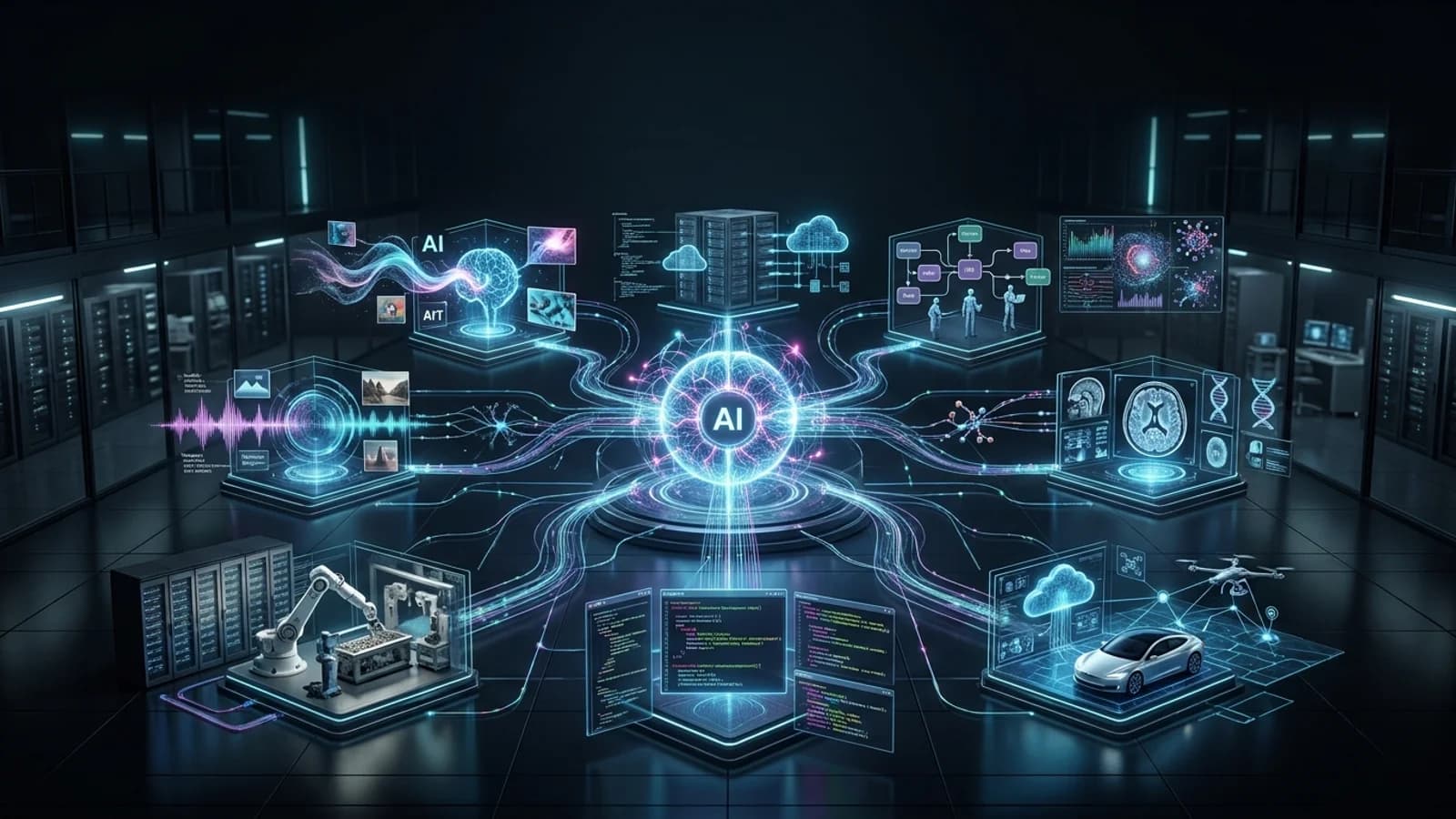
The Latest Developments in Artificial Intelligence
Introduction to Modern AI
Artificial intelligence is advancing at an extraordinary pace, moving beyond traditional machine learning systems toward more capable models that can understand language, analyze images, reason through complex problems, generate content, use software tools, and support increasingly sophisticated workflows. Recent progress has expanded AI from a specialized technology into a major part of modern computing and business. :contentReference[oaicite:0]{index=0}
One of the most important developments is the rapid improvement of foundation and multimodal AI models. Modern systems can work across multiple types of information, including text, images, audio, video, and code. At the same time, AI agents are emerging that can combine models with tools and workflows to perform multi-step tasks rather than simply responding to individual prompts.
The scale of this progress is significant. Stanford's 2026 AI Index reports that AI capabilities continue to accelerate, while organizational adoption has reached 88%. The report also highlights major progress in multimodal reasoning, coding, science, robotics, and agentic systems. :contentReference[oaicite:1]{index=1}
01
Generative AI
AI systems are becoming increasingly capable of generating and transforming text, images, audio, video, software, and other forms of digital content.
02
AI Agents
Agentic systems are moving AI toward multi-step task execution, tool use, planning, and greater automation.
03
Multimodal Intelligence
Modern AI increasingly combines text, vision, speech, video, and other modalities within unified systems.
04
AI in Science and Industry
AI is increasingly being applied to scientific research, medicine, education, software development, robotics, and business operations.
Why It Matters
AI Is Shifting From Individual Tools Toward Intelligent Systems
Earlier AI applications were often designed around narrowly defined tasks. The latest generation of systems is increasingly designed to understand broader context and operate across multiple capabilities. This creates new possibilities for AI assistants, software development, research, automation, robotics, and decision-support systems.
However, rapid technical progress also creates important challenges. AI systems still require careful evaluation, reliable data, appropriate safeguards, and human oversight. Stanford's 2026 AI Index notes that AI capability is advancing faster than many of the benchmarks and governance frameworks designed to measure and manage it. :contentReference[oaicite:2]{index=2}
| AI Development | What Is Changing | Potential Impact |
|---|---|---|
| Generative AI | More capable content and code generation | Faster creative and software workflows |
| Multimodal AI | Unified processing of different information types | More natural and flexible AI interaction |
| AI Agents | Multi-step reasoning and tool-assisted workflows | Greater workflow automation |
| AI Research | Increasing use of AI across scientific disciplines | Faster research and discovery |
Key Takeaway
The AI Revolution Is Moving From Capability to Real-World Impact
The latest developments in artificial intelligence are not limited to larger models or better benchmarks. AI is increasingly becoming part of practical systems that can assist people, automate workflows, analyze complex information, and contribute to scientific and industrial progress. Understanding these developments is essential for anyone who wants to understand the future of technology.
Generative & Multimodal AI
Generative AI and Multimodal Models Are Expanding What Artificial Intelligence Can Do
One of the most important developments in artificial intelligence is the rapid evolution of generative AI. Modern AI models can create, transform, summarize, and analyze different forms of digital information, including text, images, audio, video, and computer code. This has expanded AI from traditional prediction and classification tasks into more interactive creative and problem-solving systems.
At the same time, multimodal AI is making it possible for a single system to work with multiple types of information. Instead of treating language, vision, audio, and other data as completely separate capabilities, multimodal systems can connect information across these formats to build a richer understanding of a task or environment.
01
Text Generation
AI can generate explanations, summaries, drafts, structured information, and software code from natural-language instructions.
02
Image Understanding
Vision-capable AI can analyze images, identify visual information, interpret documents, and connect visual information with language.
03
Audio and Video
AI systems are increasingly capable of processing speech and video, creating opportunities for richer communication and media workflows.
04
Cross-Modal Reasoning
Multimodal systems can connect information from different formats to support more flexible analysis and problem-solving.
Multimodal Intelligence
How Multimodal AI Combines Different Types of Information
A multimodal AI system can receive information from multiple sources and use those inputs together when generating an output. For example, a system may analyze a written question alongside an image, document, audio recording, or video and use the combined context to produce a response.
Input 01
Text
Questions, instructions, documents, conversations, and code.
Input 02
Vision
Photographs, diagrams, screenshots, charts, and scanned documents.
Input 03
Audio & Video
Speech, recordings, demonstrations, and dynamic visual information.
Output
Intelligent Response
Analysis, explanation, generation, transformation, or task support.
| Application | How Generative AI Helps | Potential Benefit |
|---|---|---|
| Software Development | Code generation, explanation, debugging, and documentation | Faster development workflows |
| Education | Explanations, tutoring, summarization, and personalized learning | More interactive learning experiences |
| Content Creation | Drafting, editing, ideation, image generation, and media workflows | Faster creative production |
| Research | Information analysis, summarization, coding, and research support | More efficient knowledge workflows |
Important Consideration
More Capable AI Does Not Mean AI Is Always Correct
Generative and multimodal models can perform increasingly sophisticated tasks, but they can still produce incorrect information, misunderstand context, or generate unreliable outputs. For important applications, their results should be evaluated against trustworthy information and reviewed by people with appropriate expertise.
This is especially important as AI systems move into areas such as education, healthcare, software development, scientific research, and business decision-making. Greater capability increases the range of possible applications, but it also increases the importance of responsible deployment.
Key Takeaway
Multimodal AI Is Moving Toward More Natural Human-Computer Interaction
Generative and multimodal AI represent a major step in the evolution of artificial intelligence. By combining language, vision, audio, video, and code capabilities, modern AI systems can support a much broader range of tasks and interactions than earlier systems.
AI Agents & Autonomous Systems
AI Agents Are Moving Artificial Intelligence From Conversation to Action
One of the most important developments in artificial intelligence is the emergence of AI agents. Unlike traditional AI applications that mainly respond to individual prompts, agentic systems can be designed to plan tasks, use external tools, interact with software, retrieve information, and complete multiple steps toward a defined objective.
This development represents an important shift in how people interact with AI. Instead of asking an AI system to perform every individual step, users can increasingly provide a goal while the system determines and executes parts of the workflow. The level of autonomy varies considerably between systems, so human oversight remains important for complex or high-impact tasks.
01
Planning
AI agents can break broader objectives into smaller steps and determine possible actions needed to complete a task.
02
Tool Use
Agents can connect AI models with search systems, databases, APIs, calculators, software applications, and other external tools.
03
Memory & Context
Agent systems can maintain relevant context during workflows and use information from previous steps to guide subsequent actions.
04
Task Execution
Agents can coordinate multiple actions to complete workflows instead of limiting AI to a single question-and-answer interaction.
Agent Architecture
How an AI Agent Can Turn a Goal Into a Multi-Step Workflow
A typical agentic workflow combines an AI model with instructions, context, tools, and an execution loop. The exact architecture varies, but the general process involves understanding the objective, determining an action, using an available tool when necessary, checking the result, and continuing until the task is completed or requires human intervention.
Step 01
Goal
The user provides an objective or task that needs to be completed.
Step 02
Reason
The system determines what information or actions may be required.
Step 03
Act
The agent uses an appropriate tool or performs the next workflow action.
Step 04
Observe
The system evaluates the result and determines what should happen next.
Step 05
Complete
The workflow finishes when the objective is achieved or human input is required.
| Traditional AI Interaction | Agentic AI | Potential Advantage |
|---|---|---|
| Responds to a single prompt | Can coordinate multiple steps | Supports longer workflows |
| Limited tool interaction | Can call external tools and services | Access to external capabilities |
| User controls each step | System can coordinate defined steps | Greater workflow automation |
| Mostly reactive | Goal-oriented execution | More flexible task completion |
Real-World Applications
Where AI Agents Could Create the Most Value
Software Engineering
Agents can assist with code analysis, testing, documentation, issue investigation, and development workflows.
Business Operations
AI agents can help coordinate repetitive information and workflow tasks across business systems.
Research
Agents can assist with information retrieval, document analysis, structured research, and data-processing workflows.
Personal Productivity
Agentic assistants can coordinate tasks, organize information, and support users across multiple applications.
Challenges
Greater AI Autonomy Requires Stronger Reliability and Oversight
Giving an AI system access to tools and multi-step workflows creates new possibilities, but it also introduces additional risks. An agent may misunderstand an objective, make an incorrect decision, use the wrong tool, or continue from an inaccurate intermediate result.
For this reason, effective agentic systems need appropriate permissions, clear boundaries, monitoring, evaluation, error handling, and human oversight for important decisions. The goal is not simply to make an AI system more autonomous, but to make its autonomy useful, predictable, and controllable.
Key Takeaway
AI Agents Could Become a New Layer of Digital Automation
AI agents represent an important direction in artificial intelligence because they connect reasoning models with tools, information, and multi-step workflows. As these systems become more reliable, they could change how people interact with software and automate increasingly complex digital tasks.
AI in Science & Healthcare
How Artificial Intelligence Is Accelerating Scientific Research and Healthcare
Artificial intelligence is increasingly being applied beyond consumer applications and business automation. Researchers, healthcare organizations, and scientific institutions are using AI to analyze large datasets, identify patterns, support research workflows, and assist with complex scientific problems.
This development is particularly important because modern scientific and healthcare systems generate enormous amounts of information. AI can help researchers and professionals process this information more efficiently, although important decisions still require appropriate validation, domain expertise, and human oversight.
01
Drug Discovery
AI can help researchers analyze biological information and explore potential candidates during drug discovery and development.
02
Medical Imaging
Computer vision systems can assist qualified professionals in analyzing medical images and identifying potentially relevant patterns.
03
Scientific Discovery
AI can support researchers by analyzing complex datasets, modeling relationships, and helping explore scientific hypotheses.
04
Research Automation
AI-powered systems can assist with literature analysis, data processing, coding, documentation, and repetitive research tasks.
Research Workflow
How AI Can Support the Scientific Research Process
AI does not necessarily replace the scientific method. Instead, it can provide researchers with additional computational capabilities for processing information, generating useful predictions, and exploring large search spaces.
Step 01
Collect
Gather relevant datasets, research papers, measurements, or other scientific information.
Step 02
Analyze
Use AI and computational methods to identify patterns and relationships within the available information.
Step 03
Predict
Generate predictions or candidate solutions that researchers can investigate further.
Step 04
Validate
Compare AI-assisted findings with established evidence, experiments, and expert knowledge.
Step 05
Discover
Use validated findings to support new research directions and scientific understanding.
| Field | AI Capability | Potential Impact |
|---|---|---|
| Healthcare | Medical image analysis, clinical support, and data processing | More efficient analysis and decision-support workflows |
| Drug Discovery | Molecular modeling and candidate analysis | Faster exploration of potential treatments |
| Climate Science | Large-scale data analysis and predictive modeling | Better understanding of complex environmental systems |
| Materials Science | Simulation, prediction, and materials discovery | Faster exploration of new materials |
AI Advantage
Processing Complex Information at Scale
AI systems can process large datasets and identify patterns that may be difficult to examine manually, helping researchers focus more attention on higher-level scientific questions.
Human Expertise
Validation and Scientific Judgment
Researchers remain responsible for evaluating evidence, designing experiments, interpreting results, and determining whether an AI-generated finding is scientifically meaningful.
Responsible AI in Science
Scientific AI Requires Accuracy, Transparency, and Careful Validation
AI-generated results can be valuable, but they should not automatically be treated as scientific facts. Errors in data, model assumptions, incomplete information, or unexpected model behavior can affect results. Scientific applications therefore require appropriate testing, reproducibility, expert review, and transparent evaluation.
In healthcare especially, AI should support qualified professionals rather than become an unchecked replacement for clinical expertise. Responsible deployment depends on the specific use case, available evidence, safety requirements, and appropriate human oversight.
Key Takeaway
AI Is Becoming a Powerful Research Partner
The application of artificial intelligence to science and healthcare demonstrates how AI can extend human analytical capabilities. By processing information at scale, supporting complex modeling, and accelerating repetitive research tasks, AI can help scientists and professionals explore problems more efficiently.
The greatest value comes from combining computational intelligence with human expertise. AI can accelerate discovery, but rigorous validation, scientific reasoning, and responsible decision-making remain essential.
AI-Powered Robotics
AI-Powered Robotics Is Bringing Artificial Intelligence Into the Physical World
Another major development in artificial intelligence is the growing connection between AI software and physical robotic systems. Modern robots can combine machine learning, computer vision, language models, sensors, and advanced control systems to understand their surroundings and perform increasingly complex tasks.
Unlike traditional automation, which often depends on fixed instructions and highly controlled environments, AI-powered robotics aims to make machines more adaptable. Robots can use AI to interpret visual information, recognize objects, understand instructions, plan actions, and respond to changes in their environment.
01
Computer Vision
AI-powered vision systems help robots identify objects, interpret environments, and respond to visual information.
02
Intelligent Control
Machine learning can support robotic movement, navigation, planning, and adaptation in changing environments.
03
Language Interaction
Language-capable AI can help robots interpret natural-language instructions and support more intuitive human-robot interaction.
04
Autonomous Navigation
AI can assist robots in understanding environments, planning routes, avoiding obstacles, and adapting to changing conditions.
Intelligent Robotics Workflow
How AI Helps Robots Perceive, Decide, and Act
AI-powered robots typically combine multiple components rather than relying on a single model. Sensors provide information about the environment, AI systems interpret that information, planning systems determine possible actions, and robotic hardware executes those actions.
Step 01
Sense
Cameras, microphones, lidar, and other sensors collect information about the surrounding environment.
Step 02
Understand
AI models interpret objects, locations, instructions, and other relevant environmental information.
Step 03
Plan
Planning and control systems determine an appropriate sequence of actions for the task.
Step 04
Act
Motors, arms, wheels, and other hardware perform the selected actions in the physical environment.
Step 05
Adapt
New sensor information can be used to adjust the robot's next actions as conditions change.
| Industry | AI Robotics Application | Potential Benefit |
|---|---|---|
| Manufacturing | Intelligent inspection, assembly, material handling, and adaptive automation | Greater automation and operational efficiency |
| Logistics | Warehouse navigation, sorting, transportation, and inventory support | Faster and more flexible logistics workflows |
| Agriculture | Crop monitoring, autonomous equipment, and precision agricultural tasks | More data-driven agricultural operations |
| Healthcare | Robotic assistance, rehabilitation, logistics, and specialized medical systems | Support for specialized healthcare workflows |
Traditional Automation
Fixed and Highly Structured Workflows
Traditional robotic systems are often optimized for predefined tasks in predictable environments. Their strength is reliable repetition, but changing conditions can require significant reprogramming or system redesign.
AI-Powered Robotics
More Adaptive Physical Systems
AI can provide robots with stronger perception, learning, planning, and decision-support capabilities, making it possible to explore applications that involve more variation and uncertainty.
Engineering Challenges
Real-World Robotics Requires More Than an Intelligent AI Model
Physical environments are unpredictable, and robotic systems must deal with sensor limitations, hardware constraints, latency, uncertainty, safety requirements, and unexpected situations. An AI model that works well in software does not automatically translate into reliable physical behavior.
Successful AI robotics therefore depends on the integration of machine learning, sensors, control systems, hardware engineering, simulation, testing, and safety mechanisms. The intelligence of the software is only one part of the overall robotic system.
Key Takeaway
AI Is Giving Robots a More Intelligent Connection to the Physical World
The combination of artificial intelligence and robotics is creating systems that can perceive environments, interpret information, plan actions, and interact with the physical world. As AI models, sensors, hardware, and control technologies continue to improve, intelligent robotics could become increasingly useful across manufacturing, logistics, agriculture, healthcare, and other industries.
Final Reflection
The Future of Artificial Intelligence Will Be Defined by Capability, Responsibility, and Real-World Impact
The latest developments in artificial intelligence show that the field is moving beyond simple automation toward increasingly capable systems that can generate content, understand multiple forms of information, use tools, support scientific research, and interact with the physical world. These advances are creating new opportunities across technology, healthcare, education, business, software development, and robotics.
However, technological capability alone does not determine the success of AI. Reliable data, responsible development, human oversight, security, transparency, and appropriate evaluation will become increasingly important as AI systems are integrated into more important parts of everyday life and professional workflows.
01
AI Is Becoming More Capable
Modern AI systems can handle increasingly complex language, vision, coding, reasoning, and multimodal tasks.
02
AI Agents Are Expanding Automation
Agentic systems are creating new approaches to multi-step digital workflows and intelligent task execution.
03
AI Is Entering the Physical World
Robotics and intelligent machines are connecting AI capabilities with sensors, hardware, and real-world environments.
04
Responsible AI Matters
Safety, reliability, transparency, privacy, evaluation, and human oversight remain essential as AI adoption grows.
| Earlier AI | Modern AI | Future Direction |
|---|---|---|
| Narrow task-specific systems | General-purpose and multimodal systems | More capable intelligent platforms |
| Mostly human-directed workflows | AI-assisted multi-step workflows | More useful and controllable AI agents |
| Primarily digital applications | AI connected with robotics and physical systems | More intelligent real-world automation |
| Limited specialized applications | Broad adoption across industries | Deeper integration into everyday workflows |
Final Takeaway
The Next Era of AI Will Combine Intelligence With Responsible Innovation
Artificial intelligence is entering a new stage in which model capabilities, AI agents, multimodal systems, scientific applications, and robotics are increasingly connected. The result could be a broader generation of AI-powered systems capable of assisting people with increasingly complex tasks.
The most valuable progress will not simply come from making AI models larger or more autonomous. It will come from building systems that are useful, reliable, secure, transparent, and designed around real human needs. Understanding both the opportunities and limitations of AI will be essential for navigating its next stage of development.