ARTICLE
The Latest Advances in Text, Image, Audio, and Video AI
Explore the latest advancements in AI across text, image, audio, and video modalities, transforming digital content creation and communication.
Sudais Azlan
17 min read
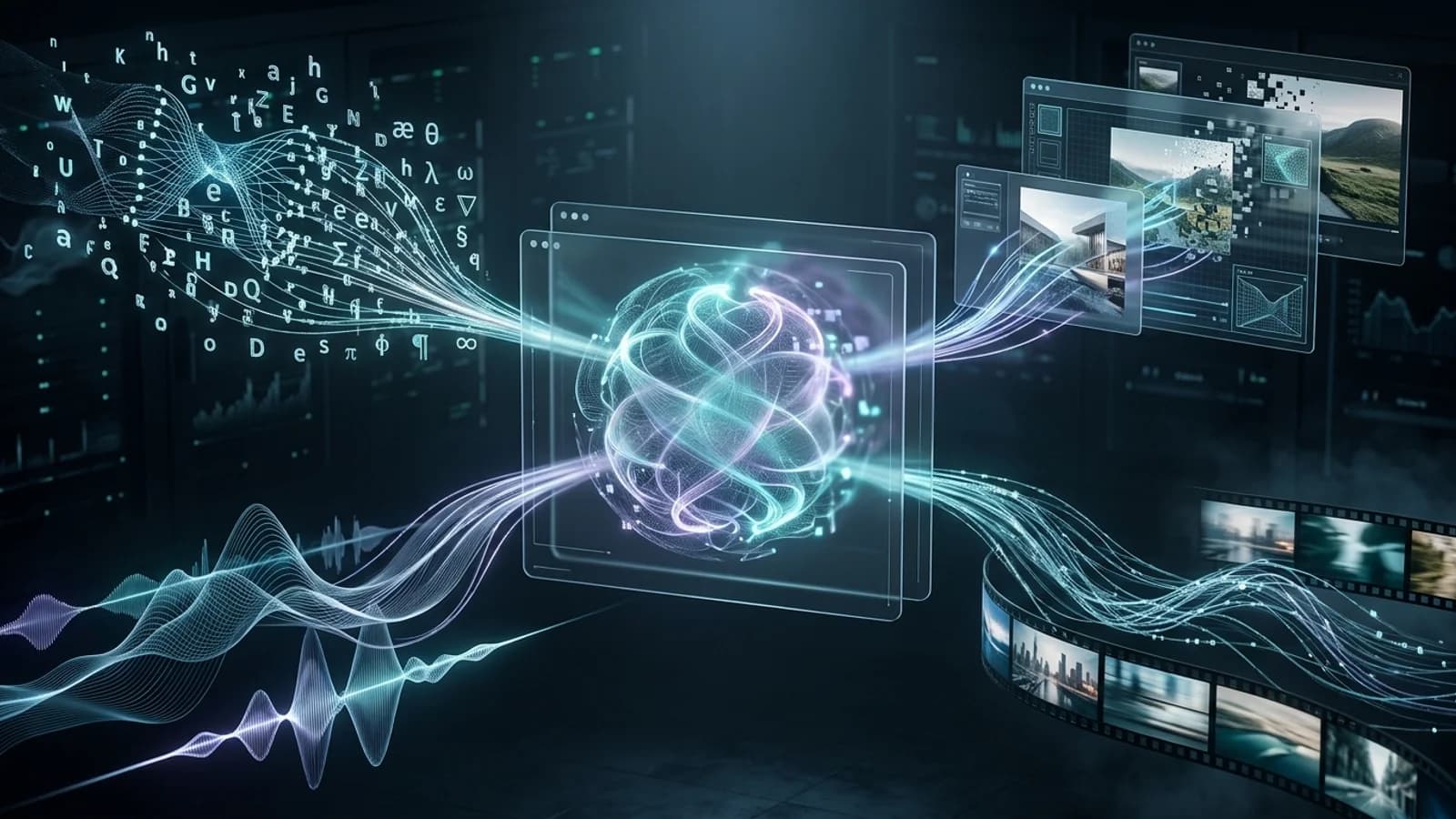
The Latest Advances in Text, Image, Audio, and Video AI
Introduction
Artificial intelligence is rapidly expanding beyond text generation into a broader multimodal ecosystem capable of understanding and creating text, images, audio, and video. These advances are changing how people communicate with AI, create digital content, analyze information, and build intelligent applications.
Modern generative AI systems can assist with writing and reasoning, generate detailed images from natural-language instructions, synthesize and understand speech, and create increasingly sophisticated video content. The convergence of these capabilities is also enabling AI systems to work across multiple formats within a single workflow.
Understanding the latest developments in text, image, audio, and video AI is important for developers, content creators, businesses, researchers, and anyone interested in the future of artificial intelligence. Each modality has its own technologies, opportunities, limitations, and practical applications.
01
Text AI
Language models can generate, summarize, translate, analyze, and transform written information while supporting reasoning and conversational applications.
02
Image AI
Generative image models can create, edit, transform, and analyze visual content from natural-language prompts and other inputs.
03
Audio AI
AI systems can increasingly recognize speech, generate natural-sounding voices, translate spoken language, and support intelligent audio applications.
04
Video AI
Video generation and understanding are advancing toward systems that can create scenes, interpret visual sequences, and support automated video production.
Multimodal AI
AI Is Moving Toward One Connected Multimodal Experience
One of the most important trends is the convergence of different AI modalities. Instead of treating text, images, audio, and video as completely separate technologies, modern AI systems are increasingly designed to understand and combine multiple forms of information. This creates opportunities for richer assistants, creative tools, education platforms, accessibility solutions, and intelligent business workflows.
Text AI
Advances in Text AI Are Making Language Models More Capable and Useful
Text-based artificial intelligence remains one of the most important areas of generative AI development. Modern language models are evolving from systems focused primarily on generating fluent text into more capable platforms that can reason through complex instructions, analyze documents, write and understand code, use external tools, and support sophisticated knowledge-based workflows.
Improvements in reasoning, context handling, instruction following, and retrieval capabilities are making text AI increasingly useful across education, software development, research, customer service, business operations, and content creation. These capabilities are also becoming important building blocks for AI agents and multimodal applications.
01
Advanced Reasoning
Newer language models are increasingly designed to handle complex instructions, structured analysis, planning, and multi-step problems.
02
Long-Context Understanding
Larger context capabilities allow AI systems to work with more information when analyzing documents, conversations, codebases, and complex knowledge sources.
03
Tool Integration
Language models can be connected with search engines, databases, APIs, code environments, and other tools to perform tasks beyond generating text.
04
Multilingual AI
Modern language systems increasingly support many languages and can assist with translation, multilingual communication, and cross-language information processing.
Text AI Workflow
From Language Generation to Intelligent Task Assistance
01
Understand
Interpret the user's instructions, context, intent, and available information.
02
Retrieve
Access relevant information from documents, knowledge bases, or connected sources when required.
03
Reason
Analyze the available information and determine an appropriate response or sequence of actions.
04
Generate
Produce useful text such as explanations, summaries, code, reports, or structured information.
05
Assist
Deliver the result through a conversational assistant, application, workflow, or AI-powered service.
| Application | How Text AI Helps | Practical Value |
|---|---|---|
| Software Development | Code generation, explanation, debugging, and testing assistance | Faster development and engineering support |
| Research | Summarization, information analysis, and knowledge organization | More efficient information processing |
| Education | Explanations, practice questions, tutoring, and study assistance | More personalized learning support |
| Business | Document processing, drafting, customer support, and knowledge retrieval | Productivity and workflow automation |
Key Takeaway
Text AI Is Becoming a Foundation for More Advanced AI Applications
The latest advances in language models are expanding text AI from a content-generation tool into a broader intelligence layer for software applications. When combined with retrieval, external tools, structured data, and multimodal capabilities, text-based AI can support increasingly complex workflows across many industries.
Image AI
Advances in Image AI Are Transforming Visual Creation and Understanding
Image artificial intelligence has developed rapidly, moving from simple computer vision systems toward powerful generative models capable of creating, editing, analyzing, and transforming visual content. Modern image AI can interpret natural-language instructions and produce detailed visual outputs across a wide range of styles and use cases.
Generative image models are also becoming more useful for professional workflows. Designers, marketers, educators, developers, researchers, and content creators can use AI-assisted visual tools for concept development, prototyping, image editing, visualization, and creative experimentation.
01
Text-to-Image Generation
Generative models can transform natural-language descriptions into detailed images, concepts, illustrations, and visual compositions.
02
AI Image Editing
AI-assisted editing can modify selected areas, remove or replace elements, extend compositions, and support more flexible creative workflows.
03
Visual Understanding
Multimodal AI systems can analyze images and extract useful information such as objects, text, relationships, and visual context.
04
Creative Visualization
Image AI can accelerate concept development for product design, advertising, education, entertainment, architecture, and digital content creation.
Image Generation Workflow
How Modern Generative Image Systems Turn Instructions Into Visuals
01
Prompt
A user provides a natural-language description that communicates the desired visual content.
02
Interpretation
The model interprets the relationships between concepts, objects, visual characteristics, and instructions.
03
Generation
The generative system produces a visual representation based on the learned patterns and requested conditions.
04
Refinement
Editing, variation, or additional instructions can be used to refine the generated result.
05
Application
The resulting image can support design, communication, prototyping, education, or other creative workflows.
| Image AI Capability | What It Does | Common Applications |
|---|---|---|
| Text-to-Image | Generates images from natural-language descriptions | Concept art, marketing, education, creative content |
| Image-to-Image | Transforms an existing image according to instructions | Design variations, style transformation, visual experimentation |
| Image Understanding | Interprets visual information and identifies relevant context | Document analysis, accessibility, research, visual search |
| Image Editing | Modifies or extends selected parts of an image | Creative production, advertising, product visualization |
Creative Industry
Faster Visual Prototyping and Content Creation
Image AI can help creative teams explore ideas quickly before investing significant time in manual production. This makes it useful for concept development, storyboarding, advertising, product visualization, and early-stage design exploration.
Emerging Challenges
Quality, Authenticity, and Responsible Use Still Matter
As generated images become more realistic, organizations and users need to consider authenticity, attribution, intellectual property, misleading visual content, and appropriate disclosure when AI-generated imagery is used in professional or public contexts.
Key Takeaway
Image AI Is Becoming a Core Part of Modern Generative AI
The latest advances in image generation and visual understanding are making AI increasingly useful across creative and technical workflows. As image models become more capable and increasingly connected with text, audio, and video systems, visual AI is becoming an important component of the broader multimodal AI ecosystem.
Audio AI
Advances in Audio AI Are Making Speech and Sound More Intelligent
Audio artificial intelligence is advancing rapidly across speech recognition, voice generation, translation, transcription, music, and sound understanding. Modern audio AI systems can process spoken language with increasing accuracy while also generating increasingly natural and expressive synthetic voices.
These developments are expanding the role of AI in communication, accessibility, education, entertainment, customer service, and software applications. Instead of interacting with AI only through a keyboard, users can increasingly communicate through natural speech and receive spoken responses in real time.
01
Speech Recognition
AI systems can convert spoken language into text and support transcription, voice commands, meeting notes, and conversational interfaces.
02
AI Voice Generation
Text-to-speech systems can generate increasingly natural voices with improved pronunciation, pacing, tone, and expressive characteristics.
03
Speech Translation
AI can help translate spoken communication between languages, supporting more accessible and natural multilingual interactions.
04
Audio Understanding
Advanced AI systems can analyze audio signals and spoken content to identify meaningful information, events, and conversational context.
Audio AI Pipeline
How AI Turns Human Speech Into Intelligent Interaction
01
Audio Input
A microphone or audio source captures spoken language, environmental sounds, or other acoustic information.
02
Recognition
Speech recognition models process the audio and identify words, phrases, and relevant linguistic information.
03
Understanding
Language models can interpret the meaning, intent, and context of the recognized speech.
04
Response
The AI system generates an appropriate answer, action, translation, or other useful result.
05
Voice Output
Text-to-speech technology can convert the generated response into natural spoken language for the user.
| Audio AI Technology | Primary Function | Example Applications |
|---|---|---|
| Speech-to-Text | Converts spoken language into written text | Transcription, meetings, accessibility, voice commands |
| Text-to-Speech | Converts written content into synthesized speech | Assistants, narration, education, accessibility |
| Voice Translation | Translates spoken communication between languages | Multilingual communication and international collaboration |
| Audio Understanding | Analyzes speech and other acoustic information | Media analysis, monitoring, research, intelligent applications |
Accessibility
Voice AI Can Make Digital Experiences More Accessible
Speech recognition and voice generation can provide alternative ways to interact with software and digital information. Voice interfaces can support users who have difficulty typing or reading and can make technology more natural to use in hands-free environments.
Real-Time Interaction
Voice Is Becoming a Natural Interface for AI Assistants
Improvements in speech recognition, language understanding, and voice synthesis are enabling faster conversational experiences. This opens the door to AI assistants that can listen, understand, reason, and respond through spoken interaction rather than relying entirely on traditional text interfaces.
Responsible Audio AI
Voice Generation Also Creates New Trust and Authenticity Challenges
As synthetic voices become increasingly convincing, responsible use of audio AI becomes more important. Developers and organizations need to consider consent, privacy, identity protection, disclosure, and the potential misuse of generated or manipulated audio.
Key Takeaway
Audio AI Is Turning Voice Into a Powerful Human-Computer Interface
The latest advances in speech recognition, voice generation, translation, and audio understanding are making voice-based AI more practical across consumer and professional applications. As audio capabilities become increasingly connected with language, image, and video models, they are becoming an important part of the broader multimodal AI ecosystem.
Video AI
Advances in Video AI Are Redefining AI-Generated and Intelligent Video
Video artificial intelligence is becoming one of the most rapidly developing areas of generative AI. Modern systems are increasingly capable of generating short video sequences from text or visual inputs, extending existing footage, transforming scenes, and analyzing video content.
These advances are expanding the possibilities for filmmaking, marketing, education, entertainment, product demonstrations, simulation, and digital storytelling. At the same time, video generation remains technically challenging because AI systems must maintain visual consistency, motion, temporal relationships, and coherent interactions across multiple frames.
01
Text-to-Video
Generative models can transform written descriptions into short visual sequences representing scenes, actions, environments, and cinematic concepts.
02
Image-to-Video
AI can animate or transform still images into video sequences while adding movement, camera effects, and other visual dynamics.
03
Video Understanding
AI systems can analyze video sequences to identify objects, actions, scenes, events, spoken information, and broader visual context.
04
AI Video Editing
AI-assisted editing can help with scene creation, visual transformation, content organization, and automated production workflows.
Video Generation Workflow
How Generative AI Turns Concepts Into Video
01
Concept
The user provides a description, image, or creative concept that defines the desired video.
02
Scene Planning
The AI interprets the requested environment, subjects, actions, camera movement, and visual relationships.
03
Generation
The generative model produces a sequence of frames designed to form a coherent visual scene.
04
Refinement
Additional prompts, edits, or generation controls can be used to improve the visual result and consistency.
05
Production
Generated clips can become part of larger editing, marketing, educational, entertainment, or storytelling workflows.
| Video AI Capability | Primary Function | Potential Applications |
|---|---|---|
| Text-to-Video | Creates video sequences from written descriptions | Storytelling, advertising, concept visualization, education |
| Image-to-Video | Adds motion and temporal changes to visual inputs | Creative production, animation, visual effects |
| Video Understanding | Analyzes scenes, events, actions, and visual context | Media analysis, surveillance research, education, accessibility |
| AI Video Editing | Assists with editing, transformation, and content production | Marketing, social media, filmmaking, digital content |
Technical Challenge
Maintaining Consistency Across Time
Generating a convincing individual frame is different from creating a coherent video sequence. AI systems must maintain consistency in subjects, environments, movement, lighting, camera perspective, and interactions across multiple frames.
Responsible Use
Synthetic Video Requires Stronger Authenticity Standards
As AI-generated video becomes increasingly realistic, responsible deployment requires attention to consent, copyright, provenance, disclosure, misinformation, and the potential misuse of synthetic media.
Key Takeaway
Video AI Is Moving Generative AI Toward Complete Visual Storytelling
Advances in video generation and understanding are extending generative AI from static content into dynamic visual experiences. As video models become more capable and integrate with text, image, and audio systems, they could become increasingly important tools for creative production, communication, education, simulation, and entertainment.
Multimodal AI
Multimodal AI Is Connecting Text, Image, Audio, and Video
One of the most important developments in modern artificial intelligence is the convergence of multiple AI modalities. Instead of building completely separate systems for text, images, audio, and video, newer AI architectures increasingly aim to understand and work across several types of information within a unified experience.
This shift is making AI applications more flexible and interactive. A multimodal system may be able to analyze an image, understand a spoken question about it, retrieve relevant information, generate a written explanation, and produce visual or audio content as part of the same workflow.
01
Cross-Modal Understanding
AI can combine information from different formats to build a richer understanding of a user's request and its surrounding context.
02
Natural Interaction
Users can increasingly interact with AI through combinations of written instructions, spoken language, images, and other media.
03
Unified Generation
Multimodal systems can connect different generation capabilities, allowing workflows to move between text, visual, audio, and video content.
04
Richer AI Applications
Combining modalities can enable more capable assistants, creative tools, educational systems, accessibility solutions, and business applications.
Multimodal Workflow
How Multiple AI Modalities Can Work Together
01
Input
The user provides text, an image, audio, video, or a combination of different inputs.
02
Perception
The AI system processes the available modalities and identifies relevant information from each source.
03
Reasoning
Information from different modalities can be combined to interpret context and determine an appropriate response.
04
Generation
The system can generate an appropriate output in text, image, audio, video, or another supported format.
05
Interaction
The user receives a richer result and can continue the interaction using multiple forms of information.
| Modality | Primary AI Capability | Multimodal Opportunity |
|---|---|---|
| Text | Language understanding, reasoning, and generation | Connects instructions and knowledge with other media |
| Image | Visual understanding and image generation | Enables visual reasoning and creative workflows |
| Audio | Speech recognition, synthesis, and sound analysis | Enables natural voice-based interaction |
| Video | Temporal visual understanding and generation | Enables richer scene analysis and visual storytelling |
Practical Applications
Multimodal AI Can Improve Real-World Digital Experiences
Multimodal systems can support applications such as intelligent assistants, visual search, document analysis, educational platforms, accessibility tools, creative production, customer support, and interactive software. The ability to combine different information types can make these applications more context-aware and useful.
Engineering Challenge
Integration Is More Difficult Than Supporting One Modality
Combining multiple modalities introduces additional challenges, including computational requirements, synchronization, latency, evaluation, data quality, and reliable interpretation of information across different formats.
Key Takeaway
The Future of AI Is Increasingly Multimodal
The convergence of text, image, audio, and video represents a major direction in AI development. Instead of interacting with separate specialized tools, users are increasingly able to work with systems that understand multiple forms of information within a connected workflow. This shift could make AI more natural, flexible, and useful across both consumer and professional applications.
Real-World Applications
How Text, Image, Audio, and Video AI Are Being Used in the Real World
The rapid development of generative and multimodal AI is creating practical opportunities across industries. Organizations are increasingly combining language models, visual AI, speech technologies, and video generation to automate workflows, improve communication, accelerate content production, and create more interactive digital experiences.
The most valuable applications are not necessarily those with the most impressive demonstrations. Instead, successful AI implementations usually focus on solving specific problems, improving productivity, reducing repetitive work, increasing accessibility, or helping professionals make better use of information.
01
Education
AI can combine explanations, images, spoken interaction, and video content to create more flexible and personalized learning experiences.
02
Content Creation
Creators can use AI for writing, image generation, voice production, video creation, editing, brainstorming, and content repurposing.
03
Business Operations
Organizations can apply AI to document processing, customer support, marketing, internal knowledge systems, and workflow automation.
04
Accessibility
Multimodal AI can provide alternative ways to access information through speech, visual descriptions, transcription, translation, and conversational interfaces.
AI-Powered Workflow
From Raw Information to Useful AI-Generated Output
01
Collect
Gather text, images, audio, video, documents, or other relevant information from available sources.
02
Understand
AI models analyze the available information and identify important context, patterns, relationships, and user intent.
03
Process
The system reasons over the information and determines what action or transformation is required.
04
Generate
AI produces an appropriate result such as text, images, audio, video, summaries, recommendations, or structured information.
05
Deliver
The result is integrated into a business process, application, learning environment, or creative workflow.
| Industry | AI Modalities | Potential Use Cases |
|---|---|---|
| Education | Text, image, audio, video | AI tutoring, visual explanations, transcription, personalized learning |
| Marketing | Text, image, audio, video | Campaign content, advertisements, product visuals, social media production |
| Software | Text, image, audio | Coding assistants, documentation, visual analysis, voice interfaces |
| Media | Text, image, audio, video | Content production, editing, localization, transcription, visual storytelling |
Productivity
AI Can Reduce Repetitive Work
Generative AI can automate parts of workflows that involve drafting, summarizing, transcription, image production, information extraction, and content transformation. This can allow people to spend more time on tasks requiring judgment, creativity, and domain expertise.
Human Oversight
AI Works Best When Combined With Human Expertise
AI-generated outputs can contain errors, inconsistencies, or inappropriate results. Professional applications therefore benefit from human review, clear quality standards, domain expertise, and appropriate validation before important outputs are used.
Key Takeaway
The Biggest Opportunity Is Connecting AI Capabilities to Real Problems
The practical value of text, image, audio, and video AI comes from how these capabilities are integrated into useful workflows. Rather than treating each modality as an isolated technology, organizations can combine them to create more intelligent, accessible, and efficient applications that solve specific real-world problems.
Final Reflection
Text, Image, Audio, and Video AI Are Converging Into One Intelligent Ecosystem
The latest advances in artificial intelligence demonstrate a clear shift toward systems that can understand and generate multiple forms of information. Text models are becoming stronger at reasoning and language tasks, image models are improving visual generation and understanding, audio AI is enabling more natural voice interaction, and video AI is expanding the possibilities of generative media.
The most significant opportunity lies in combining these capabilities. Multimodal AI can create richer applications that understand context across different types of information and provide more natural ways for people to interact with technology.
01
Text AI Is Advancing
Language models are becoming more capable at reasoning, understanding context, generating content, and supporting complex workflows.
02
Visual AI Is Expanding
Image and video models are creating new possibilities for visual generation, editing, analysis, and digital storytelling.
03
Voice Interaction Is Growing
Speech recognition, translation, and voice generation are making conversational AI more natural and accessible.
04
Multimodal AI Connects Everything
Combining multiple modalities can create more capable, flexible, and natural AI experiences across industries.
| AI Modality | Current Strength | Future Direction |
|---|---|---|
| Text AI | Language generation, reasoning, and information processing | More capable AI assistants and autonomous workflows |
| Image AI | Image generation, editing, and visual understanding | More controllable visual creation and analysis |
| Audio AI | Speech recognition, synthesis, and translation | More natural real-time voice interaction |
| Video AI | Video generation and visual sequence understanding | More consistent and controllable AI-generated video |
Final Takeaway
The Future of Generative AI Will Be Multimodal
The development of text, image, audio, and video AI is not happening in isolation. These technologies are increasingly converging into unified systems capable of understanding richer context and producing different types of content. This convergence could fundamentally change how people create, communicate, learn, and interact with software.
However, technical capability alone will not determine the success of these systems. Reliability, transparency, responsible development, privacy, intellectual property, human oversight, and practical value will remain essential as multimodal AI continues to mature.